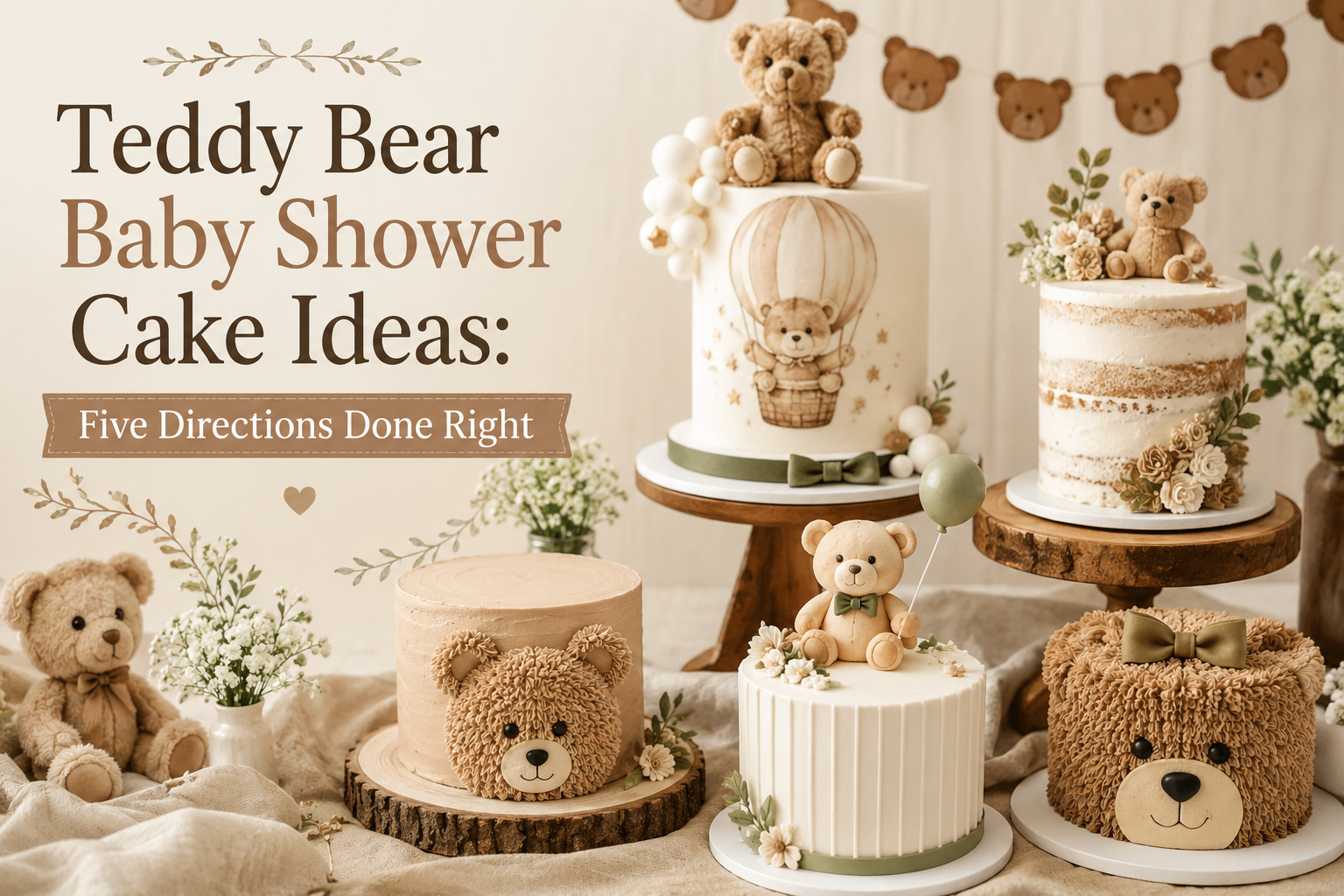
Teddy Bear Baby Shower Cake Ideas: Five Directions Done Right
Bear Baby Shower Cake Guide
Teddy Bear Baby Shower Cake Ideas: Five Directions Done Right
What makes a bear shower cake look designed rather than generic — and exactly how to brief your baker to get there.
The cake is the most photographed element of any baby shower. Every guest takes a photo. The flat lay almost always includes it. And yet, of all the decisions that go into a bear-themed shower, the cake is the one that most often arrives looking slightly wrong — not because of the baker’s skill, but because of the brief. A bear cake ordered as “a teddy bear baby shower cake” and a bear cake ordered with a palette swatch, a finish direction, and a specific topper concept are two entirely different objects. This guide covers the difference between them, and everything you need to know to get the second one.
Five cake directions, three common mistakes to avoid, and the specific language to use when you sit down with your baker — this is the bear shower cake guide most planning resources skip entirely.
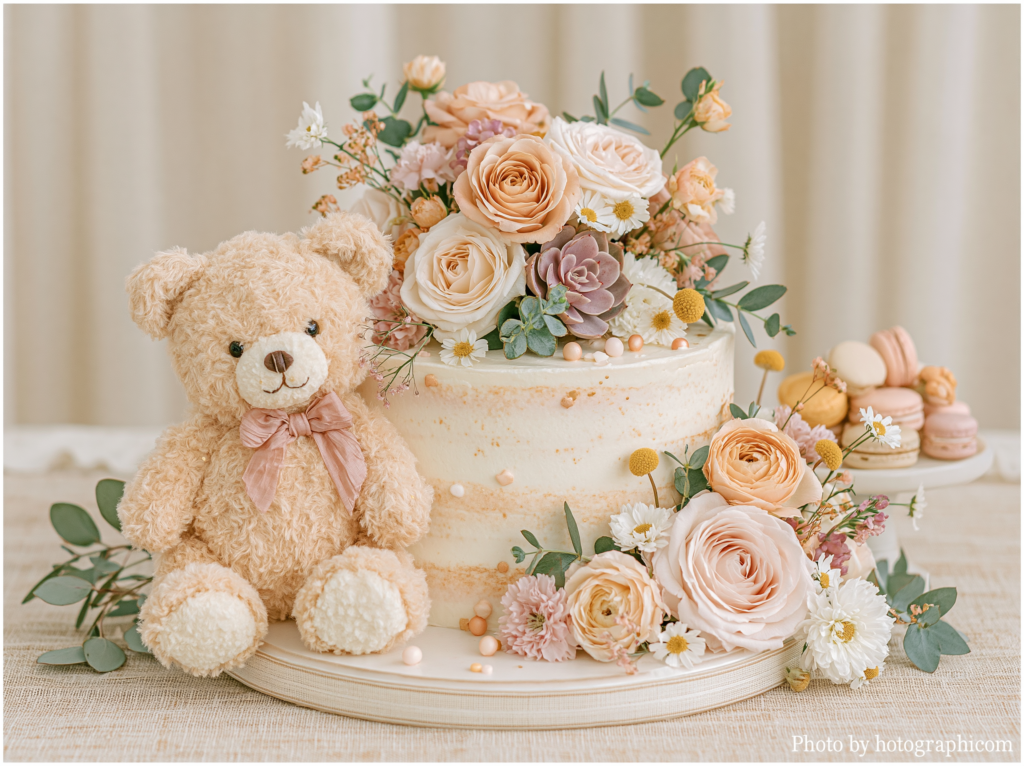
“The cake is the one element every guest photographs — it deserves to be as considered as everything else on the table.”
Section 01 Why Bear Shower Cakes Go Wrong
Most bear shower cakes that disappoint do so for one of three specific, avoidable reasons. None of them have anything to do with the baker’s technical ability. All of them are briefing failures — decisions made (or not made) before a single layer was baked. Understanding exactly what goes wrong is the fastest path to getting it right.
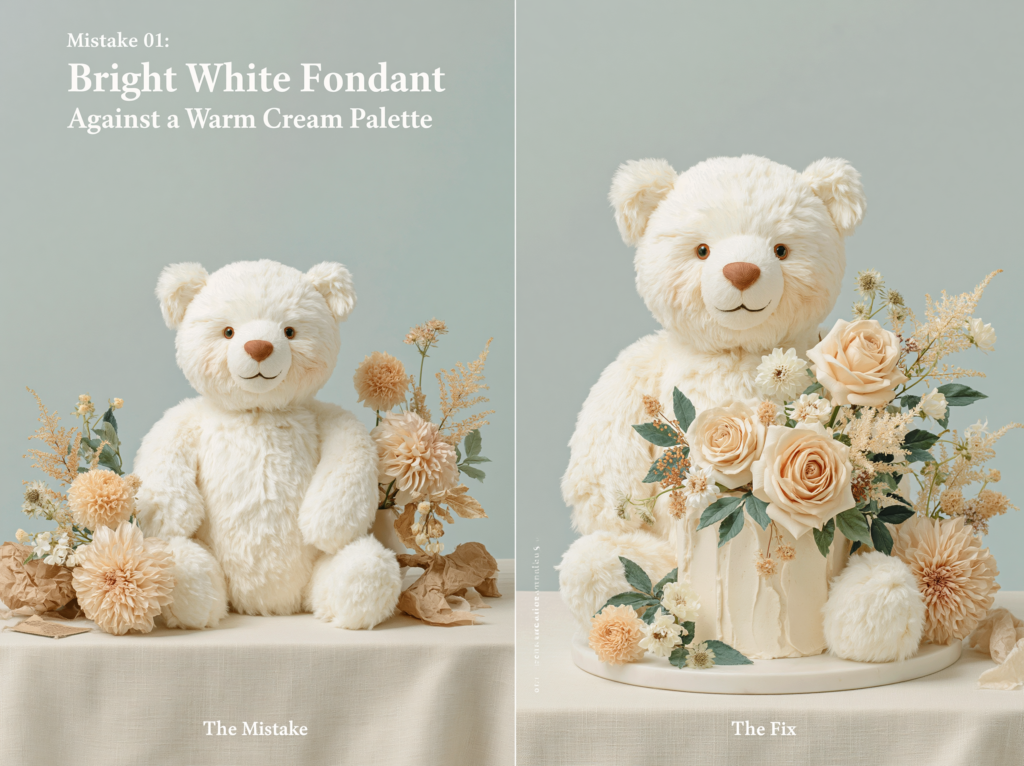
Mistake 01: Bright White Fondant Against a Warm Cream Palette
This is the single most common bear shower cake error, and it is almost invisible until the cake is placed on the table — at which point it becomes impossible to ignore. Fondant in its standard form is an optical bright white. The bear shower palette is built on warm cream, ivory, oatmeal — tones that sit several degrees warmer than stark white. When a bright white fondant cake lands on a cream linen tablecloth surrounded by honey-toned florals and warm kraft paper details, the cake reads as if it was ordered for a different party. It does not connect to anything else on the table because it is operating in a different color temperature.
The fix: If you are using fondant, specify an ivory or warm cream tint rather than standard white. Most bakers can add a small amount of ivory food coloring to match the warmth of your palette. Better still, move to buttercream — a well-finished buttercream in ivory or warm cream is almost always more cohesive with the bear shower aesthetic than the precision of fondant, and it photographs with a softness that fondant rarely achieves. Ask specifically for “warm ivory” or bring a fabric swatch from your tablecloth to the consultation so the baker has something physical to match against.
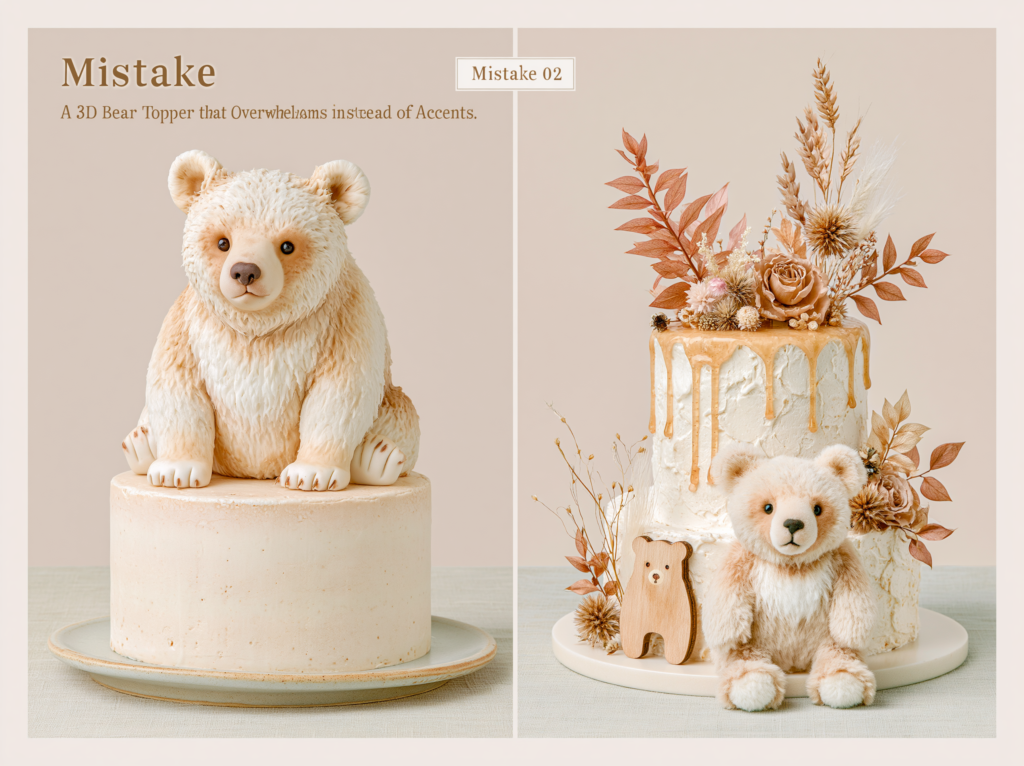
Mistake 02: A 3D Bear Topper That Overwhelms Instead of Accents
The most requested bear cake element is a three-dimensional fondant or sugar bear figure on top — and it is also the element most likely to make the cake look generic. The problem is scale and emphasis: when the topper is the entire design concept, the cake has no visual language of its own. It is a plain cake with a bear on it, which is what every generic bear cake looks like. The topper becomes the whole story rather than a punctuation mark on a more considered design. The result is a cake that reads as themed rather than styled — and in photographs, those are two very different things.
The fix: Treat the topper as one element of a designed cake rather than the design itself. A cake with textured buttercream, a honey drip, dried botanicals in the palette’s tones, and a small plush bear or wooden bear cutout propped at the base has far more visual depth than a plain tier with a fondant bear on top. If you want a bear figure specifically, ask the baker to keep it small and positioned as part of a wider topper arrangement — botanicals, ribbon, or a small sign — rather than a solo centerpiece. The bear accent reads more elegantly than the bear statement.
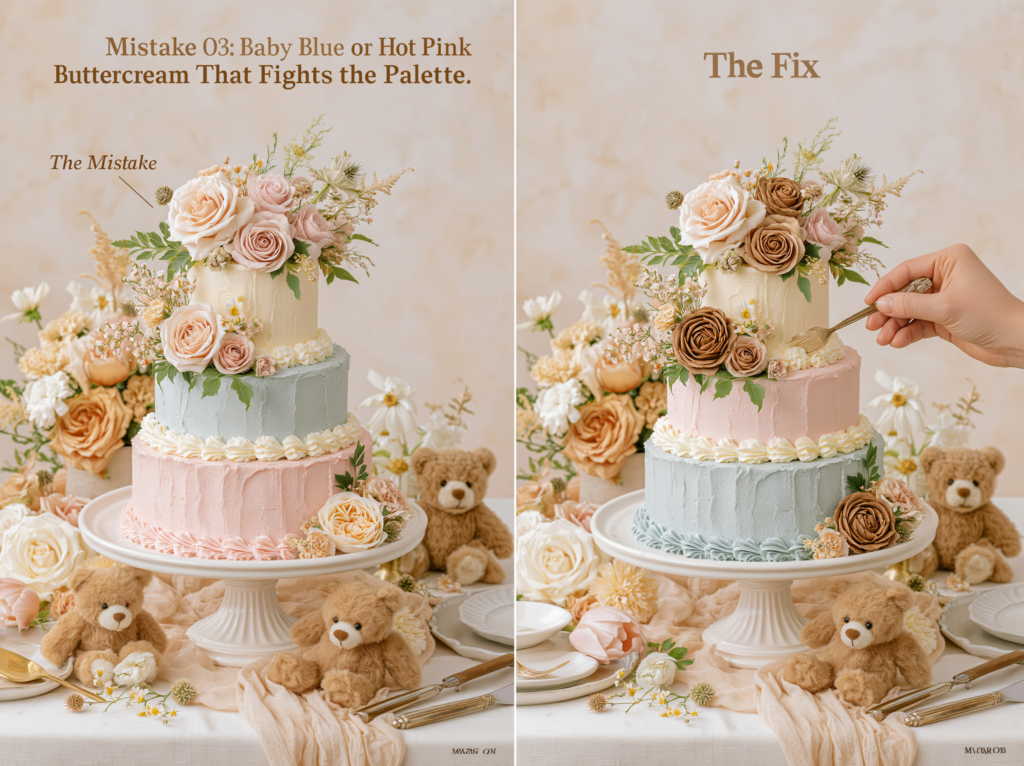
Mistake 03: Baby Blue or Hot Pink Buttercream That Fights the Palette
This mistake happens when the cake is ordered to signal the baby’s sex rather than to belong to the aesthetic of the shower. A bright baby blue or saturated hot pink cake stands out against a warm neutral bear palette not as a deliberate contrast but as a color collision — the cake is pulling in one direction while the rest of the room pulls in another. The bear theme is built on warmth and softness; both bright primary blue and saturated pink sit outside that register entirely. The cake ends up being the most photographed element of the shower and the least cohesive one in every photo.
The fix: If you want to signal a girl shower through the cake, use dusty rose or blush rather than hot pink — these muted tones sit inside the warm palette rather than fighting it. For a boy shower, dusty blue paired with warm brown buttercream is far more cohesive than primary blue against cream. The sex of the baby can be indicated through the palette direction without requiring a color that breaks the aesthetic of everything else in the room. The cake should be the most beautiful element on the table, not the most visually disconnected one.
Styling Tip
Brief your baker with a palette swatch, not just a theme name. “Teddy bear cake” means something different to every baker — it will produce a different result in every kitchen that receives it. “Warm honey, cream, and dusty rose with a semi-naked finish and dried flower topper” leaves no room for misinterpretation and gets you exactly the cake in your mood board. Bring your invitation card to the consultation. Bring a length of ribbon in your palette color. Bring a piece of the linen you’re using on the table. The more physical references you give, the fewer interpretive decisions the baker has to make — and the fewer surprises you encounter on the day.
Section 02 Five Cake Directions for the Bear Theme
Each direction below works within the bear theme’s color story. Choose the one that matches your palette, then use the baker brief language to get the result you actually want.
2.1 The Vintage Honey Cake
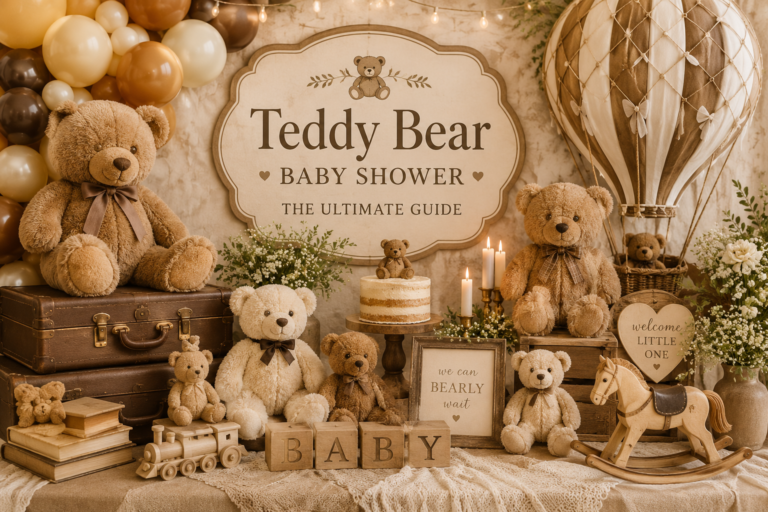
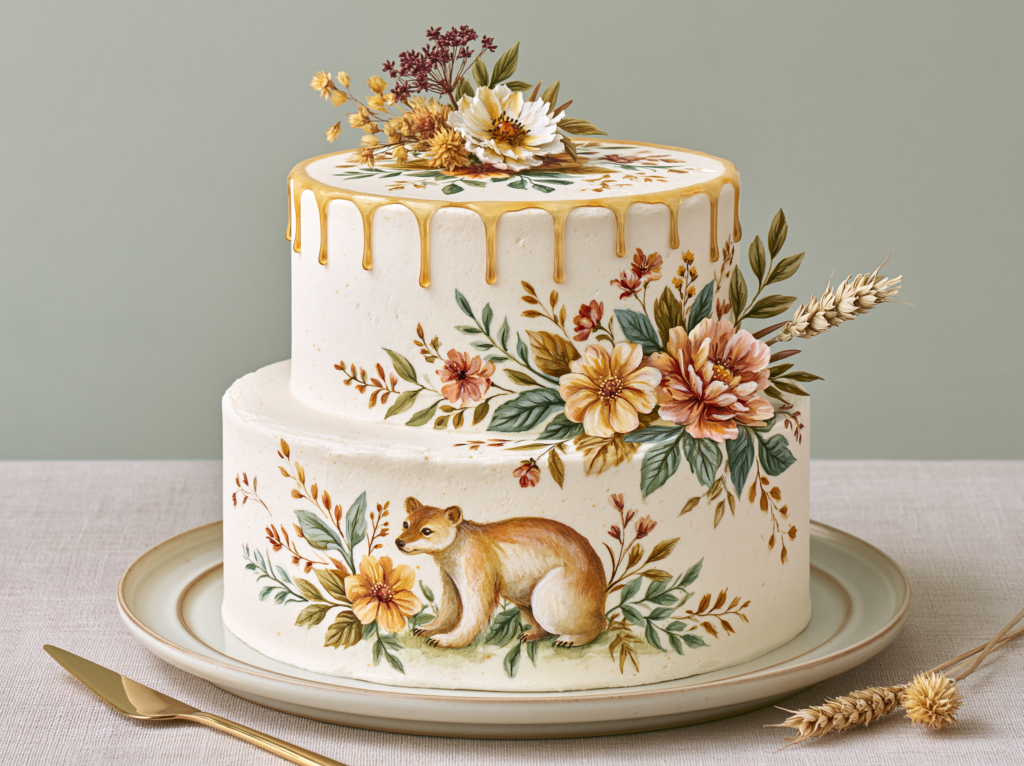
The vintage honey cake is the most distinctly bear-themed direction on this list — and the most photographically consistent with the warm, storybook register that makes the best bear showers memorable. The finish is a textured buttercream in warm ivory or pale honey, applied with palette knife strokes that are deliberately imperfect rather than smooth. The decoration comes from two sources: a hand-painted or watercolor-style botanical or bear illustration applied directly to the buttercream surface in warm brown and ochre food coloring, and a honey drip in real amber honey or warm golden caramel applied loosely at the top tier. The topper is minimal — a small dried botanical cluster in honey and rust tones, or a single sprig of dried wheat.
This direction suits the vintage, neutral, and warm brown palette directions best. It is the direction least likely to look dated in three years and most likely to produce the flat lay photograph that gets saved. Baker brief language: “Warm ivory palette knife textured buttercream, honey drip in amber, watercolor-style hand-painted bear or botanical detail in warm brown, dried botanical topper in honey and rust tones. No fondant. No bright white. Everything warm.”
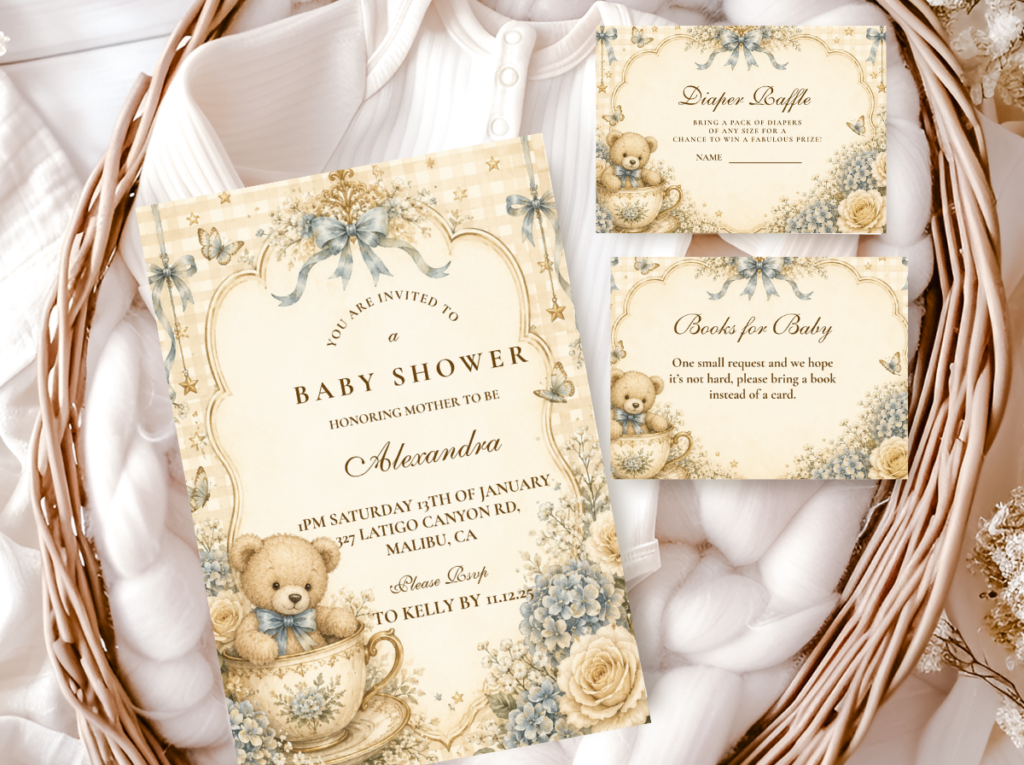
The Vintage Teddy Bear collection offers stationery in the exact palette direction of this cake — honey tones, heritage typography, hand-drawn bear motifs — so your invitation and cake belong visibly to the same world.
2.2 The Floral Bear Cake
The floral bear cake is the most romantic and versatile direction in the bear cake world — it works across the neutral, pink, sage, and vintage palette directions because the floral element adapts to whatever color story the shower is built on. The base is a smooth or lightly textured buttercream in warm cream or ivory; the decoration is a cascade of buttercream florals applied at one corner or the top tier rather than symmetrically distributed across the cake. The florals read as gathered rather than arranged, which is what gives the direction its softness. A small plush bear or wooden bear cutout nestled into the base of the floral arrangement is the only literal bear element needed.
The most important decision in this direction is the color of the florals — and it is a decision that most people make incorrectly. The florals should be in the shower’s palette, not in whatever tones the baker defaults to or the florist has available that week. Baker brief language: “Buttercream floral cascade in [your specific palette colors — dusty rose and ivory, or sage and cream, or honey and rust — state the exact tones]. Smooth or lightly textured ivory base. Single asymmetric floral grouping, not symmetrical distribution. Bear accent at the base — small, not dominant.”
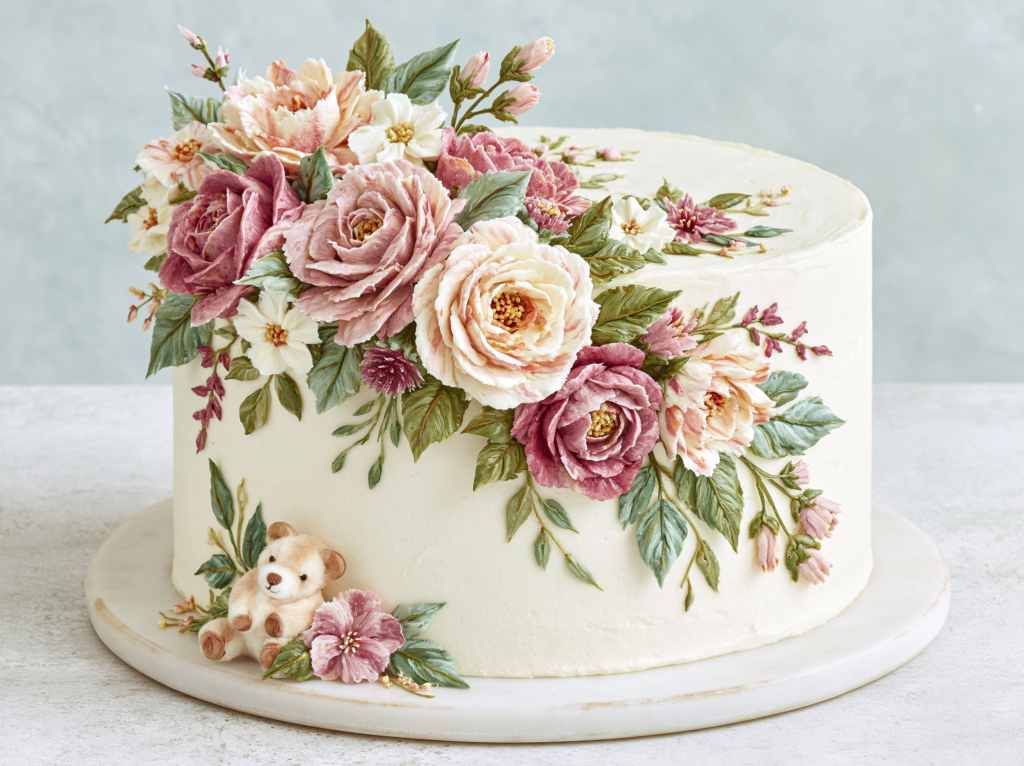
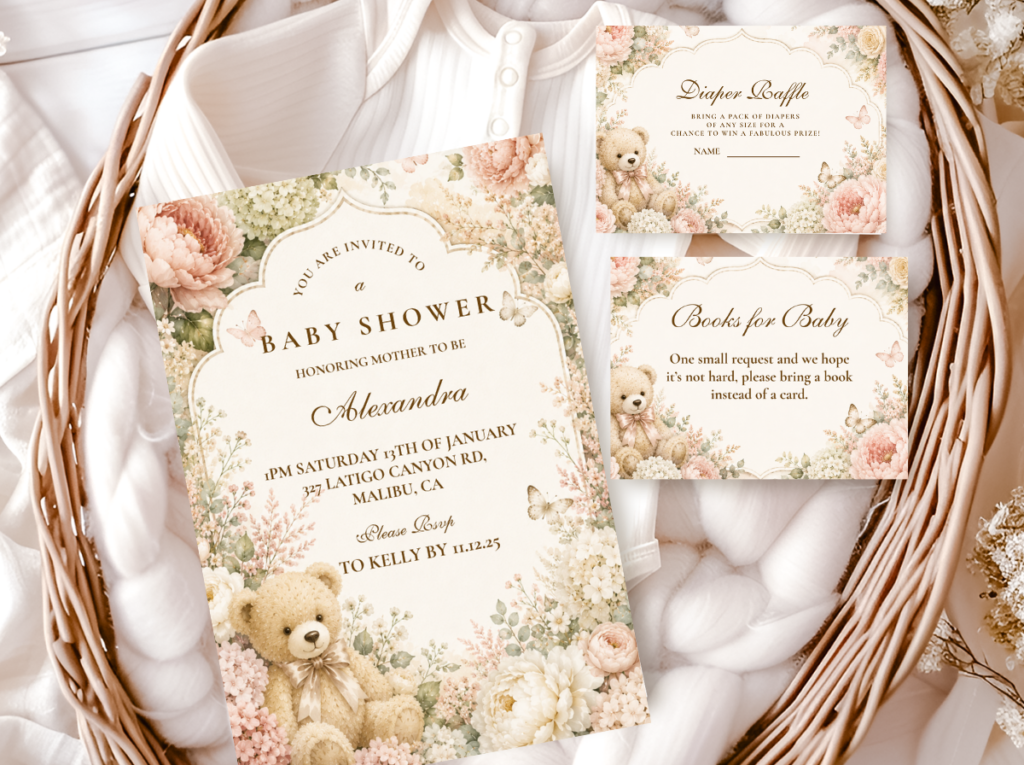
The Floral Teddy Bear collection pairs the floral cake direction with stationery in the same botanical register — soft florals, warm cream tones, and a bear motif that complements rather than competes.
Styling Tip
Buttercream florals on a bear cake should be in the shower’s palette, not the baker’s default offering or the florist’s seasonal range. This is the detail that consistently separates a cohesive, designed cake from a beautiful cake that happens to be at a bear shower. Bring your invitation to the cake tasting — the baker needs to see your actual colors, not interpret “blush” from a word. Blush to one baker is pale pink; to another it is warm peach; to another it is nearly mauve. The physical reference removes all interpretation. If you have a fabric swatch from your linens or ribbon from your favor wrapping, bring that too — the more physical materials you provide, the more precisely the florals will match everything else on the table.
2.3 The Rustic Semi-Naked Cake
The semi-naked cake is the most texture-forward direction available to the bear shower aesthetic, and for many palette directions — particularly the vintage, rustic, and nature-forward ones — it is also the most cohesive. The finish exposes the sponge layers at the sides of the cake through a thin, intentionally incomplete layer of frosting, which creates the same organic, imperfect quality that the best storybook bear details share. There is no fondant, no sharp edges, nothing that reads as precise or manufactured. The exposed sponge and the minimal frosting give the cake a handmade quality that belongs immediately to the warm, natural aesthetic of the bear theme.
The topper for a semi-naked cake should be equally organic: a loose cluster of dried botanicals — pampas, wheat, dried rose, eucalyptus — in the palette’s warm tones, with a small wooden bear or acrylic bear cutout nestled into the base of the arrangement. Fresh flowers work in place of dried for a softer result, but choose them in the shower’s palette rather than defaulting to white. Baker brief language: “Semi-naked finish, warm ivory frosting, exposed sponge sides. Organic dried botanical topper in [palette colors]. No fondant. Natural and textured, not sharp or precise.”
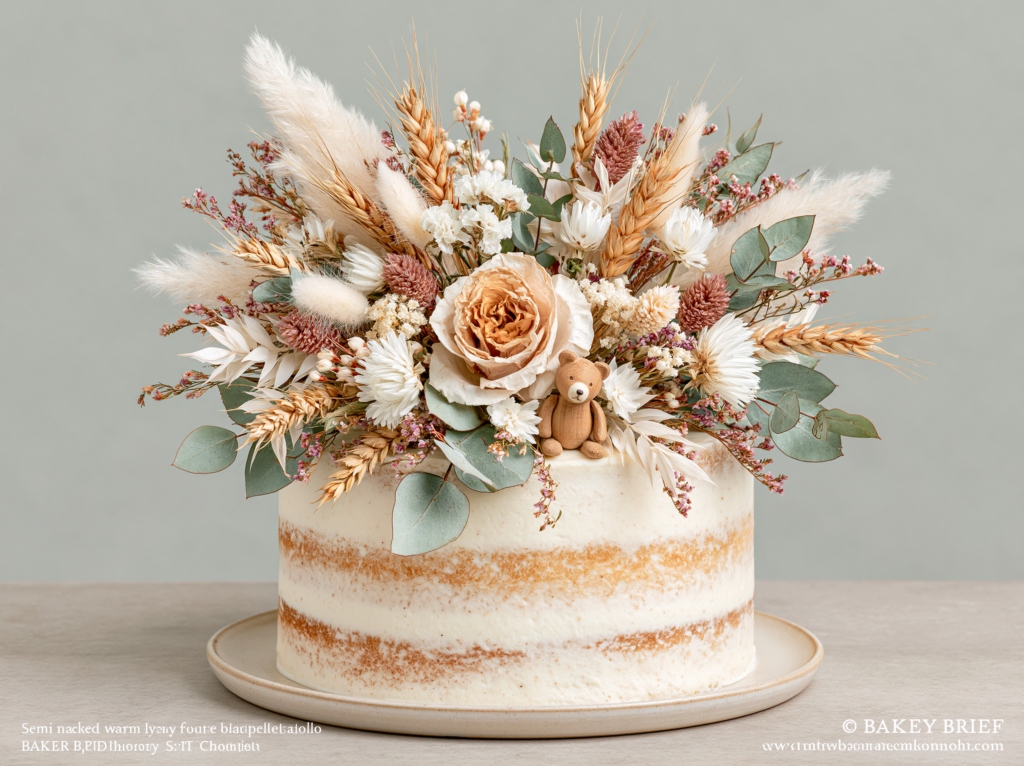
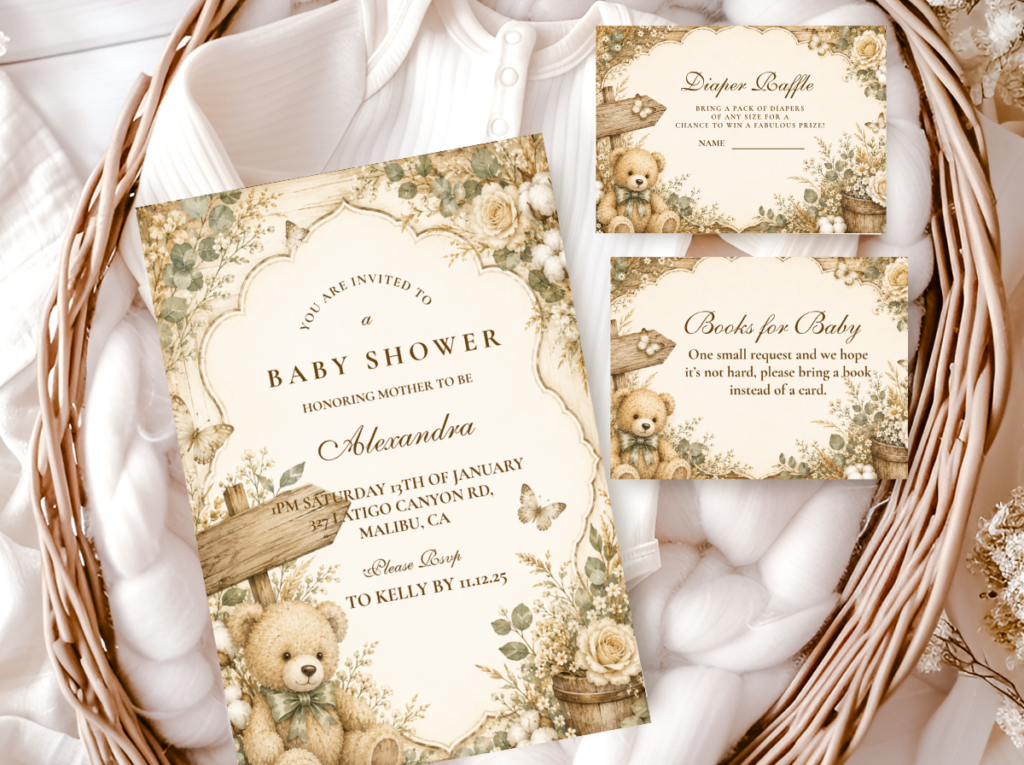
The Rustic Teddy Bear collection brings the same organic, texture-forward aesthetic into the stationery suite — natural linen-effect stock, warm typography, and bear motifs that match the semi-naked cake direction exactly.
2.4 The Classic Brown Bear Cake
A rich warm-brown cake is one of the most under-used directions in the bear shower world, and it deserves more attention. The instinct to keep the cake light (cream, ivory, pale tones) makes sense in the context of the broader palette — but a cake in warm chocolate brown buttercream reads as grounded, rich, and distinctly bear-themed in a way that pale cakes do not. The key is keeping the brown in the warm spectrum: chocolate, caramel, and walnut tones rather than cool cocoa or grey-brown. A warm brown cake sits against a cream tablecloth with a natural, grounded quality that photographs particularly well in natural light.
The bear ear detail — two small round cakes or fondant discs positioned at the top of the main tier to suggest bear ears — is the one literal motif that works well at this scale when handled with restraint. Keep the ears in the same warm brown as the main cake rather than in a contrasting color. Topper options: a honey drip in warm amber across the top tier, a small arrangement of dried botanicals in honey and cream, or a simple wooden name sign. Baker brief language: “Warm chocolate or caramel brown textured buttercream — warm brown, not cool cocoa. Bear ear detail at the top in matching tone. Honey amber drip. Minimal topper — dried botanicals or wooden name element.”
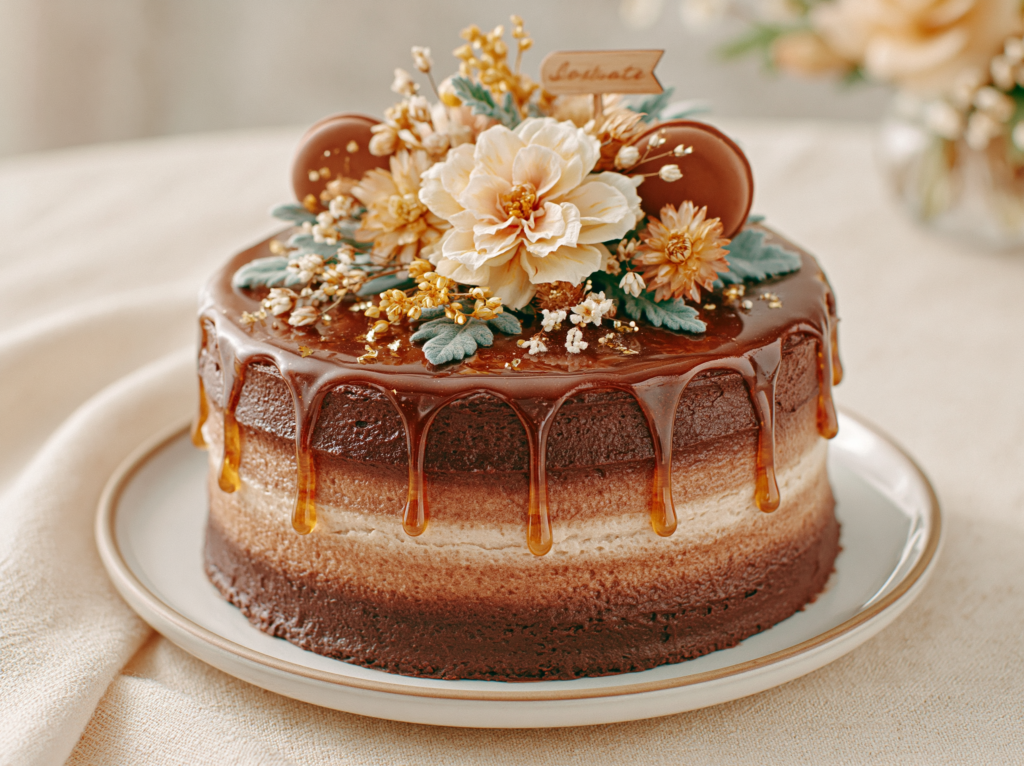
The Brown Bear collection brings the warm chocolate and caramel tones into the stationery suite — rich tan and warm brown stationery that pairs directly with the brown bear cake direction on the dessert table.
2.5 The Pink Bear Cake
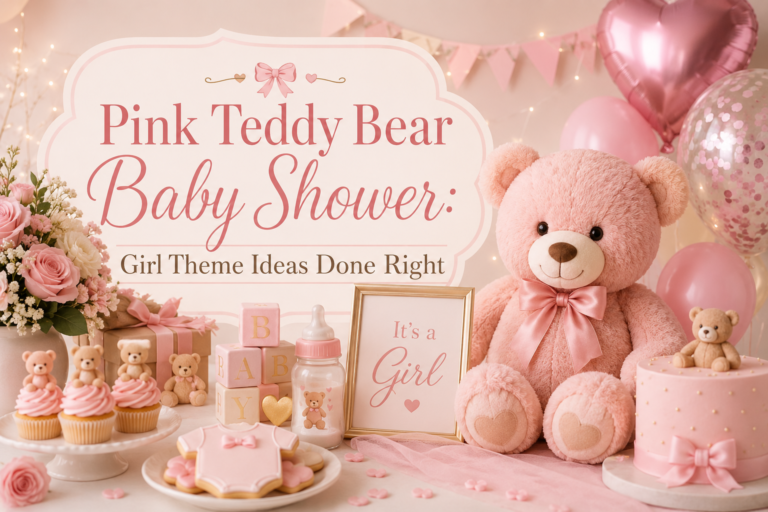
The girl-shower direction of the bear cake is the one most likely to go wrong — because “pink bear cake” has a very specific failure mode: saturated, bright pink buttercream that reads as juvenile rather than sophisticated. The version that works is dusty rose or blush, not candy pink. Dusty rose sits inside the warm palette rather than fighting it; it reads as feminine and considered rather than generic. The base buttercream should be in blush or dusty rose with a warm ivory contrast layer — either as a semi-naked reveal at the sides or as a smooth two-tone effect with ivory at the base deepening to blush at the top.
The grounding element that keeps the pink bear cake from tipping into sweetness is warm brown — in the bear accent, in the ribbon detail, or in any kraft paper element at the base of the cake. Without it, the blush reads as one-dimensional. With it, the palette has the same warmth and depth as the best neutral bear cakes. Baker brief language: “Dusty rose or blush buttercream — muted, not bright. Warm ivory contrast. Bear accent in warm honey-brown at the base, small not dominant. Dried rose or blush floral topper. No fondant. No candy pink.”
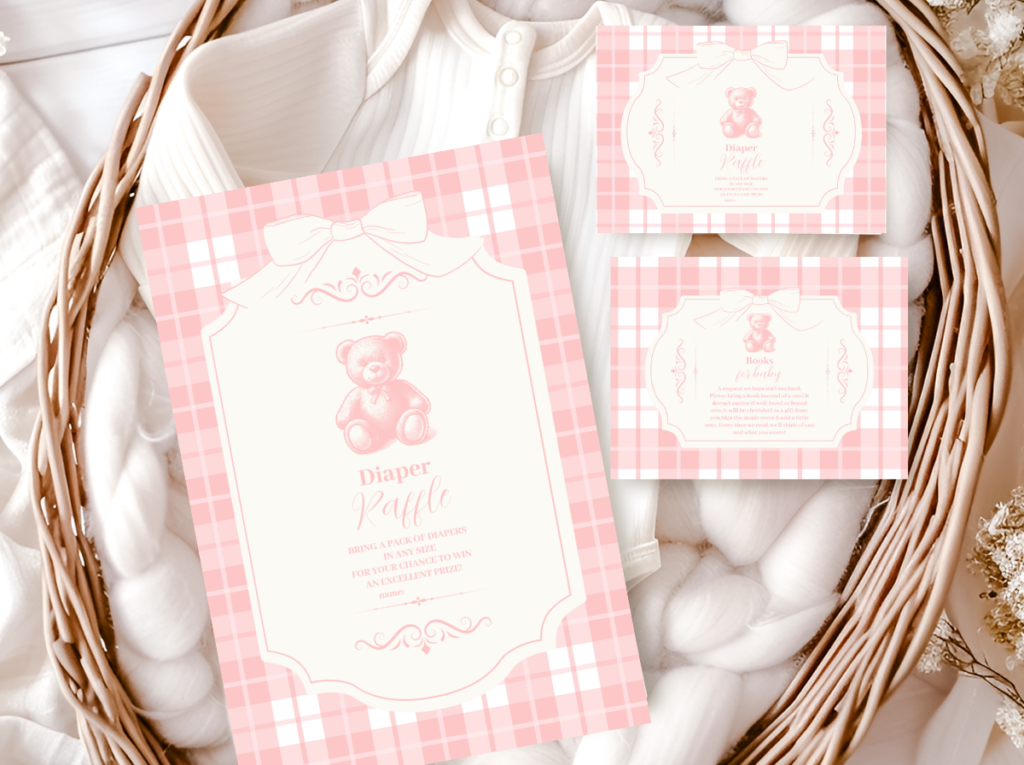
The Pink Teddy Bear collection pairs the dusty rose cake direction with stationery in the same muted blush tones — soft, romantic, and grounded by warm cream rather than tipping into bright or generic pink.
Section 03 Beyond the Main Cake
3.1 Smash Cake Coordination
A smash cake — the small single-serving cake positioned separately from the main celebration cake — is an increasingly standard element of shower setups, and an increasingly common source of visual disconnection on the dessert table. The instinct is to make the smash cake more colorful or more decorated than the main cake to give it visual presence at its smaller scale. The result is a cake that draws the eye away from the main tier rather than completing the display.
The smash cake should be simpler than the main cake, not more decorated. A single-tier version of the main cake’s finish — same palette, same frosting style, reduced decoration — reads as a coordinated suite rather than two separate orders. If the main cake has a honey drip, the smash cake can have a smaller honey drip. If the main cake has a botanical topper, the smash cake can have a single sprig of the same dried flower at its base. The visual connection is what makes the dessert table read as designed. The scale difference is already enough to distinguish the two — they do not need to be in different color worlds to read as separate pieces.
3.2 Cupcake Tower as an Alternative
A cupcake tower works better than a tiered celebration cake in two specific situations: when the guest count is very small (under fifteen) and a three-tier cake would be visually overwhelming at scale, or when the host wants every guest to have an identical serving without the formality of cutting and plating. In both cases, the cupcake tower should follow all the same palette and finish rules as the tiered cake — same buttercream tone, same topper approach, same color temperature throughout. The stand matters as much as the cupcakes: a wood or rattan tiered stand reads as part of the bear aesthetic; a chrome or acrylic stand does not.
Styling Tip
A smash cake in a different color from the main cake creates a visual disconnect on the dessert table that no amount of styling can fully correct once the cakes are in place. Match the palette, not the design — the smash cake can and should be simpler, but it must live in the same color world. If the main cake is ivory and dusty rose, the smash cake should be ivory and dusty rose at a smaller scale, not ivory and something else. The two cakes will be photographed together; they should look like they were ordered by the same person for the same occasion, because they were.
Section 04 Invitations & Stationery
The most saved photograph of any bear shower is almost always the flat lay — the cake, the invitation, a plush bear, a honey jar, and a length of ribbon arranged together as a single composed image. It is saved because everything in the frame belongs to the same visual world: the palette on the paper matches the palette on the buttercream, and the result is a coherence that reads as genuinely designed rather than coincidentally assembled. The invitation is not just a communications piece — it is a physical palette reference that tells every other vendor, including the baker, exactly what world the shower lives in.
This is why the stationery decision should happen before the cake consultation, not after. When you arrive at the cake tasting with your invitation in hand, the conversation changes entirely. The baker can see the exact tone of the cream, the exact warmth of the honey accent, the exact quality of the bear motif. Every decision — finish, color, topper, scale — becomes a matching exercise rather than a guessing game. The cake that results from this process is the one in the flat lay that guests save. The cake that results from a verbal brief is the one that looks close but not quite right.
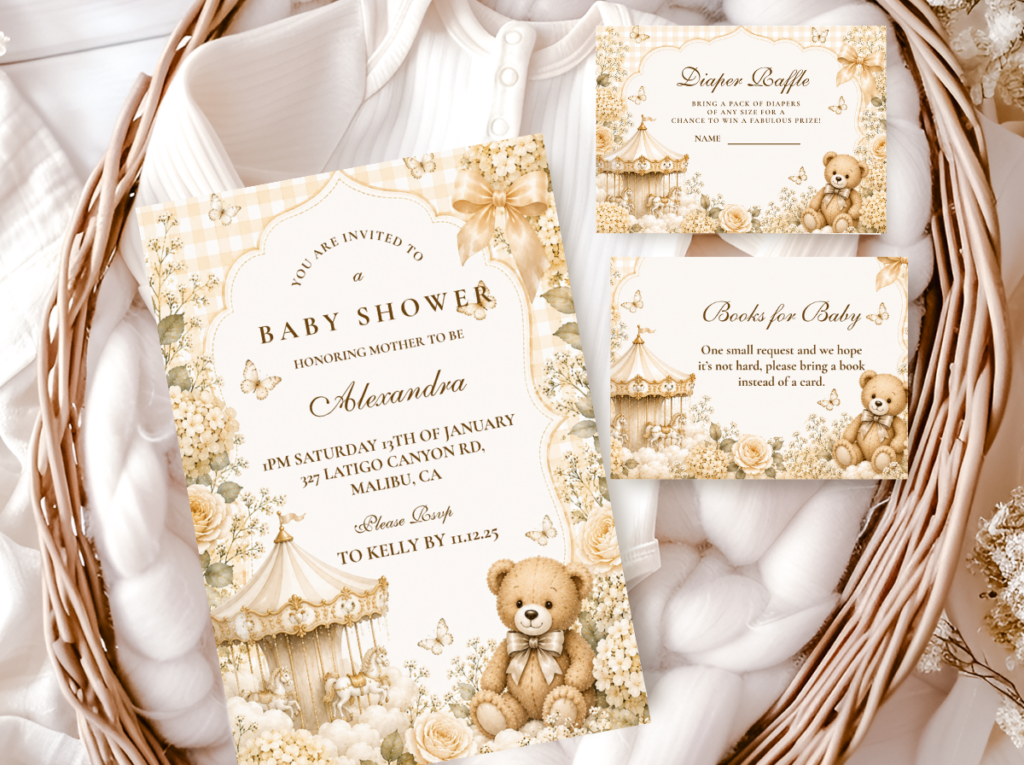
The six collections below cover every cake direction in this guide. The Vintage Teddy Bear suite matches the honey cake; the Floral collection matches the floral cake direction; the Rustic suite matches the semi-naked cake; Brown Bear and Pink Teddy Bear match their respective directions. For hosts who want to browse across all directions before committing, the main Bear Theme catalogue brings every collection together. Choose the stationery first — the cake brief follows naturally from it.
Each collection below links to the full product range for that aesthetic — invitations, favor tags, menu cards, place cards, and thank-you cards — designed as a complete suite from the first guest communication to the last.
Main Collection
Bear Theme
Browse all bear stationery directions in one place before committing to a palette direction.
Matches: Honey Cake
Vintage Teddy Bear
Honey tones, heritage typography, hand-drawn bear motifs — the stationery suite for the vintage honey cake direction.
Matches: Floral Cake
Floral Teddy Bear
Soft botanical motifs and warm cream tones — the stationery pair for the floral bear cake direction across any palette.
Matches: Semi-Naked Cake
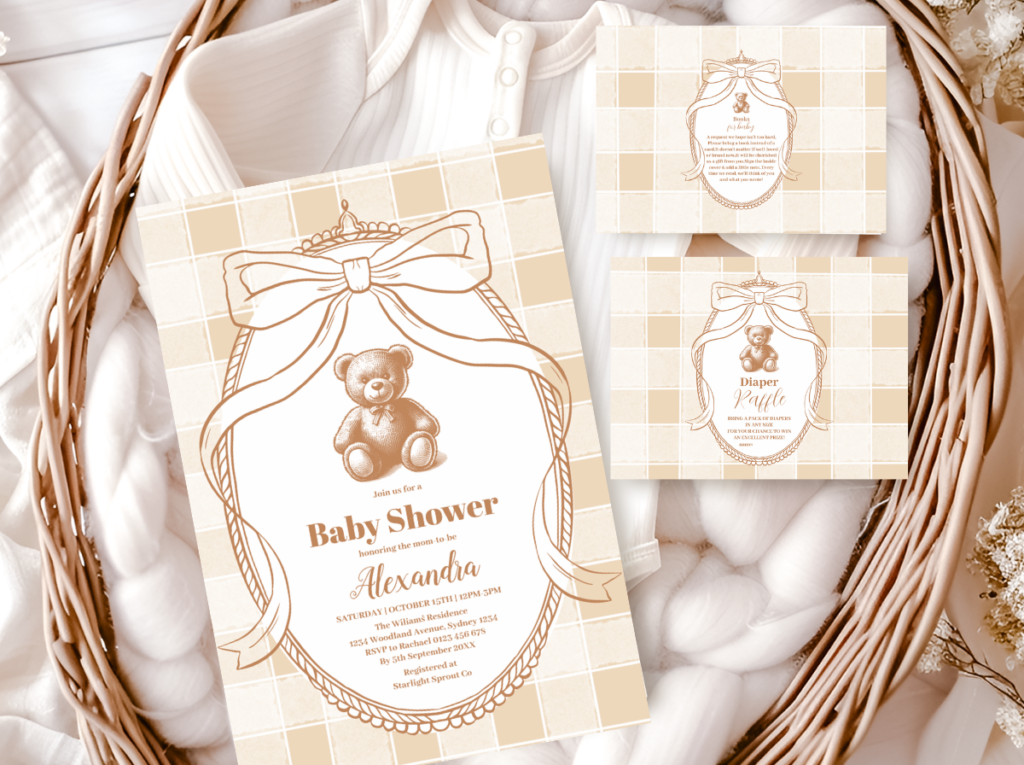
Rustic Teddy Bear
Natural linen-effect stock and organic bear motifs — the stationery pair for the rustic semi-naked cake and nature-forward palette.
Matches: Brown Bear Cake
Brown Bear
Rich tan and chocolate stationery tones that pair directly with the warm brown bear cake — grounded, earthy, and cohesive.
Matches: Pink Bear Cake
Pink Teddy Bear
Dusty rose and warm cream with soft bear motifs — the stationery pair for the pink bear cake in its muted, sophisticated register.
Frequently Asked Questions
How many tiers should a baby shower cake have?
The number of tiers should be proportional to the guest count, not to how impressive you want the cake to look. For up to twenty guests, a two-tier cake is typically more visually appropriate than three tiers — a three-tier cake for a small gathering reads as oversized rather than generous. For twenty to forty guests, two to three tiers works well. For larger showers, three tiers with a generous diameter on each tier is more effective than adding a fourth tier, which starts to create structural challenges. The visual impact of a cake comes from its finish and decoration far more than its height — a beautifully finished two-tier cake will photograph better and be remembered more clearly than a plain three-tier one. If you are planning to have both a celebration cake and a smash cake, keep the celebration cake at two tiers and let the smash cake serve as the visual companion rather than stacking the main cake higher to compensate.
Fresh flowers or sugar flowers on a bear shower cake?
For the bear shower aesthetic, dried botanicals are typically the most cohesive option — they carry the warm, organic quality the aesthetic requires better than fresh florals or sugar flowers in most situations. Dried pampas, wheat, strawflowers, dried rose heads, and eucalyptus in the palette’s tones all photograph beautifully against buttercream and require no special handling on the day. Fresh flowers work well for a softer, more romantic result but require coordination with a florist to ensure they are food-safe and placed at the last possible moment before the shower. Sugar flowers are the most labor-intensive option and make sense only when the palette requires a very specific color that dried botanicals cannot replicate, or when the shower is in a warm environment where fresh flowers would wilt. If you choose fresh flowers, select them in the shower’s palette rather than leaving the choice to the florist — defaulting to “white flowers” is a common mistake that introduces a cool tone into an otherwise warm cake.
How far in advance should I order a bear shower cake?
For a custom decorated cake in any of the directions above, a minimum of four to six weeks in advance is the standard recommendation — and for popular bakers in busy shower seasons (spring and early autumn), eight to twelve weeks is more realistic. The consultation itself — the meeting where you bring your invitation and palette references — should happen at least six weeks before the shower so there is time to order any specialist materials (specific dried botanicals, custom cake toppers, or particular food colorings) without rushing. If you are ordering closer to the shower date, be prepared to simplify the brief: a beautifully executed simple cake is always preferable to a rushed complex one. Specify palette and finish first; the decorative details can be scaled back if the timeline requires it without compromising the overall quality of the result.
Fondant vs buttercream vs semi-naked: which finish is best for the bear aesthetic?
For the bear shower aesthetic, buttercream in either a textured or semi-naked finish is almost always the better choice over fondant. The reason is texture: fondant produces a smooth, precise surface that reads as graphic and modern — qualities that work against the warmth and softness the bear theme requires. Buttercream has inherent texture, warmth in color, and a slightly imperfect quality that photographs beautifully in the flat lay context and feels cohesive with the linen, rattan, and dried botanical elements typically found alongside the cake on the dessert table. The semi-naked finish adds the additional dimension of exposed sponge layers, which introduce the most organic and texture-forward quality available — it is the finish that makes the cake look most clearly like it belongs in a warm, considered home setting rather than a confectionery window. Fondant is appropriate only in specific circumstances: when the design requires a very sharp, precise edge or a painted pattern that buttercream cannot hold cleanly. In those cases, specify ivory-tinted fondant rather than standard white to keep the palette cohesive.
Ready to Start Planning?
Find the Stationery That Matches Your Cake Direction
Choose stationery first — the cake brief follows naturally from it.