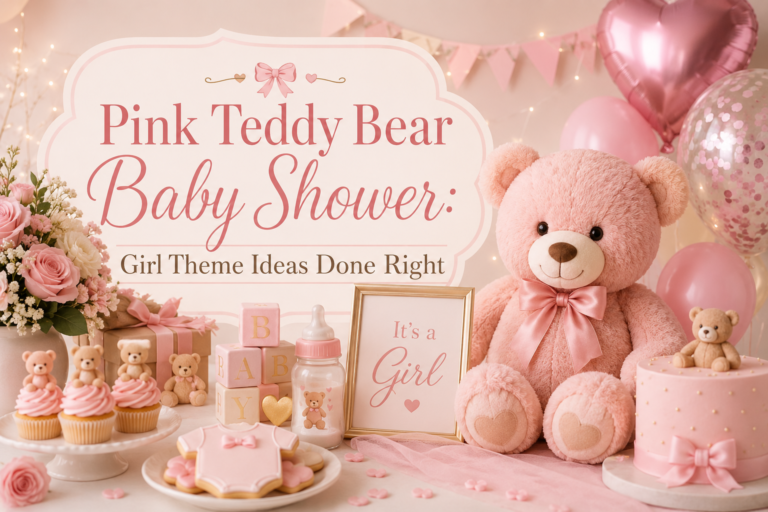
Sweet Teddy Bear Baby Shower Favor Ideas
Bear Baby Shower Favor Guide
Sweet Teddy Bear Baby Shower Favor Ideas: Five Directions That Actually Get Kept
The favor is the last impression guests take home — here is how to make it beautiful, cohesive, and worth keeping.
The shower favor is the final detail guests experience — the last object they pick up before they leave and the thing most likely to sit on their kitchen counter for a few days before being opened, used, or quietly put in a drawer. When it is beautiful, cohesive with the rest of the celebration, and genuinely useful, it extends the warmth of the shower beyond the day itself. When it is generic, it ends up forgotten within a week regardless of how thoughtfully everything else was planned.
This guide covers the three criteria that determine whether a favor gets kept or discarded, five specific favor directions for the bear theme, how to display and package them, and the stationery connection that makes the favor tag the final chapter of the celebration’s design story.
“A favor doesn’t need to be expensive to be remembered — it needs to feel like it was chosen specifically for this celebration, not sourced from a generic party supply list.”
Section 01 The Favor Test — Will They Keep It or Bin It?
Most shower favors fail for predictable reasons that have nothing to do with effort or intention. Three criteria determine whether a favor earns a place in a guest’s home or ends up discarded within a week. Apply all three before committing to any favor direction.
Criterion 01: Usefulness
A favor that does something gets kept because it has a function in a guest’s life. A honey jar gets used at breakfast. A soy candle gets lit on a quiet evening. A seed packet gets planted. A tea sachet gets steeped on a Tuesday morning. These items disappear by being used — which means guests never have to make the conscious decision to keep or discard them, because use is the path of least resistance. A favor that only decorates — a plastic bear figurine, a foam bear ear headband, a decorative ceramic that has no obvious home — requires a guest to find a place for it in their life. If that place does not exist, the favor creates a small but real decision problem at the moment of unpacking, and it usually resolves in the direction of the recycling bin.
The fix: default to functional favors. Edible favors (honey, shortbread, chocolate, tea, jam) and usable favors (candles, seed packets, small plants) consistently outperform decorative ones in terms of guest retention. If a decorative favor is important to the theme — a small bear figurine that belongs to the specific narrative of the shower — package it with a functional item rather than presenting it alone: the bear figurine as a cake topper sent home, alongside a small jar of honey. The function of the honey carries the keepsake value of the bear across the gap between the day of the shower and the shelf life of the decoration.
Criterion 02: Palette Coherence
A favor packaged in the shower’s colors and carrying the shower’s bear motif reads as part of the celebration — it is visually connected to the table it was placed on, the invitation the guest received, and the overall designed world of the event. A favor in generic packaging — a standard paper bag, a clear cellophane wrap with no label, a pre-made gift box in whatever color was available — reads as an afterthought even if the item inside is beautiful and functional. Guests register this distinction without always articulating it: a genericly packaged honey jar reads as “here is some honey”; a honey jar in kraft packaging with a warm ivory label, a bear motif, and a ribbon in the palette color reads as “here is the celebration, in your hand.”
The fix: the packaging is the favor, as much as the item inside it. Budget for both: a beautiful item in generic packaging produces a 50% result; a modest item in cohesive, palette-matched packaging with a bear motif tag produces a result that feels considered. The label and tag are the most important packaging investments — they cost almost nothing (printable at home on kraft card stock) and produce the most significant visual return. A standard honey jar with a custom label from the invitation suite palette is indistinguishable in quality impression from a custom-ordered favor at three times the cost.
Criterion 03: The Packaging-to-Favor Ratio
The packaging should take no longer than thirty seconds to remove. Overly elaborate wrapping — multiple layers of tissue paper, a sealed wax or sticker that requires effort to break, an intricate bow that needs to be untied before the item can be accessed — creates a small but real friction at the moment of opening that turns gratitude into mild frustration. The guest who received a beautifully wrapped favor and then spent ninety seconds unwrapping it at the table while conversation continued around them has had a marginally awkward experience that the beautiful favor inside does not fully recover from. This is most acute when favors are opened at the table in a group setting, where the effort of unwrapping becomes visible and slightly performative.
The fix: design packaging for thirty-second removal. A cellophane bag tied with a single length of ribbon that pulls free in one motion: correct. The same cellophane bag sealed with a sticker, tied with a bow, and wrapped in tissue paper beneath: incorrect. A kraft paper box with a magnetic closure that opens immediately: correct. A kraft paper box that is glued shut and requires tearing: incorrect. The visual complexity of the packaging should read as beautiful before it is opened; the physical experience of opening it should require no more effort than lifting a lid or pulling a ribbon.
Styling Tip — Edible Favors
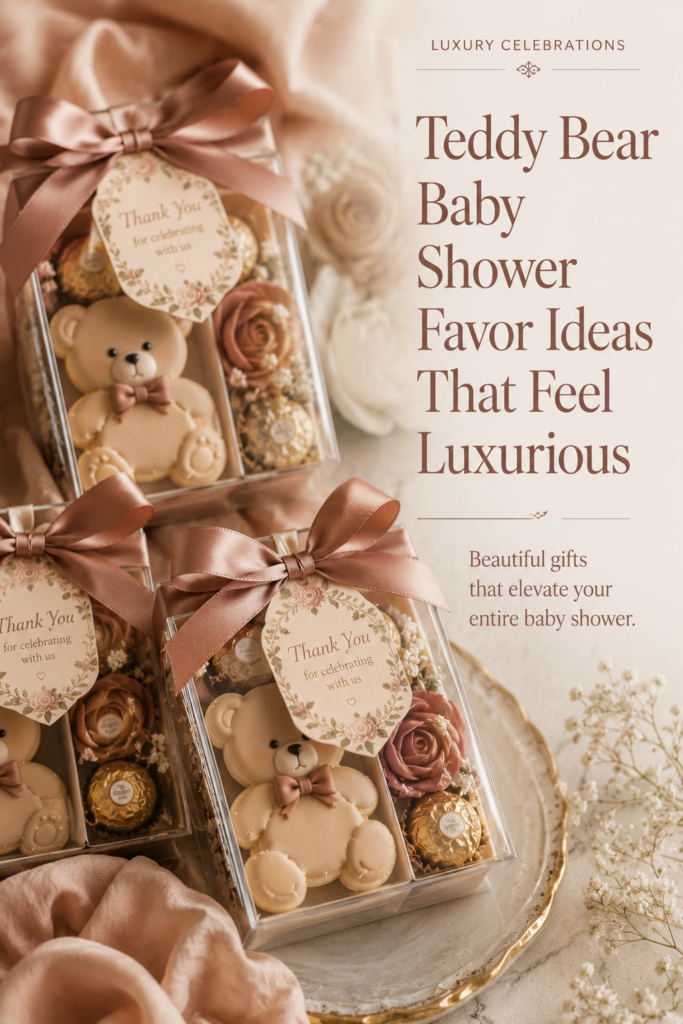
The most kept baby shower favors are edible — honey jars, tea sachets, shortbread, and small candles in roughly that order of retention rate. The reason is structural: edible favors disappear by being used, which means guests never have to make the conscious decision to keep or discard them. A honey jar on a counter gets used at breakfast within the week; a decorative bear figurine on a counter requires the guest to decide what it is, where it belongs, and whether to keep it indefinitely. One of those decisions requires no effort; the other requires effort it is easy to defer until it becomes easier to simply remove. If budget allows only one upgrade to your favor plan, make it edible — and within edible favors, honey is the most thematically coherent choice for a bear shower, because the association between bears and honey is the strongest single thematic connection available in the entire bear aesthetic world.
Section 02 Five Favor Directions for the Bear Theme
Each direction below specifies the favor item, the packaging approach, the label and tag styling, and the palette it suits. All five pass the three criteria above.
2.1 The Neutral Classic Favor
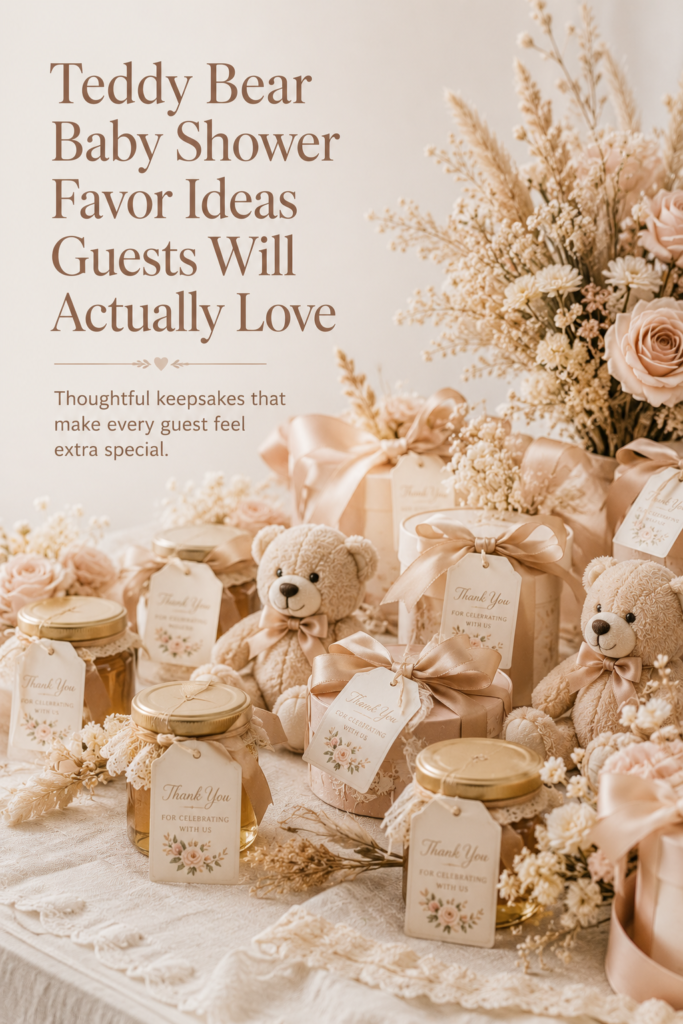
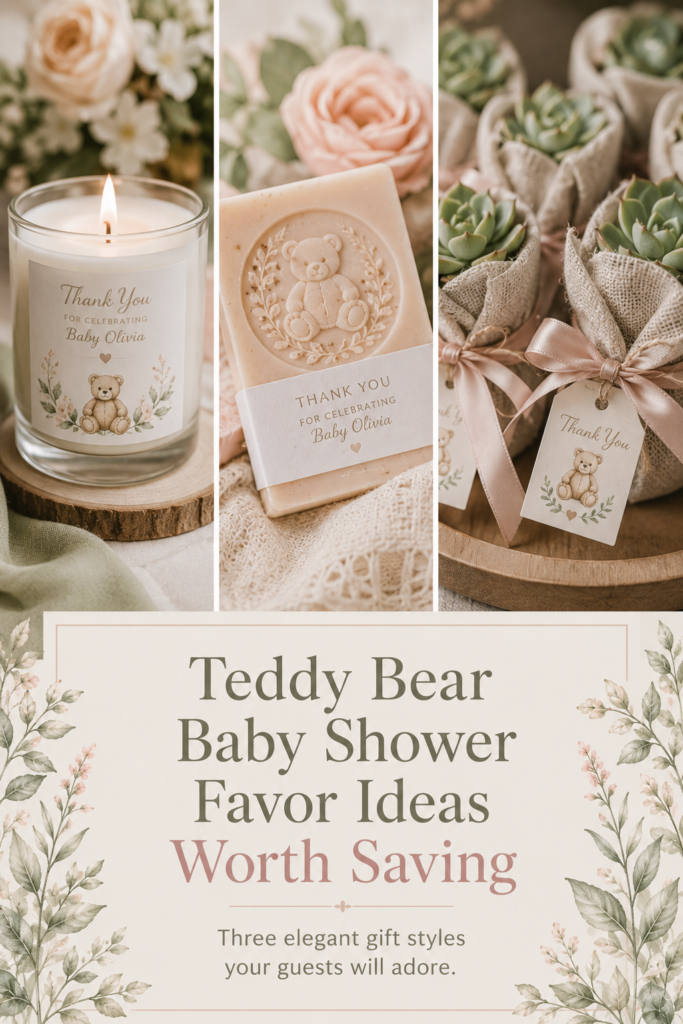
The honey jar is the most thematically coherent edible favor in the entire bear shower world, and the neutral classic direction is the version of it that suits the widest range of palettes and guest lists. A small glass honey jar — 2 oz or 3 oz is the most practical size for a favor — with a custom label in warm cream and the shower’s bear motif, tied at the neck with a length of natural twine or a narrow satin ribbon in the palette’s accent color, and finished with a small kraft tag carrying the baby’s name, the shower date, or a short warm message. The packaging cost for this favor is minimal; the jar itself is the item, and the label and tag are the design investment.
A soy candle in a small cream or clear glass vessel is the non-edible alternative for this direction — equally functional, equally kept, and suited to the same warm cream and oatmeal packaging aesthetic. The label should carry the same bear motif as the honey jar favor so that a mixed display of honey jars and candles reads as a single designed favor collection rather than two separate favor choices. Both the honey jar and the candle suit any bear palette direction and any guest list; this is the favor equivalent of the neutral invitation — universally appealing, impossible to dislike, and always appropriate.
The Neutral Teddy Bear collection includes favor tags in warm ivory with bear motifs that match the neutral classic packaging direction — printable at home and sized for both honey jar and candle favor presentations.
Styling Tip — Honey Jar Favor
A honey jar favor needs three things to read as designed rather than purchased: a custom label in the shower’s palette, a ribbon or twine tie in a complementary color, and a tag with a bear motif or a short warm message such as “So sweet, just like you” or “Little cub, big love.” The honey jar itself costs less than most shower favors — typically less than two dollars per jar for 2 oz sizes ordered in quantity — and the label is where the design investment goes. A label printed at home on kraft paper stock, cut to size, and affixed with a glue stick costs almost nothing and produces a result that reads as intentional and considered. The difference between a honey jar in its original commercial label and the same jar with a custom bear motif label in the shower’s palette is the difference between a generic favor and a keepsake.
2.2 The Rustic Natural Favor
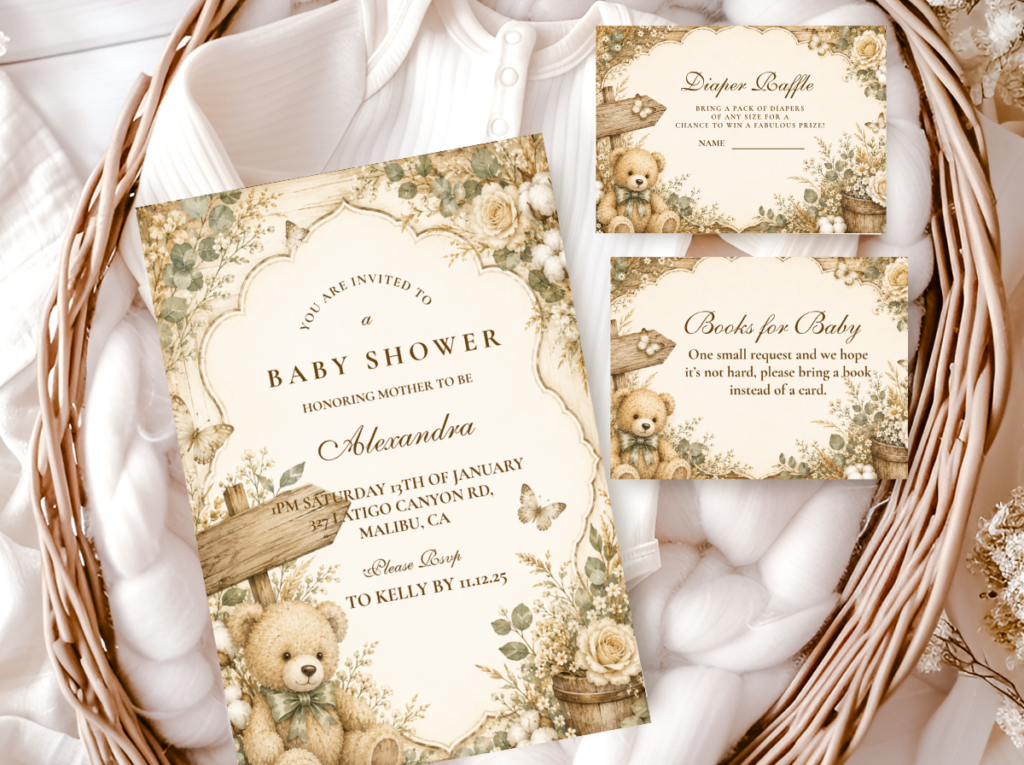
The rustic natural direction uses seed packets, dried herb bundles, or beeswax candles as the favor item — all functional, all in the warm organic register of the rustic bear aesthetic, and all packaged in kraft paper with dried botanical tags and natural twine. A seed packet favor is the most sustainable and the most seasonal of the five directions: guests receive something they can plant, which extends the celebration into a growing thing in their own space. The seed selection should match the organic quality of the aesthetic — wildflower seeds, herb seeds (lavender, chamomile, thyme), or sunflower seeds — rather than a generic mix that has no thematic connection to the shower.
A dried herb bundle — a small bunch of lavender, rosemary, or dried eucalyptus tied with twine and labeled with a kraft tag — is the lowest-cost option in this direction and one of the most atmospheric: it can be placed in a vase, used as a natural air freshener, or added to a bath. The beeswax candle is the most elevated version of the rustic direction — a small pillar or taper in natural beeswax with the characteristic warm honey scent, packaged in kraft paper with a twine-tied botanical tag. All three favor items in this direction suit the rustic, vintage, and nature-forward palette directions and photograph well on a favor table display because their materials — kraft, twine, dried botanicals — are inherently visual.
The Rustic Teddy Bear collection offers favor tags in the same organic, natural-texture register as the rustic favor packaging — kraft-toned tags and botanical bear motifs that match the dried herb and seed packet aesthetic.
2.3 The Garden & Nature Favor
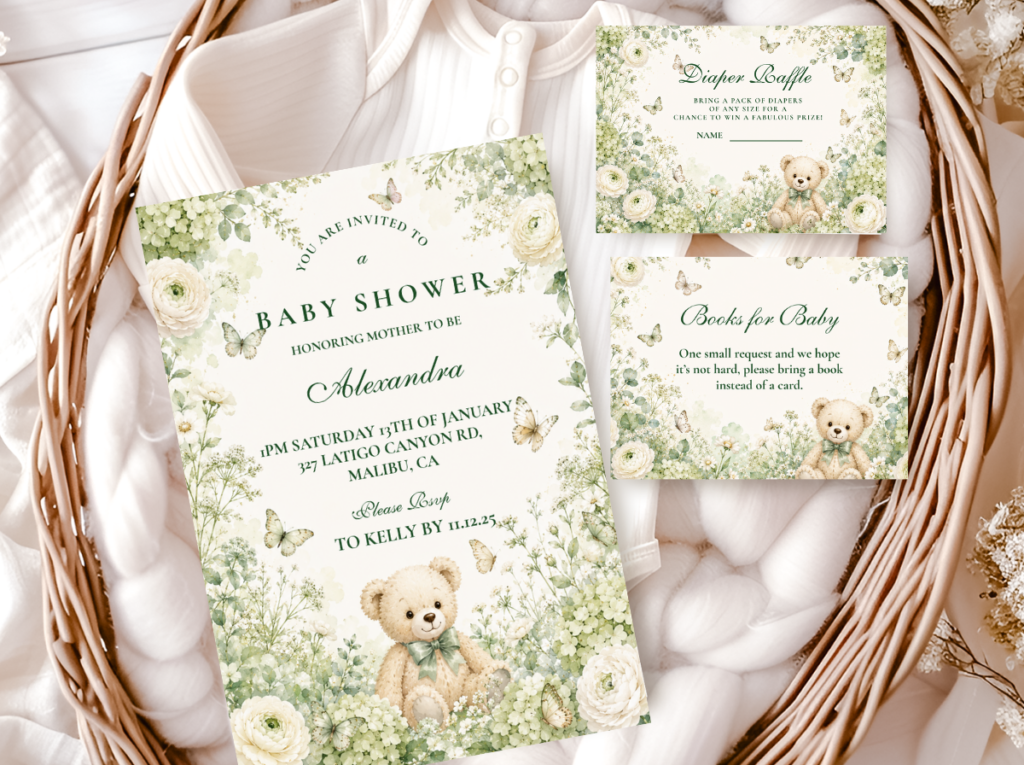
A small succulent or living plant in a terracotta pot is the most lasting favor of the five — it is still alive and visible in a guest’s home weeks, months, and potentially years after the shower, which is the maximum possible longevity for any favor. Succulents in particular are ideal: they are low-maintenance, they travel well, and they are universally appealing to guests across any level of gardening experience. A small 2-inch terracotta pot with a succulent, a sage ribbon tied around the pot’s rim, and a small greenery-motif tag with the shower date and the baby’s name is a complete, cohesive, and beautiful favor that suits any green or natural palette direction.
Packaging a plant favor for travel requires one additional consideration: stability during the event. Succulents in terracotta pots tip easily on a table surface and need to be grouped together on a display tray or board rather than standing individually. At the end of the event, provide a small paper bag or box for each guest to carry their pot safely — this bag is also a packaging moment and should match the palette: a kraft paper bag with the shower’s tag tied to the handle is the correct solution. Plants that are overwatered before the event are vulnerable to root damage in transit; plant favors should be watered normally up to two days before the shower and left dry from that point through the event.
The Green Teddy Bear collection pairs the garden and nature favor direction with stationery in sage and forest tones — the tags and labels that extend the greenery aesthetic from the potted favor to every printed element.
2.4 The Adventure Bear Favor
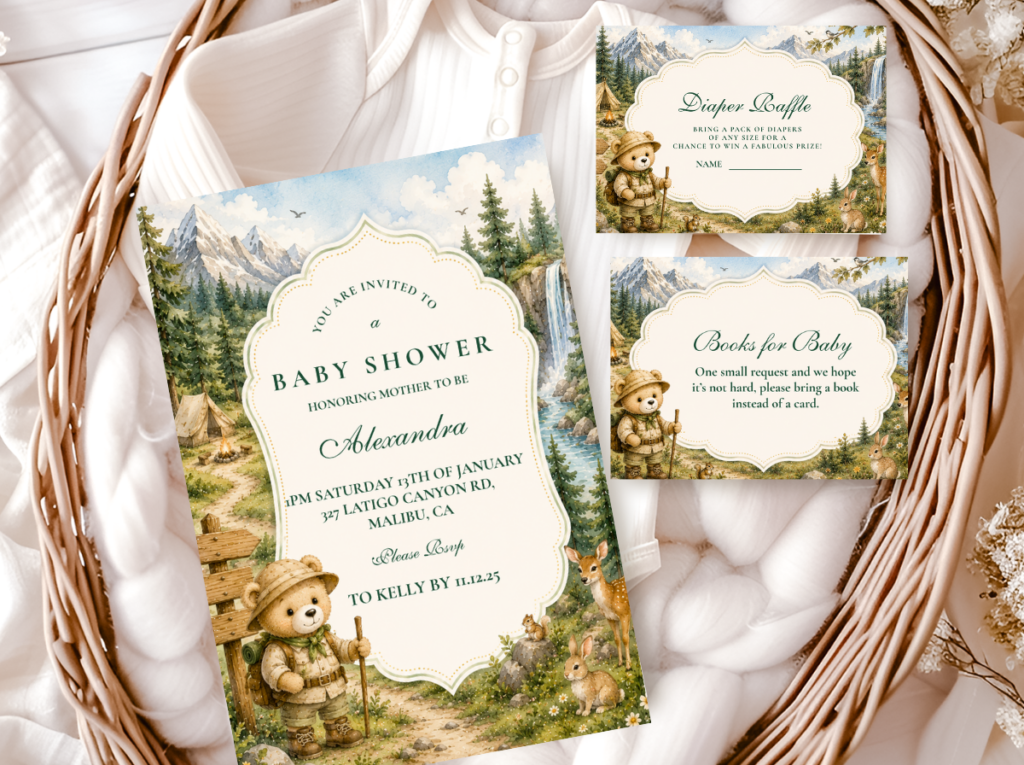
The adventure bear direction is the most narratively specific of the five — it is designed for a camping or outdoor-themed bear shower where the favor is an extension of the adventure story the shower is telling. Trail mix in a kraft pouch, a small s’mores kit (graham crackers, a chocolate piece, and a marshmallow in a cellophane bag tied with twine), or a hot cocoa sachet in a kraft envelope are the three most thematically coherent options. All three are edible, all three are functional, and all three carry the warmth and outdoor quality of the camping aesthetic without requiring any specialist sourcing — the ingredients for all three are available at a standard grocery store and can be assembled at home in bulk quantities.
The packaging for this direction should lean into the outdoor aesthetic: kraft pouches or bags in warm brown or forest green, closed with a strip of kraft tape and labeled with a hand-stamped or printed bear-and-tent motif. A small tag reading “Let the adventure begin” or “For the trail ahead” tied with natural twine completes the packaging narrative and connects the favor to the adventure theme without requiring any additional props. The s’mores kit in particular is the most photographically distinctive of the three options because the component items are visually recognizable and their arrangement in a cellophane bag creates an appealing still-life quality on the favor display table.
The Bear Camping collection pairs the adventure favor direction with stationery in warm forest tones — the packaging tags and favor labels that extend the camping narrative into the printed layer of the favor.
2.5 The Travel Bear Favor
The travel bear direction is the most keepsake-forward of the five and the one that suits the travel or adventure bear shower narrative most specifically. A small luggage tag — a genuine leather or card-stock tag in the shower’s palette with a bear illustration and the guest’s name or initials — is the most practical and most universally usable keepsake favor available for this direction. Unlike decorative keepsakes, a luggage tag has a clear function: it goes on a bag. Every guest who travels in the months after the shower will see the tag again, which extends the favor’s impact well beyond the day of the event.
A mini map print — a small illustrated map in vintage travel style, printed on warm ivory card stock and rolled into a scroll tied with twine — is the most whimsical option for this direction, and the one that photographs most distinctively on the favor table. A travel candle — a small tin with a scent labeled “The Open Road” or “Adventure Awaits” in the shower’s palette typography — is the functional alternative for guests who travel less frequently. Whatever the specific favor item, the packaging for the travel direction should carry through the vintage travel aesthetic: a kraft envelope, a wax seal in warm amber, and a tag reading “Adventures await the little one.” The packaging is as much the story as the item it contains.
The Teddy Bear Travel collection brings the vintage travel aesthetic into stationery — adventure motifs and warm tones that match the luggage tag, map print, and travel candle favor packaging directions.
Section 03 Packaging, Display & Logistics
3.1 The Favor Table Display
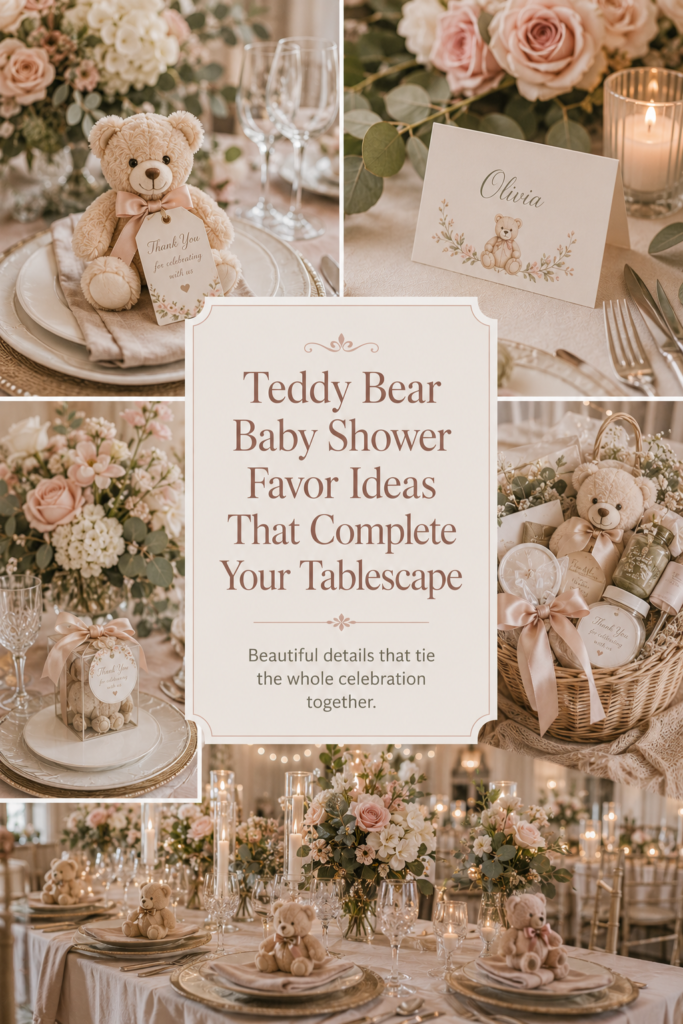
A well-styled favor table reads as a decoration until guests take from it — then it reads as abundance diminishing gracefully rather than inventory being depleted. The structural approach is the same three-height-zone logic as the dessert table: tall elements at the back (a small sign, a floral arrangement, a balloon cluster), mid elements in the center (stacked favors on a tiered stand or crate), and low elements at the front (favors laid flat or at a slight forward angle on the table surface). This height variation creates a display that is visually interesting from across the room and practically accessible from the front.
Group favors by design rather than distributing them randomly across the table surface: all honey jars together on their wooden display board, all candles grouped on a small tiered stand beside them, seed packets in a small basket at the low zone. Consistent grouping makes the display read as a collection rather than a scattering. A small handwritten or printed sign — “Please take one to remember this day” or “A little something from our family to yours” — provides the invitation for guests to take a favor without the awkwardness of wondering whether it is appropriate to do so before they are formally prompted.
3.2 Pre-Packaged vs. Self-Serve Favor Display
Pre-packaged favors — where every guest’s favor is individually wrapped and presented complete — produce the most visually cohesive display and the most consistent guest experience. Every guest receives the same presentation, the display is identical throughout the event rather than degrading as guests take items, and the packaging quality is uniform. The trade-off is setup time: pre-packaging fifty favors requires several hours of assembly in advance, and any variation in packaging quality (a label applied crookedly, a knot that is looser than the others) will be visible at individual-favor scale. Pre-packaged is the correct choice for any event where the favor display is also a centerpiece of the decor.
Self-serve favor displays — where guests select and bag their own favor from an open display of items — work best for edible favors where variety is part of the appeal (a candy bar, a tea selection display, a cookie arrangement). The self-serve approach requires a packaging station: small bags or boxes, ribbon pre-cut to length, a tissue paper pile, and a clear instruction card. It also requires more display quantity than a pre-packaged approach because the display needs to look abundant when full and still presentable when partly depleted. The advantage is flexibility: guests can choose quantities and combinations that a pre-packaged approach cannot accommodate. The disadvantage is that the packaging quality is dependent on guest execution rather than host execution.
3.3 Budget Planning for Favors
Realistic cost ranges per guest for each of the five directions above, based on standard sourcing without premium specialist suppliers. The honey jar favor (2 oz jar, custom label, twine, tag) falls in the range of approximately $2–$4 per guest when purchased in quantity and labeled at home. The rustic natural favor (seed packet, dried herb bundle, or beeswax candle with kraft packaging) falls in the $3–$6 range depending on the specific item. The garden and nature favor (small succulent in a terracotta pot) falls in the $4–$8 range including the pot, plant, sage ribbon, and tag. The adventure bear favor (trail mix pouch, s’mores kit, or hot cocoa sachet assembled at home) falls in the $2–$4 range. The travel bear favor (luggage tag, map print, or travel candle) is the most variable: a card-stock luggage tag in a kraft envelope is $2–$3 per guest; a genuine leather luggage tag can reach $8–$12.
The packaging budget should equal approximately 30–40% of the total favor budget rather than being treated as an afterthought. A $4 honey jar with a $0.50 generic label reads as a $3.50 favor. The same $4 honey jar with a $1.00 custom label, a $0.25 kraft tag, and a $0.25 ribbon reads as a $6–$8 favor to a guest — the packaging has doubled the perceived value for an additional investment of $1.50. This is the highest-return spend in the entire favor budget and the one most hosts underestimate when planning. Budget the label and tag first; then determine what favor item the remaining budget can accommodate.
Styling Tip — Display Angle
Display favors with the label or tag facing outward and slightly toward the guest — not flat on the table where only the top surface is visible. A favor display where guests can read the bear motif and the message on the tag before picking up the favor creates a moment of anticipation that encourages them to take one immediately; a display where the favor is a mystery until it is lifted creates hesitation, and hesitant guests wait to see what others do first. The facing rule applies to honey jars (label facing forward), candles (label visible from the approach angle), seed packets (tag hanging in front rather than behind), and any wrapped favor where the ribbon or bow is the front-facing element. Angle the display toward the expected guest approach direction before the event starts.
Section 04 Invitations & Stationery
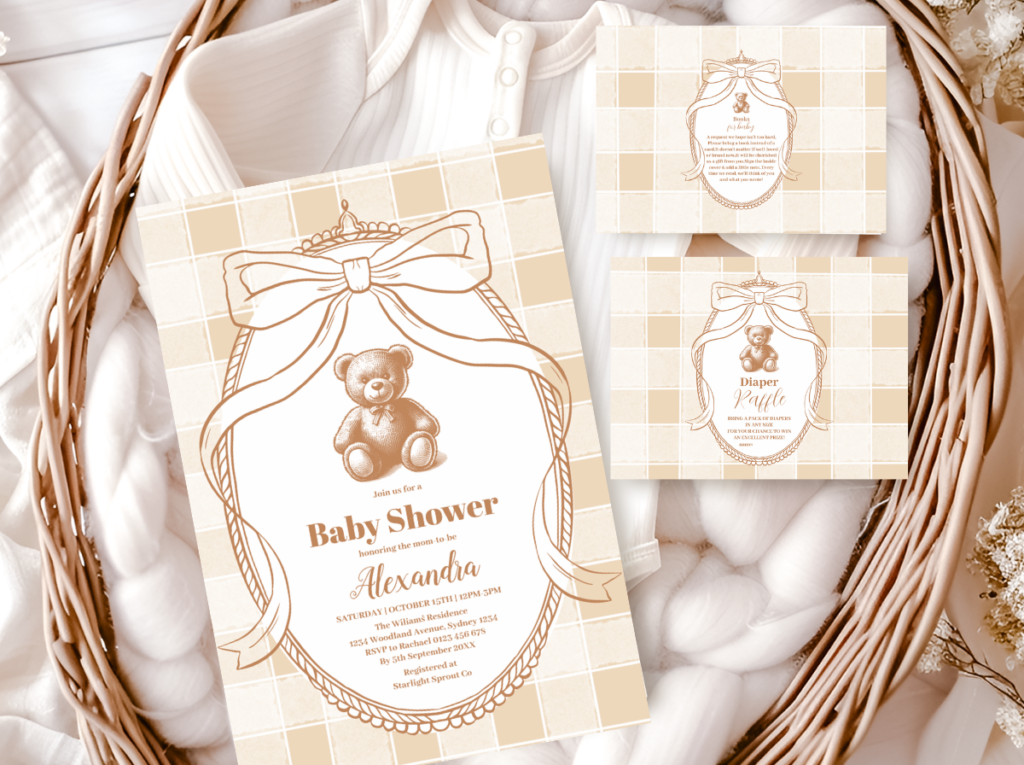
The favor tag is the smallest stationery element at the shower and the one that most guests read twice — once when they pick up the favor from the table and once when they get home and put it somewhere. It is a small card that carries the bear motif, a short warm message, and often the baby’s name and shower date; when it belongs to the same visual family as the invitation, it is the final object in a design story that began the moment the guest opened their envelope. The invitation set the expectation; the favor tag closes the loop.
When the favor tag shares the same illustration style as the invitation — the same bear motif treatment, the same typography, the same palette tone — the guest picks up the honey jar or seed packet and sees the celebration again in miniature. This is the smallest possible object that can carry the maximum amount of design coherence, and its cost is negligible: a favor tag printed at home from the invitation suite’s collection, on card stock that matches the paper weight of the invitation, trimmed with a pair of scissors and hole-punched for the twine. The materials cost is pennies per tag; the design impact is the closing chapter of a coherent story.
The six collections below each include favor tags alongside the invitation, place card, menu card, and thank-you card. Choose the collection first — it establishes the palette and bear motif for every favor tag in the room — and then use it as the reference for every packaging decision that follows. A favor that carries the same visual identity as the invitation, the place card the guest held at dinner, and the welcome sign they walked past at the entrance is the last impression of a celebration that was designed from beginning to end.
Each collection below links to the full product range: invitation, favor tag, menu card, place card, food label, and thank-you card — every printed element from the first guest communication to the last favor taken home.
Main Collection
Bear Theme
Browse all bear stationery and favor tag directions together before committing to a palette.
Honey & Candle Direction
Neutral Teddy Bear
Warm ivory and restrained bear motifs — the favor tag suite for the honey jar and candle neutral classic direction.
Botanical Direction
Rustic Teddy Bear
Organic kraft-toned motifs — the favor tag suite for the seed packet, herb bundle, and beeswax candle rustic direction.
Succulent Direction
Green Teddy Bear
Sage and forest tones — the favor tag suite for the succulent and living plant garden direction.
Adventure Direction
Bear Camping
Warm forest tones and camping motifs — the favor tag suite for trail mix, s’mores kits, and cocoa sachet adventure favors.
Travel Direction
Teddy Bear Travel
Vintage travel motifs and warm tones — the favor tag suite for luggage tags, map prints, and travel candle keepsake favors.
Frequently Asked Questions
How much should I budget per favor for a bear baby shower?
A realistic and well-received bear shower favor can be produced for between $2 and $8 per guest depending on the direction chosen. The honey jar favor assembled at home (jar, custom label, tag, and twine) sits at the low end of this range at approximately $2–$4 per guest when sourced in quantity; the succulent in a terracotta pot sits at the high end at approximately $5–$8 per guest. The travel keepsake direction is the most variable: a card-stock luggage tag is $2–$3 per guest, while a genuine leather version reaches $8–$12. Within any budget range, the most important allocation principle is to spend at least 30–40% of the per-guest favor budget on packaging — the label, tag, ribbon, and bag — because the packaging is what guests see before they open anything and what determines the first impression of quality. A $2 jar with a $1 custom label and tag reads as a $5 favor; the same jar with no label reads as a $2 jar.
Edible vs. keepsake favors — which do guests prefer?
Edible favors are retained and used more consistently than keepsake favors — this is not a preference so much as a structural reality. Edible favors disappear by being consumed, which means guests never face the decision of whether to keep or discard them. A honey jar on a kitchen counter gets used at breakfast; a decorative bear figurine on a counter requires a decision about where it belongs in the guest’s life, and if that decision cannot be made easily, the favor gets stored, then forgotten, then discarded. The exception is functional keepsakes — items that serve a purpose in a guest’s real life, like a luggage tag, a seed packet, or a succulent. These are retained because they have a use that justifies their presence. The worst-performing category is decorative-only keepsakes: miniature figurines, foam props, and items whose only function is to exist. For the best retention rate at any budget level, choose edible first, functional keepsake second, and decorative-only last or not at all.
How many favors should I order beyond the confirmed headcount?
Order 15–20% more favors than your confirmed guest count for two reasons. First, a favor display that is fully stocked throughout the event reads as more generous and more beautiful than one that shows obvious gaps mid-event — the surplus keeps the display looking abundant even as guests take their favors. Second, additional guests arrive at most showers: partners who drop a guest off and stay, siblings who are brought along, or guests who confirm late. Having surplus favors allows you to accommodate these additional attendees without anyone going without. For the display specifically, the surplus goes at the back of the display where it refills the front row as favors are taken. For packaged favors at each place setting, order exactly the confirmed count plus five extras regardless of headcount. The extras cover any packaging errors discovered on the day and any truly last-minute additional guests.
How do I display favors so guests actually take them?
Four specific decisions determine whether guests take favors readily or hesitate. First, label and tag visibility: favors displayed with the label or tag facing outward and readable before pickup invite guests to engage; favors displayed with the packaging facing away or the label hidden invite hesitation. Second, a take-permission sign: a small card reading “Please take one to remember this day” or “A little something for you” removes the social awkwardness of whether taking a favor is expected or optional. Third, placement: a favor table positioned near the exit rather than in a central location produces higher uptake because guests encounter it naturally when leaving rather than having to make a decision to approach it during the event. Fourth, timing: favor tables that are clearly visible and signed from the moment guests arrive, rather than appearing mid-event or announced at the end, produce more consistent uptake because guests have had the whole event to notice and anticipate them. The combination of visible labels, a permission sign, exit-adjacent placement, and early visibility will result in almost every favor being taken at almost every event.
Ready to Start Planning?
Find the Favor Tag That Closes the Story
The smallest stationery item at the shower — and the one guests read twice.