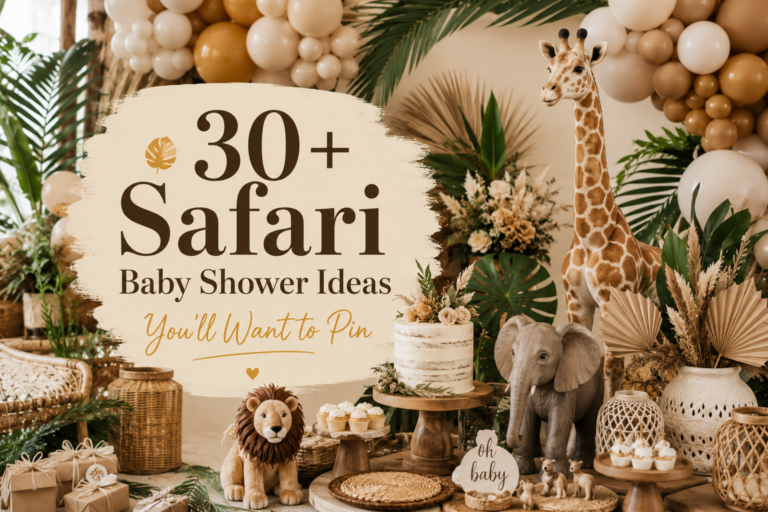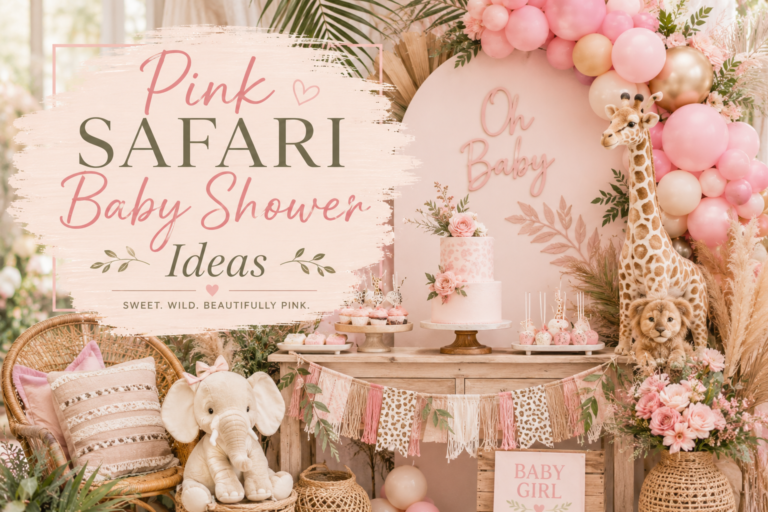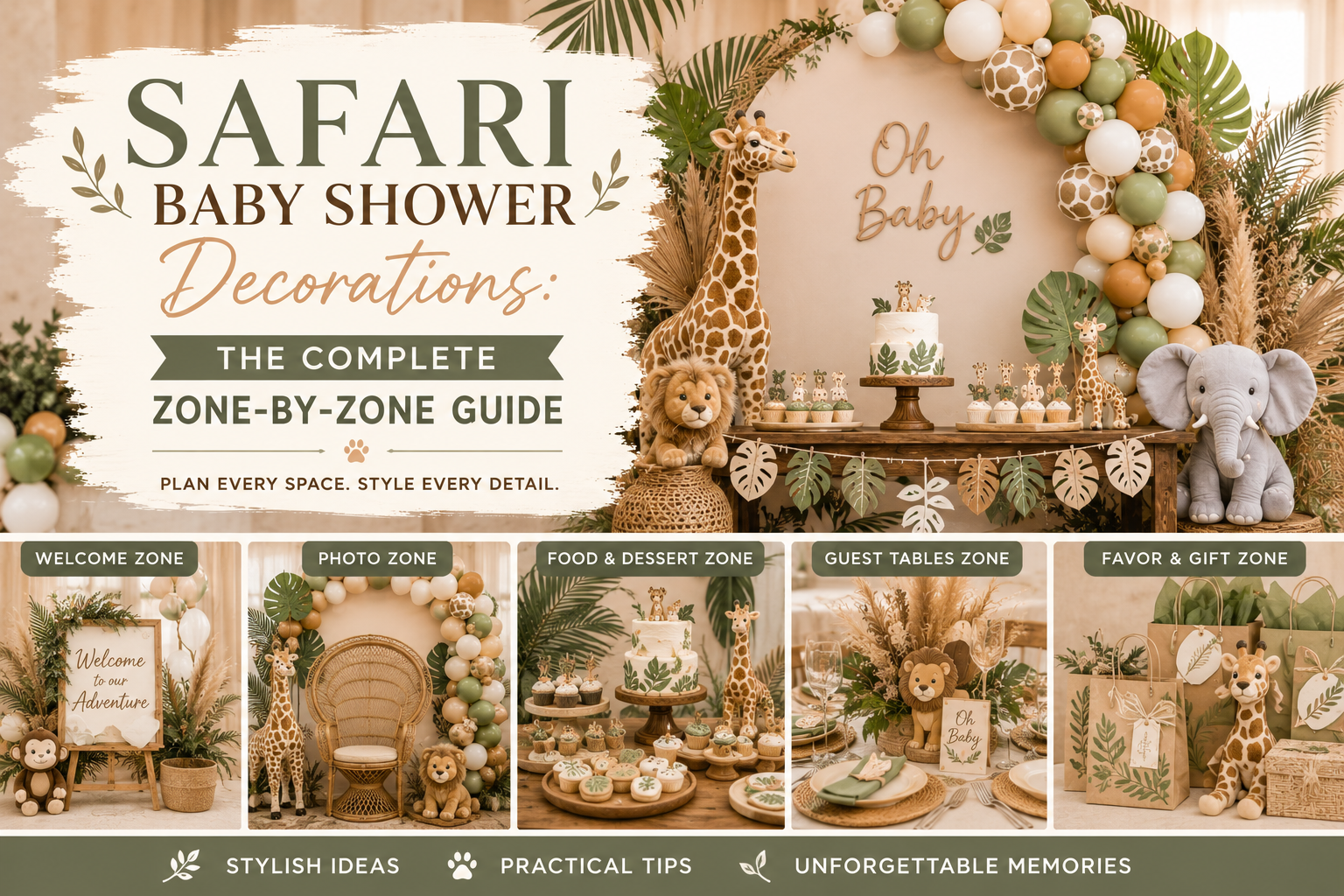
Safari Baby Shower Decorations: The Complete Zone-by-Zone Guide
Baby Shower · Decoration Guide
Safari Baby Shower Decorations: The Complete Zone-by-Zone Guide
A zone-by-zone decoration plan for every corner of the safari shower space — with budget allocation guidance, backdrop direction, table styling, and the stationery that ties the whole room together.
A decorated safari room and a designed safari room are not the same thing — and the difference is not budget. The difference is planning sequence: a designed safari room allocates decoration investment to the zones that guests actually notice, in the order that they encounter them. This guide divides the safari shower space into five zones, assigns a decoration priority and budget percentage to each, and explains exactly what each zone needs at minimum and what makes it genuinely extraordinary. Follow it in order, and the result is a room that reads as a complete designed world from the moment guests step in.
Browse the complete safari stationery collection
Welcome signs, place cards, favour tags — all coordinated and fully customisable.
“A decorated safari room and a designed safari room are not the same thing. The difference is whether every element was chosen to build the same world — or simply chosen to share the same theme.”
Section 01 The Safari Zone-by-Zone Decoration Plan
Before buying any decoration element, allocate the budget across five zones. The percentages below are based on what guests actually notice — not on what fills the room. Hosts who allocate budget proportionally to guest attention rather than to floor area consistently produce the most visually impressive results at the same or lower total spend.
Zone 1 · Highest priority · 25% of decor budget
The Entrance & Welcome Zone
Minimum: One welcome sign and one balloon cluster or botanical garland element at the entrance. These two elements are the entire minimum.
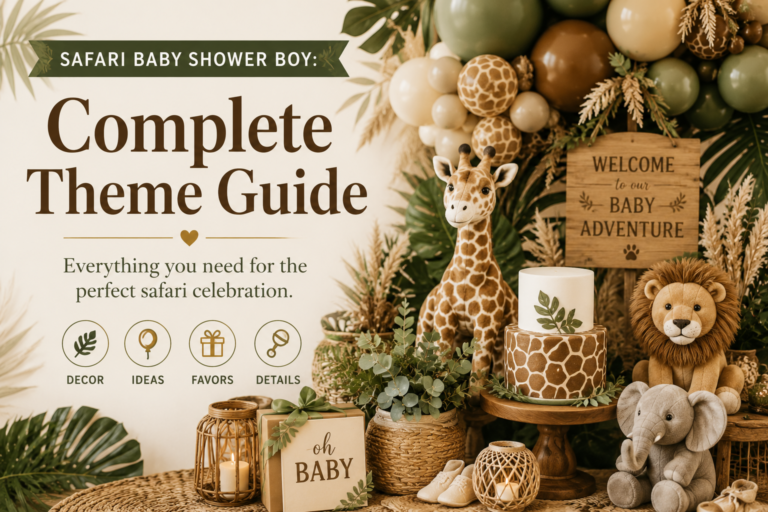
What makes it extraordinary: A large-format watercolour safari welcome sign (framed or freestanding, in the invitation’s illustration style and palette) plus a warm-toned balloon cluster of five to seven balloons (cream, honey amber, one metallic gold) at the doorframe or entrance arch. This combination reads as a complete safari world before the guest has stepped inside.
Most common mistake: Over-decorating the entrance with multiple signs, multiple balloon installations, and multiple garland layers. The entrance needs one strong statement, not five competing elements. More than two installation points at an entrance looks cluttered rather than welcoming.
Zone 2 · Highest priority · 30% of decor budget
The Backdrop & Photo Wall
Minimum: One cohesive backdrop installation — balloon arch, botanical panel, or pampas wall — at a minimum size of 180cm wide and 180cm tall. This is the most photographed element of the shower and the image most likely to be saved and shared.
What makes it extraordinary: A botanically layered backdrop that reads as a safari scene rather than a party wall: pampas plumes at the top creating a canopy quality; warm botanical elements at mid height; the guest of honour’s name in warm gold lettering or a personalised safari welcome sign positioned within the backdrop rather than beside it. When the stationery element is integrated into the backdrop rather than hung separately, the backdrop reads as a complete designed scene.
Most common mistake: Installing the backdrop directly against a plain white wall without any softening element. Even a small amount of botanical material at the backdrop’s edges — two pampas plumes at floor level, a trailing botanical garland — transforms the appearance from “banner against a wall” to “scene from the savanna.”
Zone 3 · High priority · 25% of decor budget
The Guest Tables
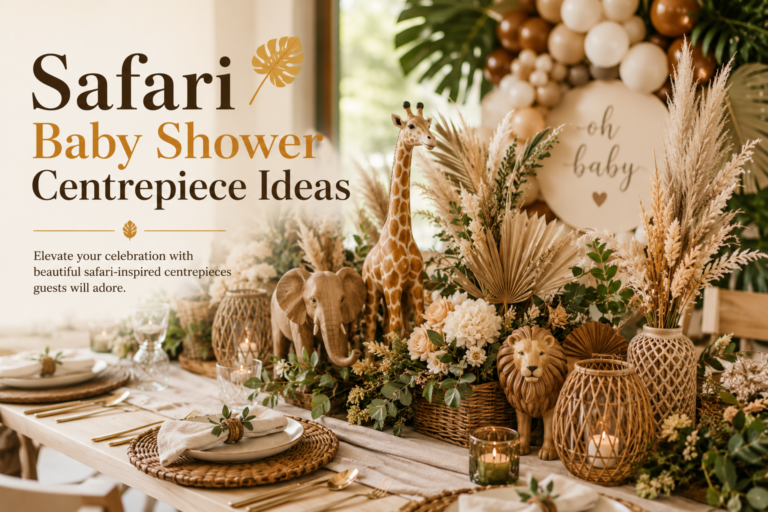
Minimum: Coordinated centrepiece (any direction from the five outlined in the centrepiece guide), appropriate linen, and safari-illustrated place cards or name cards.
What makes it extraordinary: Centrepiece in the three-height formula (tall botanical element + mid arrangement + low scatter) with table stationery (place cards, menu cards) in the same illustration style as the invitation. When the place card in the guest’s hand shares the same watercolour illustration as the invitation they received three weeks earlier, the table reads as a complete and intentionally designed world.
Most common mistake: Choosing a centrepiece from a photograph taken at a different table size or shape from the actual venue. Measure the table before buying any centrepiece elements.
Zone 4 · Medium priority · 12% of decor budget
The Dessert & Gift Table
Minimum: A small backdrop or botanical panel behind the dessert table, a table runner or skirt in the palette direction, and height variation across the display elements.
What makes it extraordinary: Coordinated stationery labels and signs on every dessert item (cake label, cookie tag, favour tag — all in the invitation’s illustration style), so the stationery layer runs from the centrepiece table through to the dessert table in a continuous visual narrative.
Most common mistake: Treating the dessert table backdrop as a separate visual world from the main room backdrop. The two backdrops should be in the same aesthetic register and the same palette, even if they are different installation types.
Zone 5 · Low priority · 8% of decor budget
The Transitional Spaces
Minimum: One botanical element per transitional corner or secondary wall — a single pampas stem in a rattan vase, a small botanical cluster, or a candle grouping. Nothing more.
What makes it extraordinary: Warm Edison string lights running through any hallway or transitional corridor connecting the main shower space to ancillary areas (bathroom corridor, gift drop zone). String lights at low cost provide the specific warm amber quality of golden hour light that extends the safari palette into spaces that would otherwise read as neutral and unrelated to the celebration.
Most common mistake: Spending Zone 5 budget on elaborate decoration installations in corners and corridors that guests notice only in passing. A single warm botanical element per transitional space is sufficient — more than this is over-investment in the spaces that matter least.
✨ Styling Tip
Most safari decoration budgets are spent in the wrong order — hosts over-invest in Zone 5 (corners and transitional spaces) because they feel empty, and under-invest in Zone 2 (the backdrop) because it seems expensive. Reverse this. A strong safari backdrop with minimal corner decoration looks like a designed savanna. A weak backdrop with decorated corners looks like a room where someone placed safari animals on every available surface. Zone 2 at 30% of the budget, Zone 5 at 8%: this allocation, applied consistently, produces the most visually impressive result per pound or dollar spent.
Section 02 Zone 1 — Entrance & Welcome Decorations
Welcome Sign Directions for Safari
Three welcome sign formats, each communicating a different register: the watercolour safari landscape welcome sign (a large-format illustration of the savanna — acacia tree, warm grass, giraffe silhouette — with the guest of honour’s name and the celebration details in warm brown script below) is the most artistically ambitious and the most specifically beautiful format; it requires a high-quality print on warm ivory stock and a frame or easel that is in the same warm material register as the sign. The kraft board welcome sign (warm brown kraft paper with the celebration details in gold or honey marker or gold foil stamping) is the most immediately achievable and the most specifically rustic-safari in register — the raw material quality of kraft paper belongs directly to the earthy, natural visual world of the safari aesthetic. The acrylic welcome sign (a clear acrylic panel with the celebration details in gold or white vinyl lettering) is the most modern and most editorial format — most appropriate for the Elegant Safari or Gold Safari directions where the contemporary material quality of the acrylic reads as premium rather than as generic party signage.
Entrance Balloon Cluster
The balloon palette for the safari entrance cluster determines whether the entrance reads as specifically safari or generically party. For the neutral and jungle safari directions: cream, oatmeal, warm honey amber, and warm brown as the primary palette, with one or two warm metallic gold balloons as the statement element; no bright green, no bright yellow. For the sage green girl direction: dusty sage, warm ivory, cream, and warm gold; the sage balloons should be clearly dusty and muted rather than bright green. For the pink girl direction: dusty rose, warm blush, cream, and warm gold; the rose balloons should be warm and peachy rather than cool-toned or candy-bright. Sizing rule: the entrance balloon cluster should read as visible from at least five metres away — which means a minimum of five to seven large balloons (30cm or larger) rather than a dense collection of small balloons at a height that reads as a tabletop decoration rather than an entrance installation.
Botanical Garland and Door Detail
A botanical garland at the entrance — a loosely assembled garland of dried botanicals, eucalyptus, and safari grasses hung across the doorframe or wound through the entrance arch — is the decoration element that most specifically communicates the safari aesthetic at the moment of arrival, because it uses the natural botanical material of the savanna rather than printed or manufactured decoration. The garland should be assembled in the warm botanical vocabulary of the specific palette direction: sage and eucalyptus for the botanical girl directions; dried pampas and honey-warm dried grasses for the neutral and jungle directions; terracotta and dusty florals for the boho direction. The printed welcome sign and the botanical garland together constitute the complete entrance zone with nothing further required.
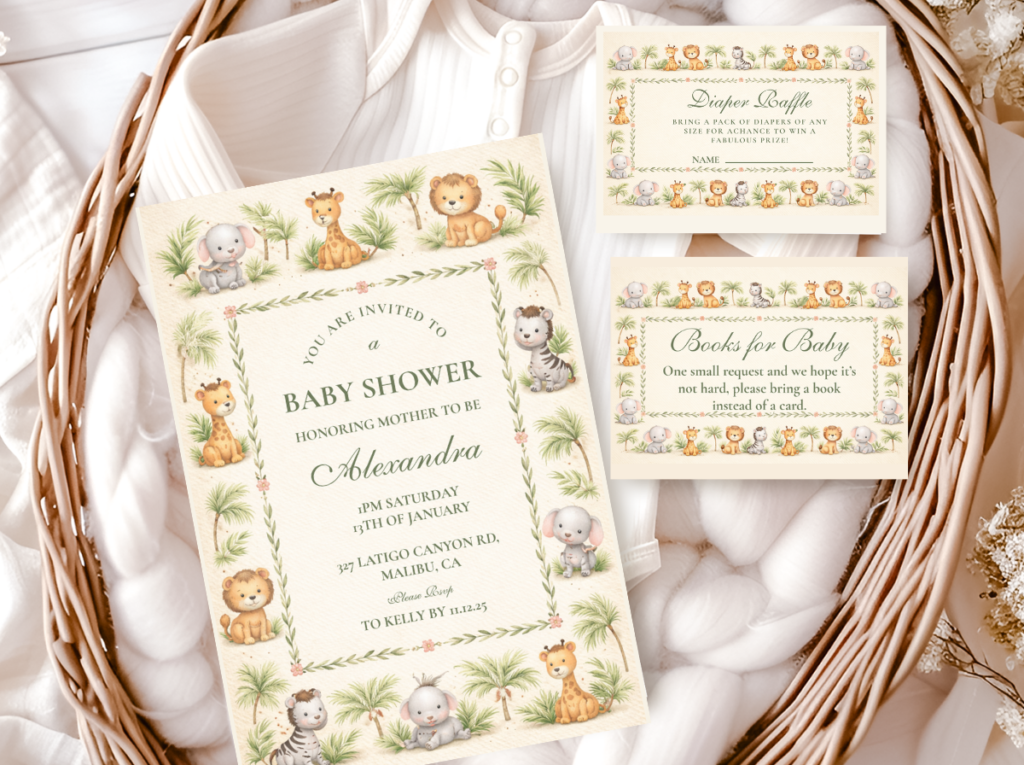
The Elegant Safari Baby Shower collection carries the most refined stationery direction — entrance welcome signs, framed prints, and personalised signage that sets the register for the entire celebration from the first moment guests arrive.
Section 03 Zone 2 — Backdrop & Photo Wall Decorations
Safari Balloon Arch Directions
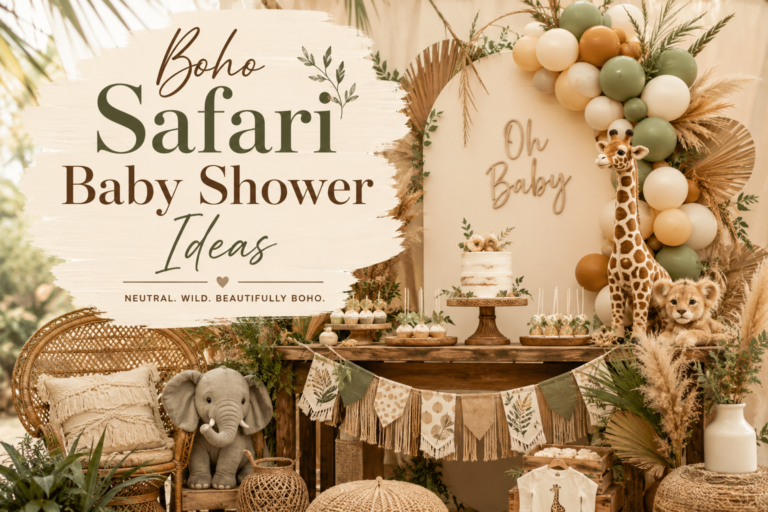
The balloon arch is the most immediately impactful and most consistently Pinterest-saved safari backdrop format. The two structural options are the organic arch (balloons in varying sizes clustered into an irregular, slightly asymmetric arch form) and the structured arch (balloons in consistent sizes assembled into a regular, symmetrical curve). The organic arch reads as more specifically botanical and more alive — it suits the jungle safari and boho safari directions where irregularity and natural quality are the primary visual register. The structured arch reads as more editorial and more formally composed — it suits the elegant and gold safari directions where precision and composition are part of the aesthetic statement.
Palette combinations that work per direction: for the jungle safari direction, a dark base (deep olive and dark forest green at 60% of the balloon count) with cream and warm gold accents at 30% and 10% respectively, assembled into an organic arch; for the sage green girl direction, dusty sage and warm ivory at 70% with warm gold metallic at 20% and pale blush at 10%; for the neutral direction, cream, oatmeal, and warm honey at 80% with antique gold metallic at 20%. The rule: the dominant balloon colour should be the palette’s base tone (cream or oatmeal for neutral directions, deep olive for jungle) rather than the accent colour — an arch in which the accent colour dominates reads as a colour statement rather than as a safari palette.
Botanical Safari Backdrop Panel
A botanical safari backdrop panel — a flat panel of botanical material (large palm leaves, eucalyptus branches, dried grasses, pampas plumes) assembled on a panel frame or wire mesh and positioned behind the guest of honour’s seating position — is the most dramatically botanical of the three backdrop directions and the one that most specifically references the living plant world of the savanna. The botanical panel should be assembled in the palette direction of the specific shower: sage and eucalyptus branches for the sage green girl direction; palm leaf and deep olive greenery for the jungle safari direction; warm pampas and dried botanical material for the neutral and boho directions.
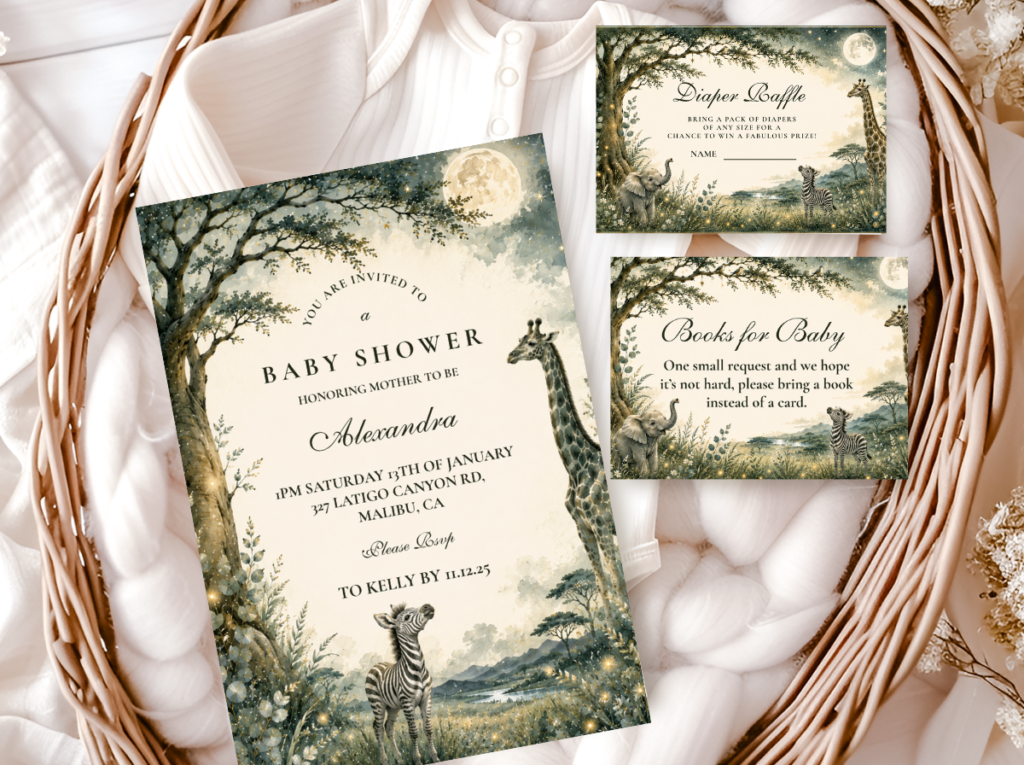
The Sage Green Safari Girl Baby Shower collection carries the most botanical and the most specifically fresh stationery direction — the most naturally cohesive companion to a sage and eucalyptus botanical backdrop panel.
Jungle Canopy Backdrop
The jungle canopy backdrop is the most dramatically immersive of the three backdrop directions — it uses large-form tropical botanical elements (large palm fronds, monstera leaves, dried or faux tropical vegetation) assembled to create a canopy effect above the primary backdrop zone, so that guests seated in front of it appear to be within a botanical environment rather than against a flat decorated wall. The canopy is created by fixing large-form botanical elements to the top and upper sides of the backdrop frame so that they extend inward and downward over the space below, creating the specific quality of enclosed organic shelter that the jungle aesthetic references. The light that filters through the canopy elements (if illuminated from behind with warm Edison string lights) creates a dappled, warm quality that is the most specifically atmospheric lighting effect available in the safari shower decoration vocabulary.
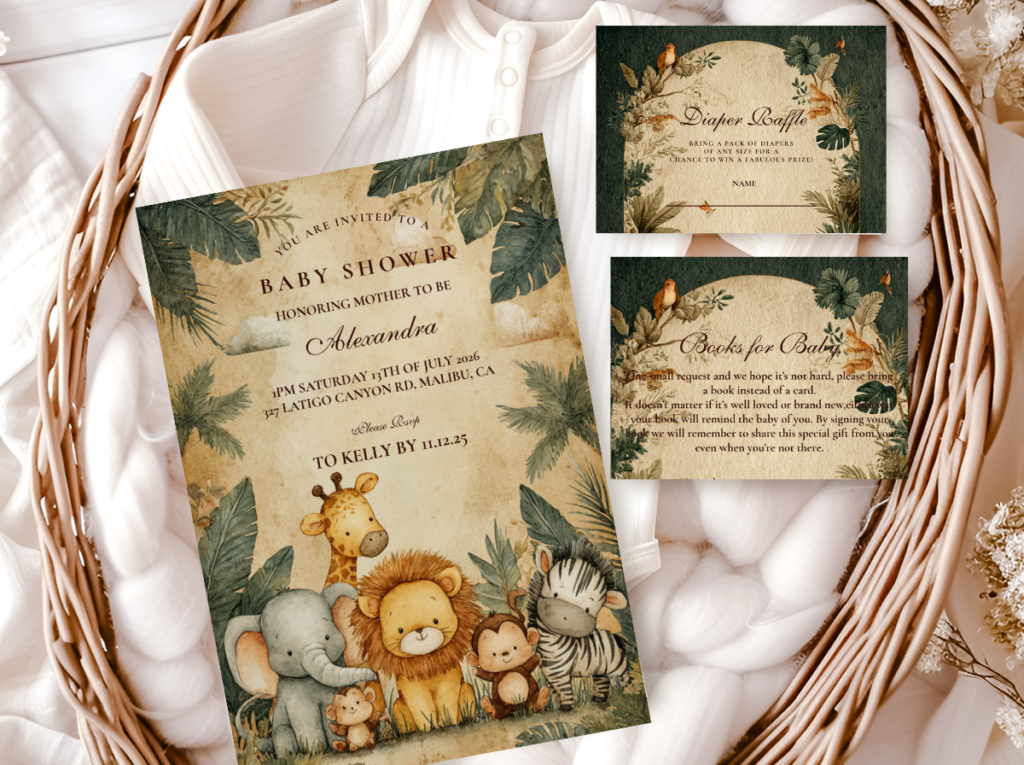
The Jungle Safari Boy Baby Shower collection carries deep olive and warm gold stationery that belongs to the same dense botanical world as the jungle canopy backdrop — welcome signs, place cards, and signage in the most adventure-forward safari direction.
✨ Styling Tip
A safari backdrop should tell a story — the savanna at golden hour, the jungle canopy from below, the morning mist over the plains. A backdrop that is simply safari-coloured balloons against a plain wall tells no story. The difference in photographs is immediate and permanent: one looks like a scene the guest stepped into; one looks like a wall that was decorated. Before assembling any backdrop, decide which single safari moment it references and build every element around that one specific moment. A backdrop that references ‘golden hour over the savanna’ has warm amber and cream balloons at the top graduating to deeper warm tones at the base — not a random assortment of safari-palette balloons at equal saturation across the full height.
Section 04 Zone 3 — Guest Table Decorations
The three non-negotiable table decoration decisions for a safari shower: centrepiece height (the maximum height should not exceed one third of the distance between the table surface and the ceiling — the most common table decoration error is choosing a centrepiece from a photograph taken in a high-ceiling venue for a standard-ceiling venue); linen colour (oatmeal or warm ivory, not cool white — the warm base is the quality that most connects the table to the safari palette); and one animal prop maximum per table (one ceramic or carved wooden giraffe or elephant half-concealed at the centrepiece base reads as a discovered safari detail; two or more reads as a toy collection). The place cards and menu cards in the same illustration style as the invitation are the stationery element that most completely ties the table to the designed world of the invitation, at the closest examination range of any element in the room.
Section 05 Zone 4 — Dessert & Gift Table Decorations
The dessert table requires three specific decisions: a backdrop (a smaller version of the main room backdrop — a botanical botanical panel, a pampas cluster, or a warm balloon installation — positioned directly behind the table so that the cake and desserts are photographed against the safari world rather than against a plain wall); a table runner or skirt in the palette direction (kraft paper for the rustic safari direction, sage linen for the botanical direction, oatmeal linen for the neutral direction); and height variation across the display elements (tall cake stand or tall tiered display at the back, medium display at mid level, flat items at the front — the three-height rule applies at the dessert table as much as at the centrepiece). The personalised stationery labels and signs on each dessert item (cake label, cookie bag tag, favour tag) in the invitation’s illustration style carry the stationery world of the shower into the dessert display at the closest visual range of any decoration in the room.
Section 06 Zone 5 — Accent & Atmosphere Decorations
Boho Safari Accent Direction
For the boho safari direction, Zone 5 accent decorations use the same dried botanical material as the primary centrepiece and backdrop directions, scaled to a single-element format: one large dried pampas plume in a tall rattan vase in each transitional corner; one rattan lantern cluster (three lanterns of varying heights grouped together at floor level) in any secondary space; and one dried botanical wreath on any door within the shower space. These three elements extend the boho safari palette into every corner of the venue without requiring significant additional investment, because the same dried botanical material is sourced once and distributed across multiple zones.
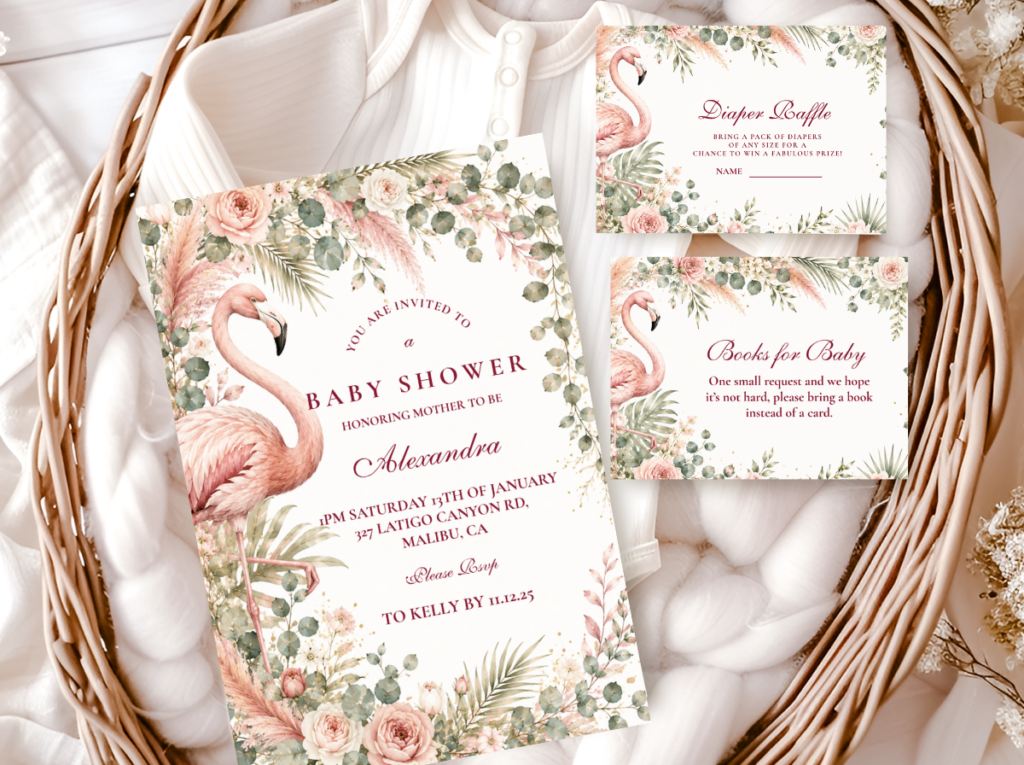
The Boho Safari Girl Baby Shower collection carries the most texture-forward and the most earthy stationery direction — small accent signage and stationery elements that extend the boho safari palette into every zone.
Neutral Safari Accent Direction
For the neutral safari direction, Zone 5 accent decorations use the simplest and most inexpensive safari palette elements: a small glass honey jar with a personalised safari label on any secondary surface or side table; a small bundle of dried grasses tied with warm twine as a natural accent element; and a small printed kraft paper tag tied to a botanical element with the guest of honour’s name or a safari-themed phrase (“Into the wild”, “Little explorer on the way”) in warm brown. These three elements cost almost nothing individually and produce the specific quality of a thoughtfully detailed safari world where even the corners and secondary spaces feel considered rather than forgotten.
The Neutral Safari Baby Shower collection carries warm cream and antique gold stationery across every printed element — including the small accent tags and labels that make Zone 5 feel intentional rather than accidental.
Lighting as the Final Decoration Layer
Warm lighting is the most underused and most impactful decoration tool in safari shower planning — because the specific warm amber quality of Edison bulb string lights is the closest available artificial equivalent to the golden hour light that the safari palette is designed to reference. Installed at low height (suspended at 120–150cm from the floor rather than at ceiling height, so the light sources are within the human visual field rather than above it), warm Edison string lights transform the amber and cream palette elements of any safari decoration scheme from pleasant to genuinely luminous. Three specific lighting applications that produce the most significant visual impact at the lowest cost: Edison string lights at low height above the main table and the dessert table; one rattan lantern or terracotta lamp with a warm-toned bulb in each Zone 5 corner; and three pillar candles (in warm cream or honey amber, in antique brass or terracotta holders) on each guest table as the lowest level of the three-height centrepiece formula.
✨ Styling Tip
Zone 5 decorations should cost no more than 10% of the total decoration budget. If you find yourself allocating more than this to corner and transitional space details, stop and reallocate to Zone 2. A corner with one pampas stem in a rattan vase costs almost nothing and looks intentional. A corner with a balloon cluster, a sign, a lantern, and a safari animal figure costs significantly more and reads as a space where the decoration ran out of room on the main table and got placed wherever it would fit. Zone 2 first: when the backdrop is extraordinary, guests remember the room. When the corners are elaborate but the backdrop is weak, guests remember nothing specific.
Section 07 Invitations & Stationery
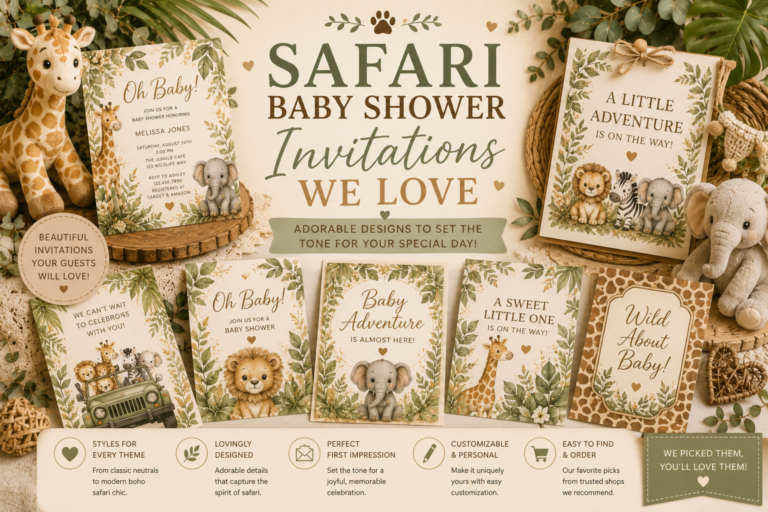
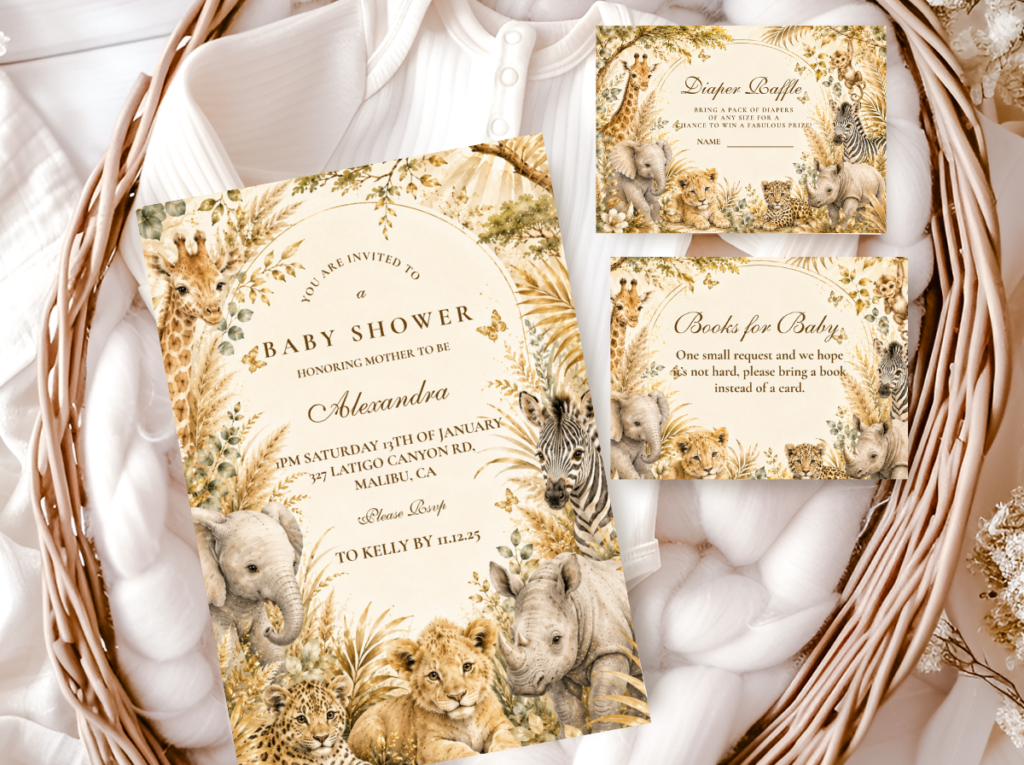
Every printed element in the safari room — the welcome sign at the entrance, the place cards at each guest setting, the menu cards during the meal, the favour tags guests take home — is a stationery decision. Each piece exists at a different distance from the guest and is examined with a different level of attention: the welcome sign is seen from five metres and remembered as a scene; the place card is held in the hand and read at ten centimetres. When every piece across all five zones shares the same watercolour illustration style and the same warm safari palette as the invitation the guest received weeks before arriving, the room reads as a complete designed world from the first moment to the last. When stationery pieces are sourced from different designers, the inconsistency in illustration quality and palette temperature is visible at every scale from the room to the hand.
The stationery pieces that most reward investment in illustration quality and palette consistency: the welcome sign (Zone 1 — the largest piece and the first one seen); the place card (Zone 3 — the most personally addressed and most closely examined); and the favour tag (Zone 4 and 5 — the piece guests take home and look at again later, when the rest of the celebration has passed). These three pieces, sourced from the same collection as the invitation, constitute the minimum stationery suite that produces a fully cohesive safari decoration scheme across all five zones.
For the most completely designed room, add the menu card (the longest-held piece, examined throughout the meal period), the table number or table name sign (visible across the room from Zone 2, which means it should read as part of the same designed world as the backdrop), and the cupcake topper (the stationery element at the closest range of any piece in the room — held at arm’s length beside the face in every cupcake photograph). Browse all six collections below.
All Safari
Safari Theme Collection
The complete umbrella collection — every safari style, every stationery piece, every zone.
Jungle Direction
Jungle Safari Boy
Deep olive and warm gold — most aligned with jungle canopy backdrop and dense botanical table styling.
Elegant
Elegant Safari
The most refined direction — entrance signage, welcome prints, and table stationery at the highest illustration quality.
Sage Green Girl
Sage Green Safari Girl
Sage and warm ivory — most aligned with botanical panel backdrop and sage linen table direction.
Neutral
Neutral Safari
Warm cream and antique gold — the most versatile direction, cohesive across all five zones.
Boho Girl
Boho Safari Girl
Warm earthy botanical — most aligned with pampas and dried botanical accent decoration in Zone 5.
Frequently Asked Questions
How many decorations do I actually need for a safari baby shower?
Far fewer than most decoration lists suggest, when they are allocated correctly. The five-zone framework in this guide requires: Zone 1 — one welcome sign and one balloon cluster (two elements); Zone 2 — one backdrop installation (one element); Zone 3 — one centrepiece per table and coordinated linen (two elements per table); Zone 4 — one small backdrop and one table runner (two elements); Zone 5 — one botanical accent per transitional corner (one element per corner). For a shower with four guest tables, two transitional corners, one entrance, one main backdrop, and one dessert table, this totals approximately twelve to fifteen individual decoration investments — at which point, every investment is visible, attended to, and memorable. The most common error is buying twenty-five individual decoration items and distributing them across the room until the room looks full rather than designed.
What should I prioritise when decorating a safari shower on a tight budget?
In strict priority order: Zone 2 backdrop first (30% of budget), Zone 3 table centrepiece and linen second (25%), Zone 1 welcome sign third (15%), Zone 4 dessert table fourth (12%), Zone 5 accent elements last (8%) — with stationery (place cards, menu cards, favour tags) taking the remaining 10% and distributed across zones as needed. If the total budget requires cuts, reduce Zone 5 to near-zero (pampas stem in a rattan vase costs almost nothing), reduce Zone 4 to a table runner only with no backdrop, and maintain the full investment in Zones 1, 2, and 3. Guests spend the entire celebration within sight of Zone 2 and Zone 3; they pass through Zone 5 for seconds.
How far in advance should I set up safari baby shower decorations?
The practical timeline: backdrop and Zone 2 installations should be set up the day before the shower if the venue permits, or the morning of the shower (minimum three hours before guests arrive). Fresh botanical centrepieces require same-day assembly — fresh flowers assembled more than eighteen hours in advance will have visibly deteriorated by the shower, particularly in warm indoor environments. Dried botanical centrepieces, linen, place settings, and Zone 5 accent elements can be set up the day before. Stationery elements (place cards, menu cards, welcome signs) should be placed last — after all other table elements are set, so the printed elements can be positioned in relation to the centrepiece and linen rather than the other way around. Budget two to three hours for Zone 1 and Zone 2 installations; one hour per guest table for Zone 3.
What is the easiest safari decoration to DIY that still looks elevated?
The warm honey jar cluster (Zone 3 and Zone 5): small glass honey jars of varying heights, grouped in clusters of three to five, each with a small personalised safari label in the shower’s palette direction (available from the stationery collections below). The honey jars provide warm amber tone, natural material quality, and height variation in a single inexpensive cluster — and when personalised safari labels are applied, they become stationery elements as well as decoration elements. The cluster format (multiple small jars grouped together) reads as more visually complex and more specifically designed than any individual element in isolation, which is the quality that makes it read as elevated rather than simple. At Zone 3 (on the table), three to five jars grouped beside the centrepiece as the low element of the three-height formula; at Zone 5 (in corners), one to three jars on a secondary surface with a small dried botanical element beside them.
Complete Your Safari Room
Safari Baby Shower Stationery — Every Zone, Every Piece
Welcome signs, place cards, favour tags, and more — all coordinated, fully customisable, and matched to every safari palette direction.