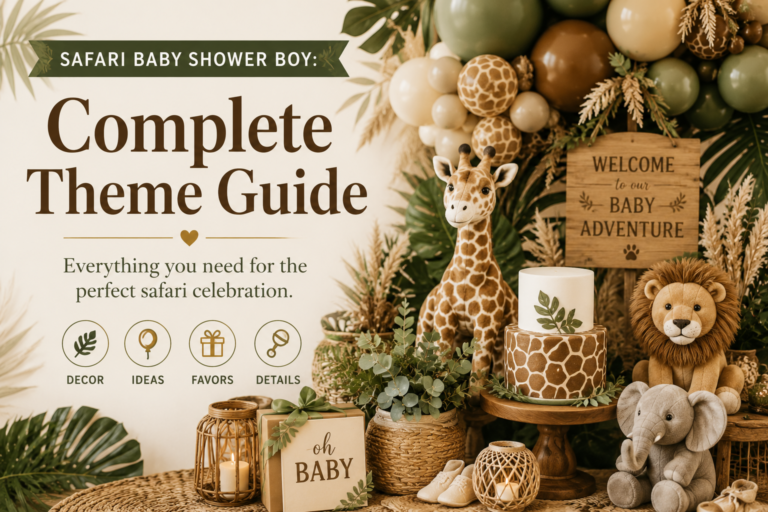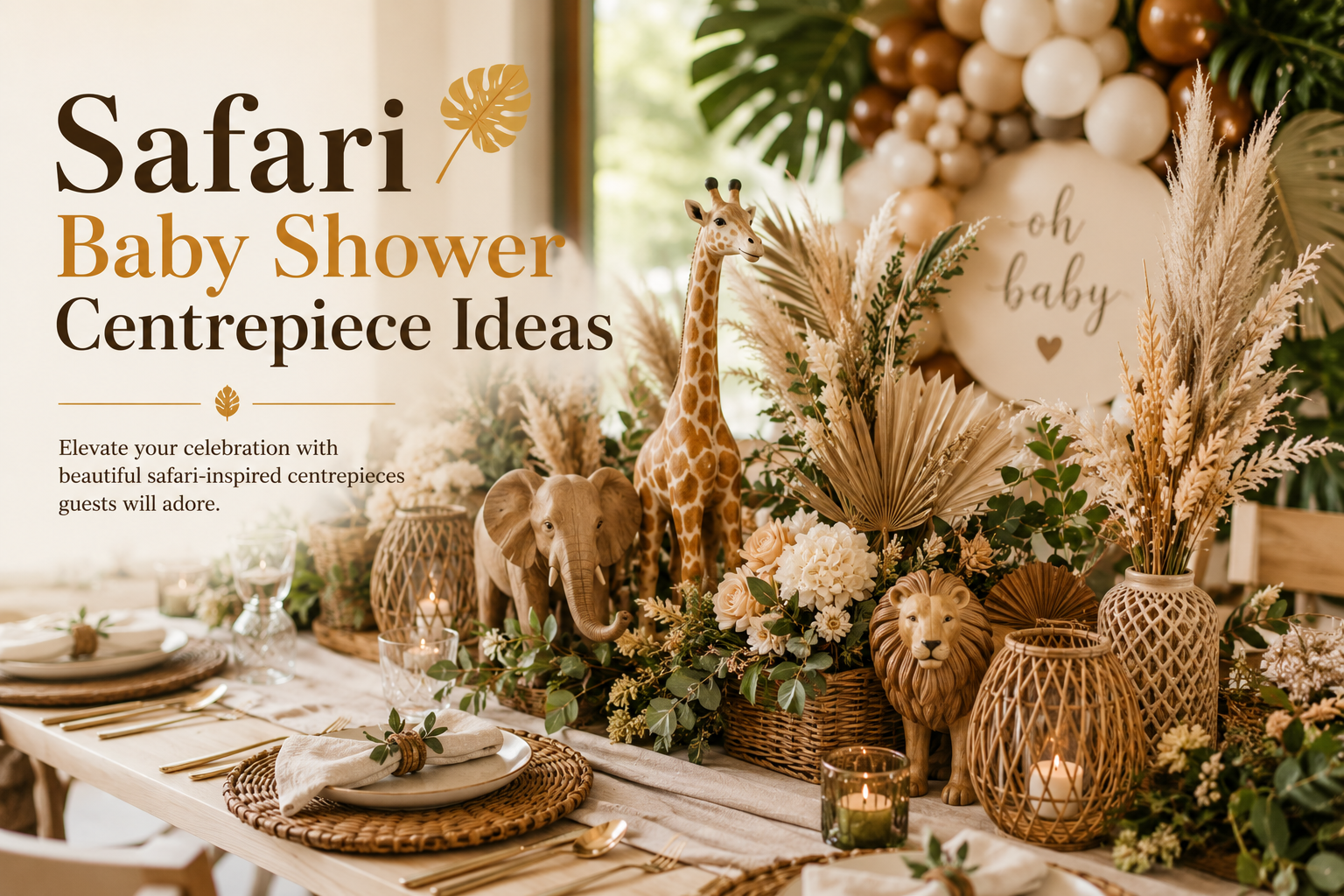
Safari Baby Shower Centrepiece Ideas
Baby Shower · Centrepiece Guide
Safari Baby Shower Centrepiece Ideas
The three-question planning framework, five centrepiece directions for every safari palette, table styling guidance, and the stationery that ties the whole table together.
The centrepiece is the detail guests examine most closely — the element at arm’s reach throughout the longest continuous part of the celebration, where every material choice and every botanical selection is seen at a proximity that photographs and decorations across the room do not provide. It should reward that attention with the same care and intention as the invitation that brought them to the table. This guide provides a concrete planning framework for selecting the right centrepiece before buying anything, five specific centrepiece directions across every safari palette, and the table styling guidance that ties every element into a complete designed surface.
⚠ This post contains affiliate links. If you click and purchase through these links, I may earn a small commission at no extra cost to you. I only recommend products I genuinely believe will add value for my readers. Thank you for supporting Baby Wonderland Studio.
Browse the complete safari stationery collection
Place cards, menu cards, table stationery — all coordinated and fully customisable.
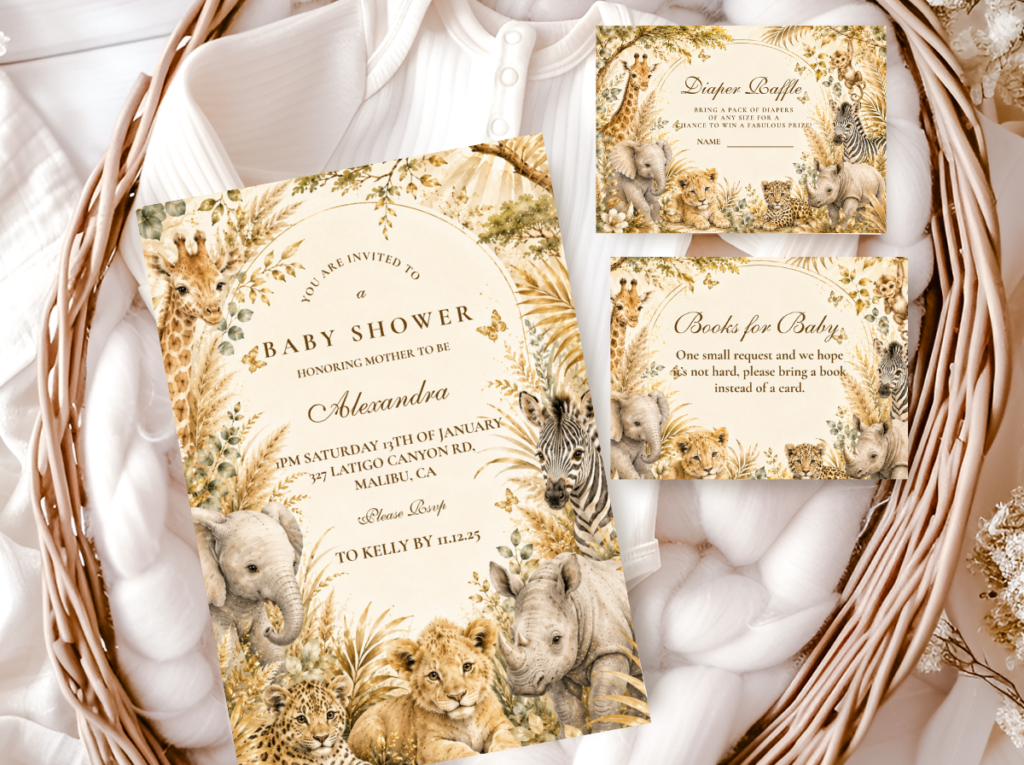
“The centrepiece is the detail guests examine most closely. It should reward that attention with the same care and intention as the invitation that brought them there.”
Section 01 The Safari Centrepiece Decision Framework
Three questions to answer before choosing any centrepiece. The most common planning mistake is choosing a centrepiece based on how it looks in a Pinterest photograph and discovering at the venue that it is the wrong size, the wrong height, or the wrong scale for the actual table. These three questions prevent that mistake.
Question 1
What is your table shape and size?
Round tables with a diameter of 60 inches (the most common banquet round) suit one central focal point centrepiece: a single arrangement at 30–40cm diameter, positioned at the exact centre of the table so that every seated guest has the same view. Long banquet tables (any table longer than 180cm) suit a repeating rhythm of smaller identical arrangements at 60–90cm intervals along the table length — or one continuous low runner of botanical material (pampas, dried grasses, scattered botanicals) that runs the full length of the table with taller elements placed at intervals within it. The mistake: placing a single large centrepiece at the centre of a long banquet table. It creates one beautiful moment for the guests seated within two metres of it and an empty void for everyone else.
Most common mistake: Choosing a centrepiece from a photograph taken on a round table when the actual venue has long rectangular tables. Measure your table, note its shape, and use those specific dimensions before looking at any centrepiece photographs.
Question 2
What is your ceiling height?
The one-third rule: the centrepiece height should not exceed one third of the distance between the table surface and the ceiling. A standard commercial venue ceiling at 270cm leaves 180cm above the table surface — which allows a centrepiece of up to 60cm height. An acacia branch installation at 90cm height in a 270cm ceiling room reads as oppressive and visually blocks the sightlines of guests seated across the table from each other. In a venue with a 400cm ceiling (a converted barn, a tall country house room), the same 90cm acacia branch installation reads as appropriately dramatic. Low lush arrangements (20–35cm) suit standard 240–270cm ceiling heights without any calculation required — they are always proportionally appropriate.
Most common mistake: Bringing a tall acacia branch or tall grass bundle installation to a venue with a standard 240cm ceiling without checking the proportions in advance. The result blocks conversation and photographs as too dense and too vertical for the space.
Question 3
What is your palette direction?
The centrepiece must live inside the palette rather than beside it. A jungle or boy safari palette (deep olive, warm brown, cream) suits centrepieces that are dark, dense, and botanical — deep olive greenery as the primary botanical element with warm brown as the vessel and anchor tone. A girl or botanical safari palette (blush, sage, honey) suits softer centrepieces where the botanical material is in the warm rose or sage family and the overall impression is of warmth and abundance rather than drama and density. A neutral safari palette (cream, oatmeal, honey amber) suits warm cream and honey-toned arrangements where no single botanical element reads as dramatically darker or cooler than the palette base. The mistake: choosing a centrepiece based on its general aesthetic quality and discovering that its specific botanical tones are cooler or darker than the table’s palette, creating a centrepiece that reads as belonging to a different colour world from every other element on the table.
Most common mistake: Choosing a centrepiece with beautiful deep green foliage for a warm cream and blush table. The deep green reads as too cool and too dark against the warm palette, creating a centrepiece that competes with rather than completes the table.
🌿 Tall glass cylinder vase: The most versatile safari centerpiece vessel — clear glass disappears behind whatever botanical arrangement is placed inside it, letting the stems and flowers do the visual work. Fill with water and fresh eucalyptus for the watercolor direction, or use dry with pampas and safari grass for the neutral and boho directions.
✨ Styling Tip
The most reliable safari centrepiece formula works at any size and any palette direction: one tall element (acacia branch, tall grass bundle, lantern at 35cm or above), one mid element (floral arrangement, animal prop cluster, honey jar group at 20–30cm), and one low element (scattered botanicals at table surface, small votives, or place card holders). Three heights, one palette, one vessel or grouping area. This three-height formula reads as designed in any photograph because the eye has three points at which to enter and explore the arrangement, rather than a single undifferentiated mass.
Section 02 Five Safari Centrepiece Directions
Five specific centrepiece directions, each built for a specific palette and a specific table scale. Browse all five before deciding — the right direction is the one whose palette, botanical material, and height profile match both the shower’s aesthetic and the venue’s table shape and ceiling.
2.1 The Jungle Safari Centrepiece
The Jungle Safari Centrepiece is the most dramatically botanical and the most specifically adventure-forward of the five directions — it achieves its beauty through density and layering rather than through airiness and restraint, and the result reads as a piece of the savanna floor transported intact to the table surface. The botanical vocabulary: deep olive or dark forest green as the primary greenery (in the form of large tropical leaves — philodendron or large-form tropical foliage — rather than small-form garden greenery); warm brown botanical elements as the secondary layer (dried seed pods, dried grass stems, warm-toned botanical filler); and one safari animal detail integrated into the lower third of the arrangement — a ceramic or carved wooden giraffe or elephant half-concealed by botanical material at the base of the arrangement.
The vessel for the Jungle Safari Centrepiece: a wide, low ceramic pot in dark olive or warm brown glaze; a wicker basket with a visible weave texture in natural honey or warm brown; or a section of a hollow log or a split bamboo form for the most specifically natural reading. The arrangement is assembled in the vessel rather than in a florist’s foam form — the arrangement should look like it arrived in the vessel already growing, rather than like it was constructed in a florist’s studio and transferred.
Table shape and size for the Jungle Safari Centrepiece: most naturally suited to long banquet tables as a repeating element — three to five identical dense jungle arrangements at 60cm intervals read as a continuous botanical world running the length of the table. On round tables, one single Jungle Safari centrepiece of 35–45cm diameter works at 60-inch round tables; larger than this at the same table size begins to crowd the place settings.
🌴 Artificial tropical palm and monstera leaves: The hero botanical element for the jungle safari centerpiece direction — large tropical leaves create the dense, dramatic canopy effect that makes a jungle arrangement look lush rather than sparse. Mix with real eucalyptus stems for the most convincing result; the artificial leaves provide structure while the real stems add organic movement.
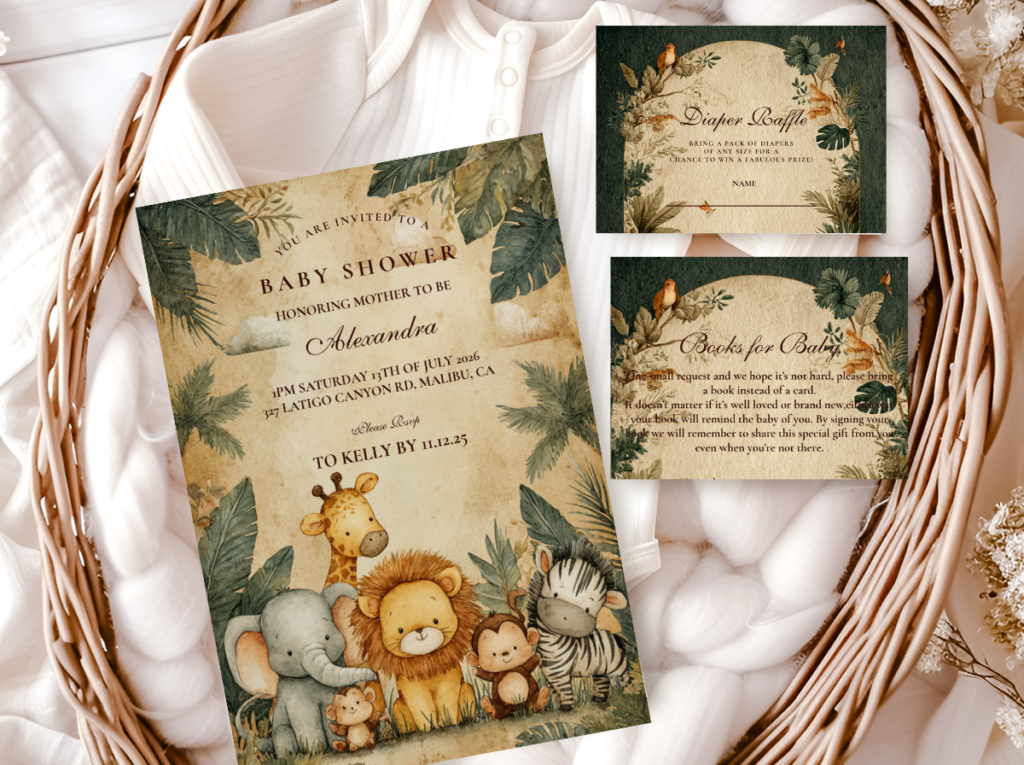
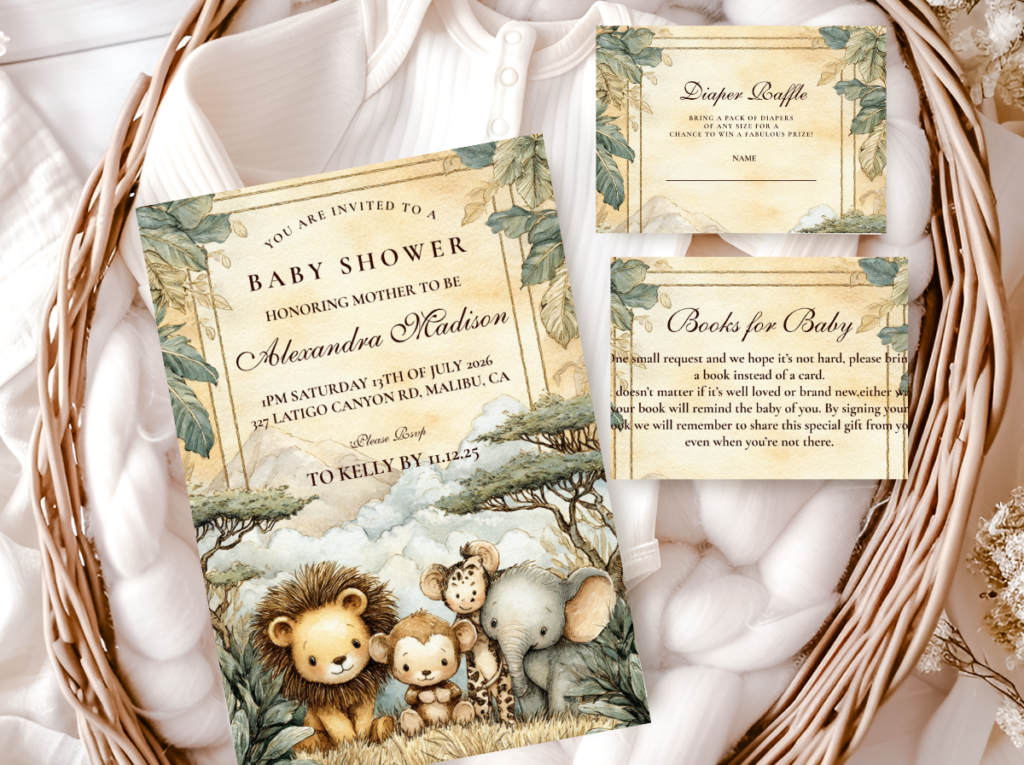
The Jungle Safari Boy Baby Shower collection carries deep olive and warm gold into every table stationery piece — place cards, menu cards, and table stationery that belongs to the same dense botanical world as the centrepiece.
✨ Styling Tip
A jungle safari centrepiece should feel like a piece of the savanna floor transported to the table — dense, layered, and slightly wild. The mistake most hosts make is arranging it too neatly: stems evenly spaced, leaves all facing the same direction, the arrangement shaped into a symmetrical dome. Let some stems extend beyond the arrangement boundary. Let leaves overlap naturally and face different directions. Let one or two stems reach significantly higher than the main arrangement mass. The arrangement should look as though it grew in the vessel over time rather than as though it was placed there two hours before the guests arrived.
2.2 The Watercolour Botanical Centrepiece
The Watercolour Botanical Centrepiece is the most romantically beautiful and the most photographically rewarding of the five directions — it uses the loose, abundant, slightly wild quality of a garden-gathered bouquet (rather than a formally structured arrangement) as its primary visual language, and the result reads in photographs as genuinely lovely in the way of things that are beautiful without trying to be. The botanical vocabulary: garden roses at their most fully open form in warm cream, dusty blush, or warm honey tones; eucalyptus in the round-leaf cinerea variety as the primary foliage (its dusty sage and warm green tones read as directly complementary to the warm cream and honey safari palette); wildflowers in small warm tones — dried chamomile heads, dried limonium, small dried strawflowers in honey and warm amber — as the scatter botanical element filling the spaces between the larger forms.
The vessel for the Watercolour Botanical Centrepiece: a simple ceramic bud vase in warm cream or warm ivory (not white, not grey); a glass cylinder vase with the warmth of the interior botanical material readable through the glass; or a small terracotta pot whose warm russet tone works as the third warm colour in the arrangement alongside the cream flowers and the sage foliage. The arrangement should be assembled loosely — not tightly packed, not architecturally structured, but with space between the individual stems so that each flower form is visible and each botanical element has air around it.
Table shape and size for the Watercolour Botanical Centrepiece: most naturally suited to round tables as a single central arrangement — the loose, three-dimensional quality of the botanical arrangement reads as most complete when viewed from multiple angles simultaneously (which is the viewing condition of a round table) rather than from a single direction (which is the viewing condition of the long table, where each guest sees primarily the front face of the arrangement). At long tables, a row of smaller single-variety bud vase clusters is more effective than multiple full watercolour arrangements.
🌾 Dried pampas grass stems: The hero element for neutral and watercolor safari centerpieces — pampas grass adds the tall architectural height that anchors every arrangement and signals organic warmth before any other element is placed. Position it as the tallest element by at least 30%; everything else relates to it in height and proportion.
The Watercolour Safari Baby Shower collection carries warm watercolour illustration into every table stationery piece — the most naturally beautiful companion to the Watercolour Botanical Centrepiece.
2.3 The Elegant Neutral Centrepiece
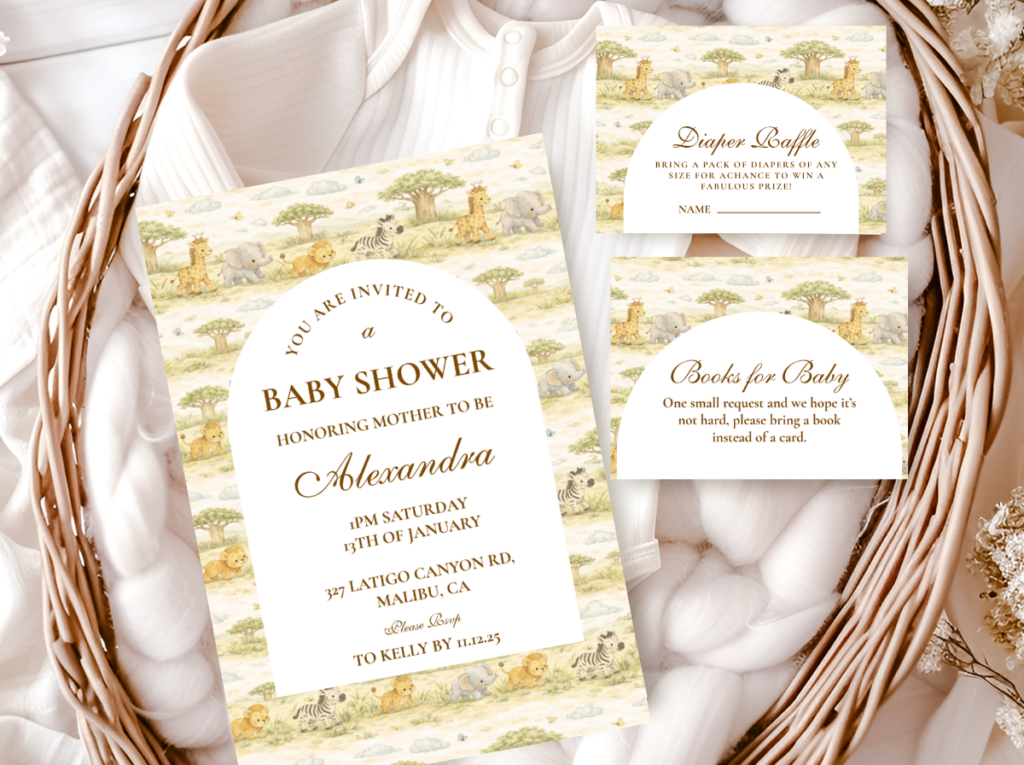
The Elegant Neutral Centrepiece is the most versatile and the most immediately achievable of the five directions — it is built from four to six elements that are individually straightforward to source and that together produce a centrepiece with significantly more visual complexity and warmth than any individual element would suggest. The four-element formula: a cluster of warm honey jars (three to five small glass honey jars of varying heights grouped together as the primary horizontal element at mid level, ideally with a small personalised safari label in the shower’s palette direction); a bundle of dried safari grasses tied with twine as the tall element (dried pampas at 35–45cm, dried miscanthus, or dried bunny tail grass at a shorter height for standard ceilings); one small ceramic or carved wooden safari animal figure at the base; and three to five small tea light votives scattered at table level around the arrangement cluster. The honey jars provide the warm amber tone that most directly connects the centrepiece to the savanna palette; the dried grass provides the height and the specifically savanna botanical reference; the animal provides the safari theme connection at the closest examination range; and the votives provide the ambient light that makes the honey amber tone glow in the evening.
The Elegant Neutral Centrepiece works on any table shape and any size: on round tables, the cluster is assembled as a single central grouping; on long tables, identical clusters are repeated at 75–90cm intervals, with the honey jar quantities and votive quantities adjusted to fill the longer space. It is the centrepiece direction most appropriate for hosts who want a genuinely beautiful result without florist involvement or complex assembly.
🍯 Small honey jars for centerpiece clusters: Three honey jars at varying heights — one tall, one mid, one low — create the elegant neutral safari centerpiece at minimal cost. Add a sprig of eucalyptus or a kraft label to each and they function simultaneously as centerpiece detail, decor element, and take-home favor for nearby guests.
The Elegant Safari Baby Shower collection carries warm watercolour-quality illustration into the table stationery layer — place cards and menu cards that match the honey and cream warmth of the Elegant Neutral Centrepiece.
2.4 The Boho Safari Centrepiece
The Boho Safari Centrepiece is the most texture-forward and the most earthy of the five directions — it achieves its beauty through the specific quality of dried botanical material (the warm, slightly dusty, organic quality of dried pampas, dried protea, and dried grasses that belongs so directly to the warm, dry quality of the savanna landscape that the connection between the centrepiece and the aesthetic seems natural rather than designed). The primary botanical material: large dried pampas plumes in cream and honey as the tall element; dried protea flower heads in their dried form (the brown, papery quality of dried protea is one of the most specifically beautiful dried botanical elements available and belongs directly to the South African savanna world) as the mid element; dried golden millet or dried oat grass stems as the low scatter element; and terracotta pots or warm clay vessels as the primary container form.
The Boho Safari Centrepiece is most naturally suited to long tables as a continuous runner element — a long arrangement of botanical material running the full length of the table, with pampas plumes rising at intervals from a continuous low layer of dried grasses and scattered dried botanicals. This runner format is the most specifically beautiful boho safari table direction because it creates the impression of a continuous natural landscape running through the centre of the table rather than a series of individual decoration points. For round tables, a medium-sized rattan basket or terracotta vessel holding a mixed dried arrangement at 25–35cm height reads as complete and beautiful.
🌸 Dried protea flowers for boho safari centerpieces: The most distinctively boho botanical element available — dried protea in terracotta and dusty rose tones adds the earthy texture that separates a genuine boho safari arrangement from a standard neutral one. Pair with pampas grass and dried eucalyptus in a rattan vessel for the complete boho safari centerpiece.
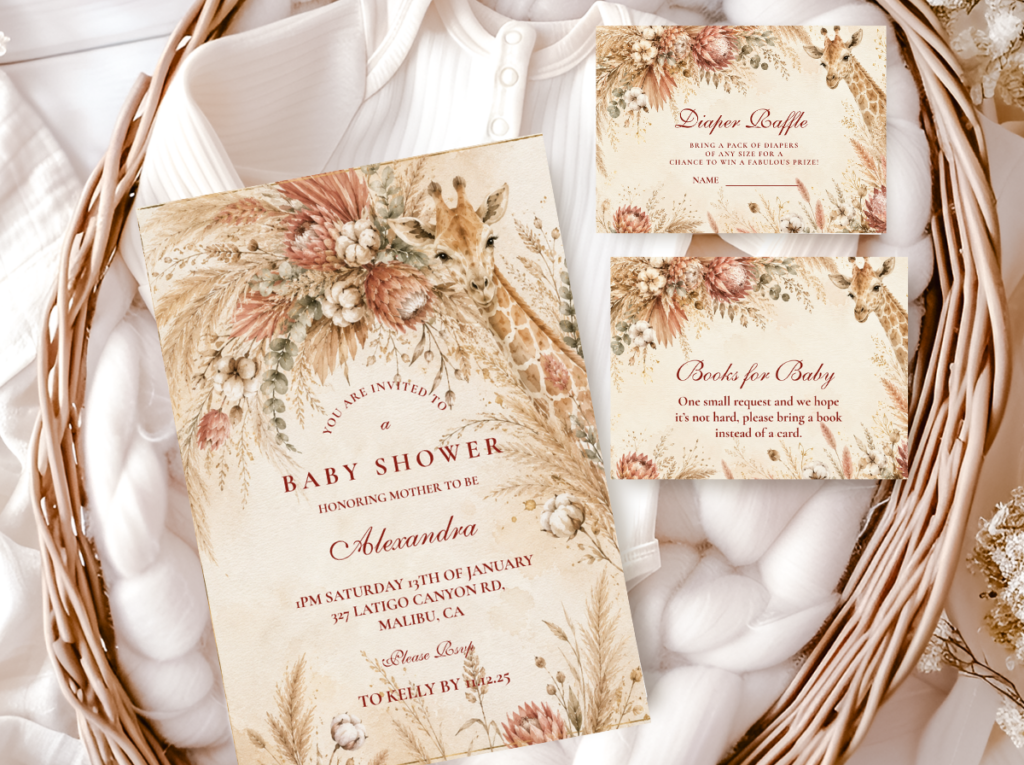
The Boho Safari Girl Baby Shower collection carries warm earthy botanical illustration into every table stationery piece — the most naturally cohesive companion to the textural warmth of the Boho Safari Centrepiece.
2.5 The Neutral Minimal Centrepiece
The Neutral Minimal Centrepiece is the most restrained and the most specifically elegant of the five directions — it achieves its beauty through the deliberate decision to use very little, very well, rather than assembling a complex arrangement. The format: a cluster of three to five bud vases of varying heights (7cm to 22cm), all in warm cream or warm ivory ceramic or clear glass, each holding one single stem. The stem selection: one variety of flower across all the vases (white cosmos, single open garden roses in cream, white anemones with their dark centres — any single-variety selection in warm white or cream that produces a visually consistent cluster where the variety and the individuality of each stem are both visible). The cluster is the centrepiece — nothing else is needed, and nothing else should be added.
The Neutral Minimal Centrepiece is most appropriate for intimate tables of four to six guests where a more elaborate centrepiece would overpower the conversation distance — at a four-person table, a 40cm tall elaborate centrepiece creates a visual wall between the two pairs of guests seated across from each other. A 15cm bud vase cluster creates a shared visual element that is beautiful at close range without obstructing the conversation or the sightlines. It is also the most appropriate direction for outdoor celebrations in genuinely beautiful settings (a garden, a terrace with a view) where the surrounding natural world is more beautiful than any centrepiece element and the centrepiece’s role is to complement rather than compete.
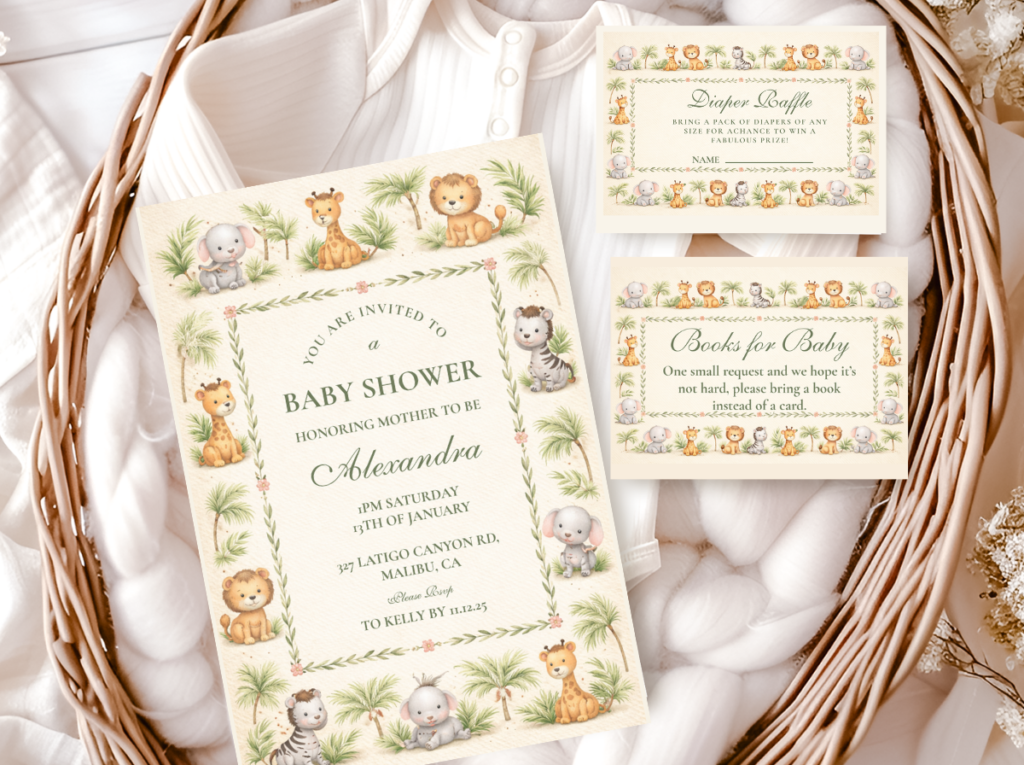
The Neutral Safari Baby Shower collection carries warm cream and antique gold into every table stationery piece — the most cohesive companion to the restrained warmth of the Neutral Minimal Centrepiece.
Section 03 Table Styling Beyond the Centrepiece
Linen and Runner Directions per Safari Palette
The linen choice is the decision that most determines the table’s overall tone before the centrepiece is placed — it is the largest continuous colour surface on the table and everything else reads against it. The specific pairings that work: oatmeal or natural linen tablecloth with the Jungle Safari centrepiece direction (the warm neutral tone of oatmeal reads against the deep olive botanical material in a way that makes both more visible — the contrast between the light tablecloth and the dark botanical material is the specific quality that makes jungle safari tables look so photographically dramatic); sage linen runner over ivory tablecloth with the Watercolour Botanical centrepiece direction (the sage tone echoes the eucalyptus foliage in the arrangement and extends the botanical palette to the table surface); kraft paper runner over warm ivory tablecloth with the Boho Safari centrepiece direction (the raw kraft quality and the dried botanical material share the same specific earthy and natural register); and warm ivory tablecloth alone with the Neutral Minimal centrepiece direction (no runner, no pattern — the clean warm ivory surface gives the bud vase cluster the same breathing room that white space gives text on a page).
Place Setting Details for Safari
Three specific details make a safari place setting look intentional rather than assembled: the charger plate, the napkin treatment, and the place card position. For the charger: a natural wood or natural rattan charger under a cream or warm ivory plate reads as specifically safari (the natural material reference is direct and the warm tonal combination of wood and cream is beautiful); a warm gold or antique brass charger reads as premium and specifically warm (most appropriate for the Elegant and Gold Safari directions); a simple cream ceramic plate without a charger reads as most appropriate for the Minimal Neutral direction. For the napkin: a simple fold held with twine and a small safari tag reads as the most cohesive detail across any direction — the tag in the invitation’s illustration style brings the stationery world of the shower into physical contact with the guest at the table. For the place card: positioned at the base of the centrepiece arrangement (where the guest will find it without searching) or leaning against the base of the water glass (where it is visible immediately on sitting down).
🌍 Natural jute table runner: When a single centerpiece is not enough for a long banquet table, a continuous jute runner with botanical clusters placed at intervals creates a cohesive safari table that reads as designed from one end to the other. The texture of the jute does the work that a single arrangement cannot — it connects every element placed on top of it into one unified display.
The Animal Prop Question
Safari animal props — ceramic, carved wood, or resin giraffe, elephant, or lion figurines — are most effective when used at the rate of one per table and when integrated into the centrepiece arrangement rather than displayed independently on the table surface. One elephant figurine half-concealed at the base of a rattan centrepiece vessel, visible between the botanical stems, reads as a discovered detail — the specific quality of something found rather than something placed. The same elephant figurine sitting alone on the tablecloth beside the water glasses reads as a toy that was left on the table. Context is everything: the animal prop transforms from a detail into a design decision when the botanical material of the centrepiece gives it a natural setting.
✨ Styling Tip
Safari animal props belong at the base of the centrepiece, half-hidden by botanical elements — not displayed openly on the table surface. An elephant figurine emerging from a cluster of safari grass looks as though it was discovered there. The same figurine sitting alone on a white tablecloth looks like a toy was left on the table. The rule: if you can see the entire animal from any angle without the botanical material partially concealing it, it is displayed rather than integrated. Partially conceal it so that one side is always visible and one side is always within the arrangement. That is the difference between a prop and a design decision.
Section 04 Invitations & Stationery
Every printed element on the safari table — the place card held at the start of the meal, the menu card read during the food courses, the table number or table name sign visible from across the room — is a stationery decision. Each of these pieces exists at a closer proximity to the guest than any other decoration in the room: the place card is in the hand; the menu card is held and read at arm’s length; the table stationery is within the same visual range as the centrepiece itself. When these pieces share the same illustration style and palette as the invitation the guest received three weeks before arriving, the table reads as a complete designed world. When they do not — when the invitation is watercolour and warm but the place cards are generic card from a stationery shop in a cooler tone — the guest notices the inconsistency at the most intimate range of the celebration.
The specific table stationery pieces that most reward investment in quality: the place card (the most personally addressed piece of the entire celebration — the guest’s own name in the illustration style of the safari aesthetic, positioned at a setting made specifically for them); the menu card (held and read for the longest continuous period of any printed piece at a seated celebration — it is examined with more attention than the invitation because the guest has more time to look at it); and the table name or table number card (visible from a distance as a way-finding element, which means it should read as part of the same design world as the centrepiece rather than as a generic label attached to a table).
The most cohesive approach: source all table stationery from the same collection as the invitation. When the same watercolour giraffe illustration — in the same warm brown on the same warm ivory stock — appears on the invitation, the welcome sign, the place card, and the menu card, the guest experiences a complete visual narrative across the entire celebration rather than a series of related but individually sourced elements. Browse all six collections below.
All Safari
Safari Theme Collection
The complete umbrella collection — every safari style, every stationery piece.
Jungle Direction
Jungle Safari Boy
Deep olive and warm gold — most aligned with the Jungle Safari Centrepiece direction.
Watercolour
Watercolour Safari
Soft organic watercolour illustration — most aligned with the Watercolour Botanical Centrepiece.
Elegant
Elegant Safari
The most refined stationery direction — most aligned with the Elegant Neutral Centrepiece.
Boho Direction
Boho Safari Girl
Warm earthy botanical — most aligned with the Boho Safari Centrepiece and runner direction.
Neutral
Neutral Safari
Warm cream and antique gold — most aligned with the Neutral Minimal Centrepiece direction.
Frequently Asked Questions
How tall should a safari baby shower centrepiece be?
The one-third rule: centrepiece height should not exceed one third of the distance between the table surface and the ceiling. In a standard venue with a 270cm ceiling, the table surface is typically at 75cm, leaving 195cm to the ceiling — which means the maximum appropriate centrepiece height is approximately 65cm. In practice, 30–45cm is the most reliable height range for standard venues: tall enough to be a visual focal point, short enough to allow conversation across the table without visual obstruction. The exception is a venue with high ceilings (350cm or above), where a taller element — an acacia branch installation at 70–80cm, or a tall dried grass bundle at 60cm — reads as proportionally appropriate and adds the dramatic height that high-ceiling spaces require to feel filled rather than empty. Always measure the ceiling height of the specific venue before deciding on centrepiece height.
Fresh botanicals vs. faux botanicals for safari centrepieces: which is better?
Fresh botanicals produce the most beautiful result in photographs because the natural variation of colour, texture, and form in fresh plant material reads as genuinely organic rather than produced. However, fresh botanical centrepieces for a baby shower require either same-day assembly or access to a cool storage space to keep them fresh from assembly to the event. Faux botanicals (high-quality dried or artificial botanical elements) are appropriate for any centrepiece direction where the primary botanical element is already dry in its natural state — dried pampas, dried protea, and dried grasses are genuinely dry and therefore do not have a fresh equivalent; the faux version of these materials is a product whose quality can be assessed at purchase rather than at the last minute. For the Watercolour Botanical Centrepiece, which depends heavily on the specific quality of open garden roses, fresh is strongly preferable. For the Boho Safari and Jungle Safari directions, high-quality dried botanicals produce results that are indistinguishable from fresh-equivalent options — and have the advantage of being assessable weeks in advance.
How many centrepieces do I need for a long table?
One centrepiece arrangement per 75–90cm of table length is the most reliable spacing rule for a visually consistent long table. A 240cm table (8-person rectangular) needs three centrepiece arrangements. A 360cm table (12-person rectangular) needs four to five. The arrangement spacing should be equal, with the first arrangement at 45cm from each end and the remaining arrangements at equal intervals between. Alternatively: one continuous botanical runner at table level (dried grasses, scattered botanicals, small votives) running the full table length, with taller focal elements (a pampas plume, a lantern, a honey jar cluster) placed at the intervals where individual arrangements would otherwise stand. The runner approach requires more raw botanical material than individual arrangements but produces a more dramatically cohesive result at long tables.
What are the most budget-friendly safari centrepiece options that still look elevated?
Three specific budget-friendly options that consistently read as elevated rather than inexpensive: the Elegant Neutral honey jar cluster (small glass honey jars sourced from a bulk food supplier at very low cost per unit, grouped with a tied bundle of dried grasses from a craft supply store and three small tea light votives — total material cost under the price of one florist-assembled arrangement, visual result comparable to arrangements at four times the budget); the single-stem bud vase cluster (three to five inexpensive ceramic bud vases in warm cream from a home store, each holding one stem of a single affordable variety — white cosmos, white chamomile, or white anemone — bought in bunches at low cost and divided across the vases); and the dried pampas bundle in a terracotta pot (one large dried pampas plume, which is extremely durable and can be sourced at low cost, in a plain terracotta pot with three tea light votives at the base — the specific warmth and texture of the combination reads as specifically designed at any budget). The key to budget centrepieces that read as elevated: invest in one quality botanical material and one quality vessel, and let the palette coherence with the rest of the table do the rest of the work.
Complete Your Safari Table
Safari Baby Shower Table Stationery — All Directions
Place cards, menu cards, and table stationery — all coordinated, fully customisable, and matched to every safari palette direction.