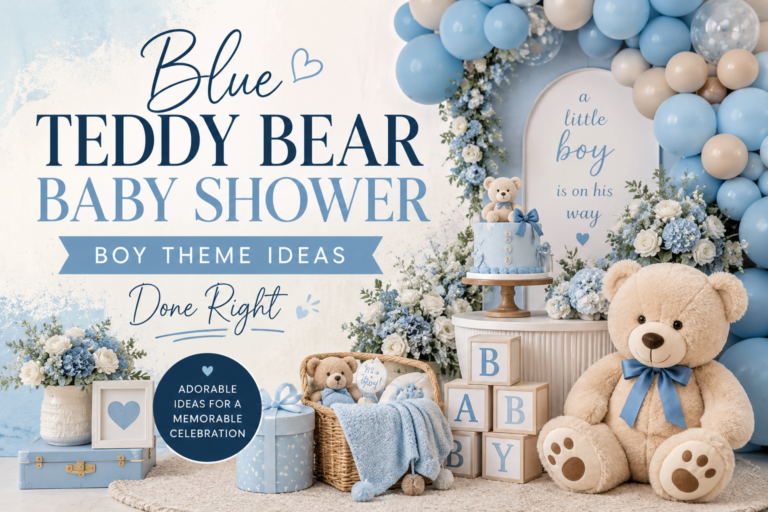
Teddy Bear Baby Shower Cookies: Five Styling Directions Done Right
Bear Baby Shower Cookie Guide
Teddy Bear Baby Shower Cookies: Five Styling Directions Done Right
What to brief your baker on, which finish reads best, and five cookie styling directions that belong on a bear shower dessert table.
Decorated cookies are the most versatile element on a bear shower dessert table. They work as display pieces at the tall and mid zones, as individually packaged favors for guests to take home, and as the detail that pulls the whole palette together in a single handheld object that every guest examines closely. A cookie is the smallest complete design decision at the shower — and when it is wrong, it is wrong in a way that every guest notices, even if they cannot say why.
This guide covers the three briefing mistakes that produce cookies that look wrong on the table, the five styling directions that work across the bear theme’s palette range, how to display and package cookies as favors, and the stationery connection that ties the cookie motif into the designed world of the room.
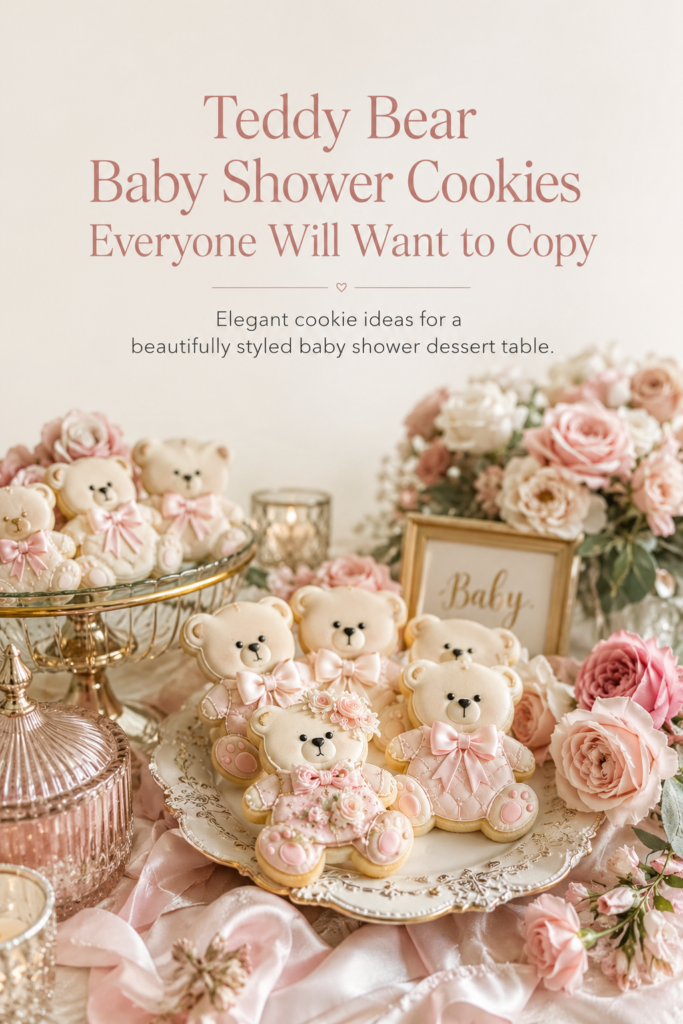
“A decorated cookie is the smallest complete design object at the shower — every detail is visible, every color choice is examined, every decision either holds or breaks the palette.”
Section 01 The Cookie Brief — What Most People Get Wrong
Most bear shower cookies that look wrong on the table do so for three specific reasons that have nothing to do with the baker’s skill. They are briefing failures — decisions made before a single cookie was baked. Here they are named clearly, with the exact fix and the exact language to use with the baker.
Mistake 01: Ordering in the Theme But Not the Palette
Bear-shaped cookies in bright white royal icing on a cream and honey dessert table create an immediate color disconnect — the cookies are bear-shaped, so they reference the theme correctly, but their color sits outside the palette entirely. Bright white icing reads as sharp and cool against the warm, muted tones of a bear shower table. It looks as though the cookies arrived from a different event. And yet this is the default output when a baker is briefed only on the shape (“teddy bear cookies”) without a specific color reference. Every baker’s instinct for “teddy bear cookie” is a brown bear outline on white royal icing, which is fine in isolation and wrong on a warm cream table.
The fix: specify the base icing color before the shape. The shape is secondary; the color is primary. “Warm ivory or oatmeal base, not white — the color of warm cream, not bright white” is the instruction that prevents the default output. Then specify the detail colors: “bear face detail in warm honey-brown, not dark chocolate brown.” The distinction between warm honey-brown and cool dark brown is the difference between a cookie that belongs on the table and one that reads as a generic birthday cookie that happened to be bear-shaped.
Mistake 02: Too Many Designs in One Order
Five different cookie designs on a dessert table create visual noise — the eye moves between bear faces, honey pots, baby onesies, stars, and hearts without being able to settle on any one element as the design statement. The variety signals enthusiasm but reads as incoherence. Each individual design may be beautifully executed; together, they compete rather than complement. This is one of the most common briefing failures in baby shower cookie ordering because the instinct is to cover the theme comprehensively (all the bear-related shapes) rather than to maintain the palette identity (two or three shapes in the same color story).
The fix: limit to two or three cookie designs per order, and choose designs that share the same color story rather than the same theme category. A bear face cookie and a simple round cookie with a honey pot detail, both in warm cream and honey tones, produce a more cohesive display than five different bear-adjacent shapes in multiple colors. The cohesion comes from the palette, not the variety of shapes. Two designs in the same palette say “designed”; five designs in five colors say “assembled.”
Mistake 03: The Wrong Finish
Glossy royal icing — the high-shine finish that sets hard and smooth — is technically impressive and visually sharp. On a soft, warm bear shower table, it reads as commercial rather than artisan, as precise rather than considered. The high shine reflects light in a way that photographs as a small point of visual noise, and it introduces a hard, graphic quality that conflicts with the organic softness the bear theme is built on. This does not mean glossy royal icing is wrong — it works well in the preppy and graphic directions where precision is part of the aesthetic. But for the vintage, rustic, neutral, and warm honey directions, it is the finish most likely to make the cookies look like they were bought from a commercial bakery display case rather than made for this specific celebration.
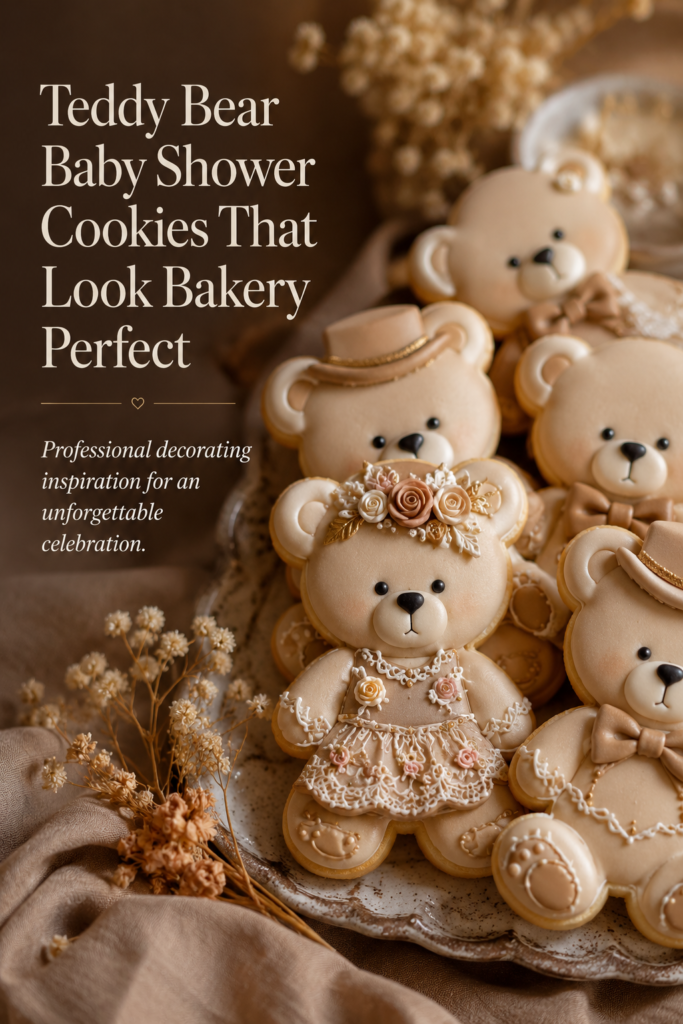
The fix: specify a matte finish for warm, soft, and vintage directions; specify a hand-painted or watercolor-effect finish for the most artisan results. Matte royal icing uses the same medium but is formulated or dried differently to produce a non-reflective surface. Hand-painted details (food coloring applied with a fine brush over a matte base) produce the highest-quality, most photographically distinctive results and are the technique that makes bear shower cookies look like illustrations rather than confectionery. Brief the baker explicitly: “matte finish, not glossy” or “hand-painted bear details in watercolor style.”
Styling Tip — The Baker Brief
When briefing a baker for bear shower cookies, share three things at the point of inquiry — not after the order is placed, not at the tasting. First: a photo of your invitation, mood board, or the most representative image of your palette direction, so the baker can see the actual colors rather than interpreting a description. Second: the specific palette as hex codes, paint chip names, or fabric swatches — not “blush” or “brown,” because every baker will interpret those words differently. “Warm cream closer to ivory than white, honey amber for the bear detail, matte dusty rose accent” is a brief that produces predictable results. Third: the finish preference — matte, glossy, or hand-painted. A baker who has all three will produce cookies that belong on your table. A baker working from “teddy bear theme” alone will produce cookies that belong on any table.
Section 02 Five Cookie Styling Directions for the Bear Theme
Each direction below specifies the icing technique, the palette it suits, and the exact brief language for your baker. Choose the one that matches your shower direction, then use the brief language verbatim.
2.1 Classic Brown Bear Cookies
The classic brown bear cookie is the most immediately recognizable and the most versatile direction — it works across every bear palette from vintage honey to neutral cream to rustic natural. The bear face shape in warm honey-brown royal icing with a slightly lighter snout area, small ears, and a simple face detail (two dots for eyes, a small nose) is the cookie that registers as “bear shower” before the guest’s eye has moved to anything else. The key is the warm quality of the brown: honey-brown rather than dark chocolate, caramel rather than mocha. Cool or dark browns read as heavy and commercial; warm honey-browns read as the same tone as the plush bear itself, which is exactly the palette connection the cookie needs to make.
A honey drip detail — a small drip of amber-toned icing at the base of the bear face or along the cookie edge — adds the honey motif without requiring a separate honey pot shape and elevates the cookie into the storybook register. Display on a tiered stand or propped face-out on a board so the full bear design is visible. The matte finish is essential in this direction: a glossy brown bear cookie reads as a decorated chocolate; a matte brown bear cookie reads as a bear. Baker brief language: “Warm honey-brown base, matte finish, not dark or cool brown. Simple bear face detail in a slightly lighter caramel tone. Optional honey drip in amber. No glossy finish.”
The Brown Bear collection brings the warm caramel and honey tones of this cookie direction into the stationery suite — so the bear on the invitation and the bear on the cookie share the same warm palette without requiring any additional coordination.
2.2 Neutral & Cream Cookies
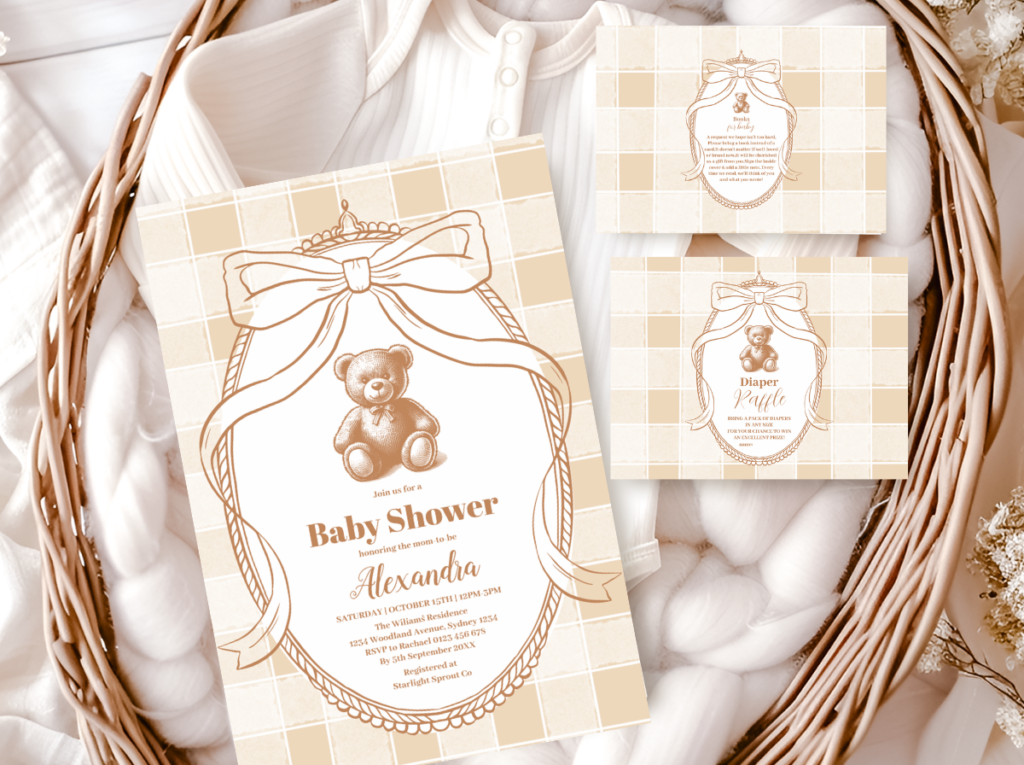
The neutral and cream direction is the most sophisticated and the most underestimated of the five — it relies on restraint rather than decoration to achieve its quality, which makes it also the easiest direction to execute for hosts who are ordering from a less specialized bakery or attempting DIY. The cookies are in warm ivory or oatmeal-toned icing — not white, not decorated elaborately — with minimal detail: a bear ear outline in a slightly deeper cream tone, a small dot of warm honey amber as an accent, or nothing at all beyond the beautifully toned base. The absence of heavy decoration is the design decision. A cookie in a perfectly calibrated warm cream tone that matches the linen and the invitation stock reads as more intentional than a heavily decorated cookie in multiple colors, because the restraint signals confidence in the palette rather than uncertainty about it.
This direction suits the neutral and cream palette most naturally but also works as the secondary cookie shape in any direction — a warm cream bear alongside the brown bear cookies, a cream round alongside the rustic natural cookies, a cream star alongside the moon and stars cookies. Its flexibility comes from its palette neutrality: warm cream sits beside every other warm tone without conflict. Baker brief language: “Warm ivory or oatmeal base, not white. Matte finish. Minimal detail — bear outline or ear detail in slightly deeper cream, or no additional detail. Match the base color to warm ivory, not optical white.”
The Neutral Teddy Bear collection pairs this restrained cookie direction with warm ivory stationery and a bear motif that matches the same palette register — minimal, warm, and considered throughout the whole printed suite.
Styling Tip
Neutral cookies with a single gold detail — a painted dot, a thin gold border, a bear ear outlined in gold luster — cost the same as fully decorated cookies and read as significantly more elevated. Gold luster dust applied with a dry brush over matte icing is the single highest-impact finishing detail available for bear shower cookies, and it requires almost no additional skill or material cost beyond the luster dust itself. The effect is the difference between a cream cookie that reads as “plain” and a cream cookie that reads as “considered.” Brief it explicitly: “Small gold luster dust detail — bear ear outline or single dot accent. Applied dry brush over matte base, not mixed into the icing.”
2.3 Rustic & Natural Cookies
The rustic and natural direction is the most texture-forward and the most artisan of the five — it embraces imperfection as a design feature rather than a production limitation. The base icing in a kraft-adjacent warm tan or oatmeal tone is applied with an intentionally irregular edge rather than a precise outline: the edge that looks slightly rough or hand-pressed rather than machine-cut is the edge that reads as handmade. Hand-painted botanical details — a small sprig of eucalyptus, a tiny dried flower motif, a watercolor-style leaf pattern — in muted sage, warm brown, or dusty rust are applied over the matte base with a fine brush. The botanical elements do not need to be elaborate; a single three-leaf sprig at the upper corner of the cookie is more effective than a fully decorated surface.
This direction suits the rustic, floral, and vintage palette directions and produces the most photographically distinctive cookies of the five because the hand-painted botanical detail creates genuine variation — no two cookies in the order will look identical, which gives the display table an organic, assembled-from-nature quality that mass production cannot replicate. Baker brief language: “Warm tan or oatmeal base, matte finish, intentionally organic edge — not machine-precise. Hand-painted botanical detail in muted sage, warm brown, or dusty rust. Fine brush application, watercolor-style. No glossy finish.”
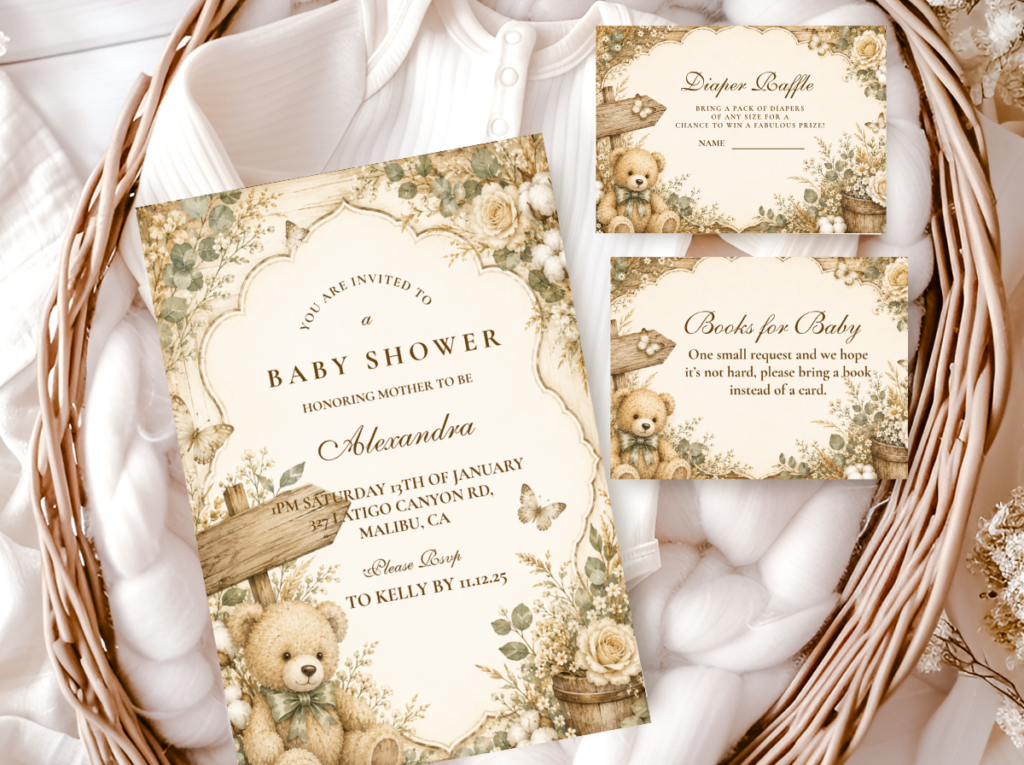
The Rustic Teddy Bear collection pairs this organic, texture-forward cookie direction with stationery in the same natural register — linen-effect stock and warm bear motifs that match the hand-painted botanical quality of the rustic cookie aesthetic.
2.4 Vintage Illustration Cookies
The vintage illustration direction is the most labor-intensive and the most photographically extraordinary of the five. The cookies in this direction look like they have been pulled from the pages of a well-loved children’s book: watercolor-effect icing in soft honey and cream tones, with hand-painted bear details that have the quality of a skilled illustration rather than a cookie decoration. The technique is wet-on-wet royal icing for the watercolor wash (diluted food coloring applied over a wet ivory base before it sets, which creates the bleeding, soft-edged quality of watercolor) followed by fine-line painting of bear features and botanical details once the base has set.
This direction requires a baker who has specific experience with watercolor icing technique — it is not a standard request and should be confirmed as within the baker’s skillset before ordering. It is also the direction that commands the highest price per cookie and produces the highest visual return per dollar when displayed face-out at the focal zone of the dessert table. One dozen vintage illustration bear cookies propped face-out on a small tiered stand is a complete dessert table statement that requires no additional decoration around it. Baker brief language: “Watercolor-effect icing — wet-on-wet technique, soft honey and warm ivory tones, no sharp edges or bright colors. Hand-painted bear detail in fine line over matte base. Storybook illustration quality, not graphic or precise.”
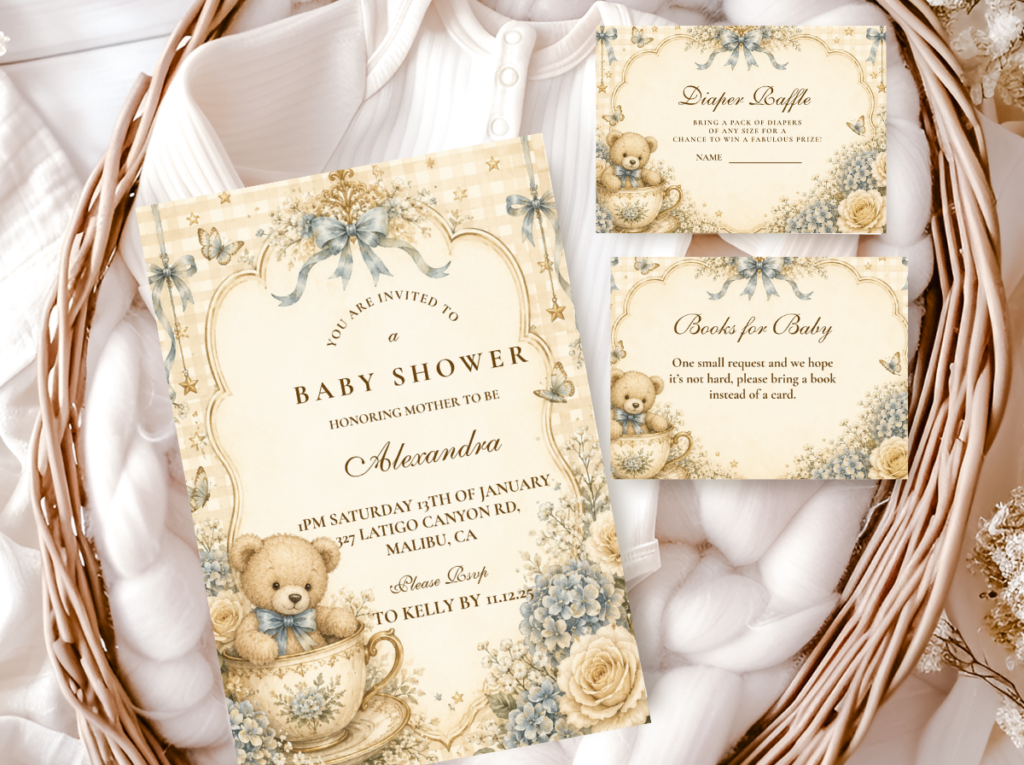
The Vintage Teddy Bear collection matches the storybook illustration quality of this direction — heritage typography, warm honey tones, and a hand-drawn bear motif that shares the same watercolor-adjacent aesthetic as the painted cookies.
2.5 Moon & Stars Bear Cookies
The moon and stars direction is the most whimsical and the most gender-neutral of the five — it expands the cookie selection from bear shapes to include celestial shapes (crescent moon, star, round planet), which allows for a wider variety of silhouettes without introducing additional color complexity. The palette for this direction is the most distinctive: deep navy or dusty lavender as the primary tone, with warm gold star details and cream accents. The deep color ground with gold detail creates a striking contrast that reads well from across a dessert table and photographs with more visual drama than any of the other four directions.
The cookies in this direction work in a set of three shapes: a bear face in a warm cream tone (the grounding element that maintains the bear theme), a crescent moon in deep navy or dusty lavender, and a five-point star in the same navy or lavender with a gold luster dust accent. The three shapes in two colors (deep celestial tone + warm cream) with gold accent create the complete visual language of the direction in every display grouping. Baker brief language: “Three shapes: bear face in warm cream matte, crescent moon and star in deep navy or dusty lavender matte. Gold luster dust accent on star and moon shapes. No glossy finish. Warm cream for bear, deep celestial tone for the other shapes — not matching, intentionally contrasting.”
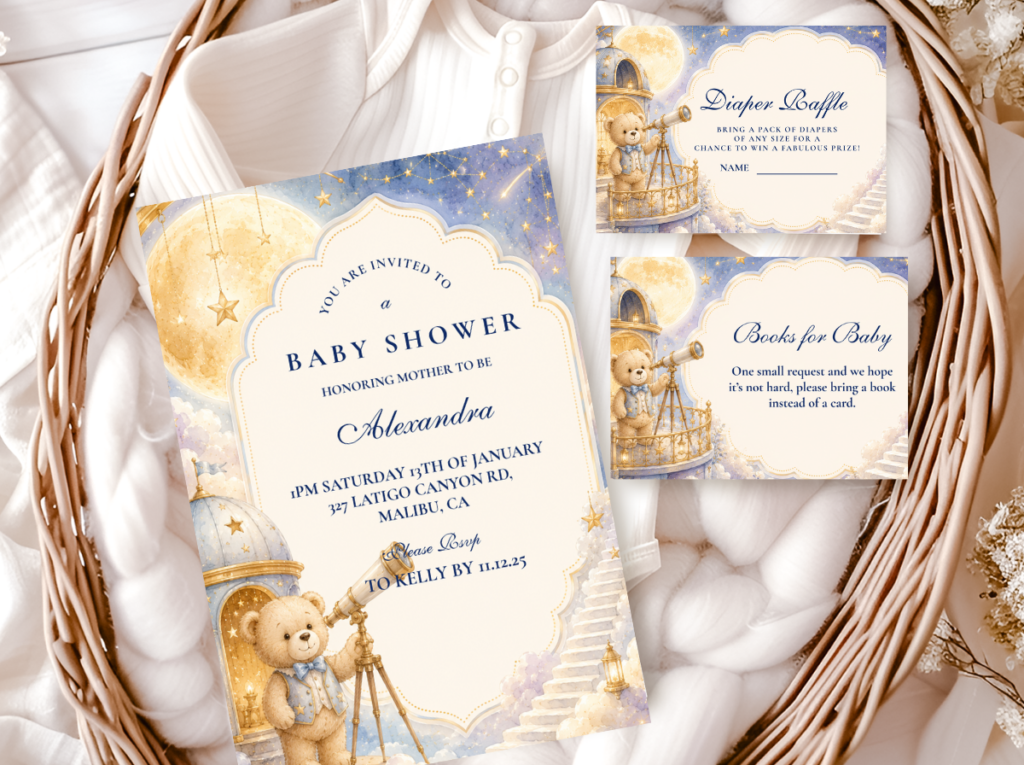
The Bear Moon And Stars collection brings the celestial direction into stationery — soft star and moon illustrations in lavender and gold tones that match the palette of the celestial cookie direction and tie both into the same visual world.
Section 03 Displaying Cookies on the Dessert Table
3.1 Cookie Stand and Display Options
Three display formats work for bear shower cookies, and each communicates a different aesthetic intention. A tiered stand — two or three tiers of varying heights, with cookies propped face-out on each level — is the format that reads most clearly as a designed display. It creates the height variation the dessert table needs at the mid zone, and it presents the cookie design in its full visibility from the guest’s viewpoint. A tiered stand in wood or rattan suits the vintage, rustic, and neutral directions; a white ceramic tiered stand suits the neutral and cream direction. A flat board — a wooden cutting board, a marble slab, or a piece of live-edge wood — with cookies laid in a loose cluster reads as gathered and casual: more appropriate for a relaxed outdoor event or a tableside display alongside other elements at the same level.
Individual wrapped cookies as display pieces — each cookie in its own cellophane bag, tied with a ribbon matching the palette, and propped in a glass jar or small basket — work for the favor-display hybrid approach where the display cookies and the take-home cookies are the same objects. This format signals to guests that the cookies are both decoration and gift, which changes how they interact with the display: they look more carefully, they handle the cookies, and they remember the display because they brought something from it home. The wrapping should match the palette: kraft paper tied with twine for the rustic and vintage directions; clear cellophane tied with satin ribbon in the palette color for the neutral and celestial directions.
3.2 Wrapped Cookies as Favors
A wrapped cookie is one of the most universally appreciated shower favors because it is useful, personal, visually beautiful when done correctly, and — uniquely — it carries the palette of the shower into the guest’s home in a physical form. A well-wrapped bear cookie in the shower’s palette looks as designed as anything on the dessert table and functions as a take-home impression of the event that guests encounter again when they unwrap it later. The wrapping materials should belong to the same palette as the cookie itself: natural twine and a small kraft tag with a bear motif for the rustic and vintage directions; a narrow satin ribbon in dusty rose or dusty blue for the pink and celestial directions; a short length of cream grosgrain ribbon with a small gold sticker seal for the neutral direction.
A favor tag tied to the wrapped cookie that matches the invitation suite typography is the detail that transforms a wrapped cookie from a takeaway snack into a designed keepsake. The tag can carry the baby’s name, the shower date, or a short phrase (“Little One” / “Sweet Bear” / “With Love”) in the same font and bear motif as the invitation. This is also where the stationery suite does its final work in the room: the favor tag is the last object a guest handles before they leave, and when it matches the invitation they received at the beginning of the process, the celebration feels complete from first communication to last detail.
3.3 How Many Cookies Per Guest and Per Display
The practical numbers for a bear shower cookie order depend on whether the cookies serve as display pieces, favors, or both. Display cookies — cookies that are part of the dessert table presentation and will be consumed at the event — should be ordered at one cookie per guest, plus 15% extra to fill visual gaps on the display as the event progresses. A display table that shows obvious gaps mid-event reads as under-catered regardless of whether the total count was correct; the extra 15% maintains the visual abundance that makes the dessert table photograph well throughout the event, not just at setup.
If the cookies also serve as favors — guests take a wrapped cookie home — that count is separate from the display count. The distinction matters because display cookies and favor cookies require different packaging and placement decisions: display cookies are presented unwrapped and arranged for visual impact; favor cookies are wrapped, tagged, and placed at a dedicated favor area or on each place setting. Combining the two roles without making this distinction explicit in the order typically results in either the display table emptying too quickly (as guests take their favor during the event) or the favor table having no cookies to offer (because all were consumed at the display). Order the two separately: display quantity + 15% buffer, and favor quantity as exactly one per guest.
Styling Tip — Display Angle
Display cookies face-out on a tiered stand, not flat. A cookie seen from the front shows the full design; a cookie seen from above shows only the top surface. Even the most beautifully decorated bear cookie reads as a brown blob from above — the bear face, the botanical detail, the watercolor wash, all invisible. Angle your stand so the front row of cookies faces the room rather than the ceiling. If you are using a flat board, prop the front row against a small object (a wooden block, a folded linen) at approximately a 45-degree angle so the design faces forward. This is the single most impactful display adjustment for cookies and it costs nothing and takes thirty seconds to implement.
Section 04 Invitations & Stationery
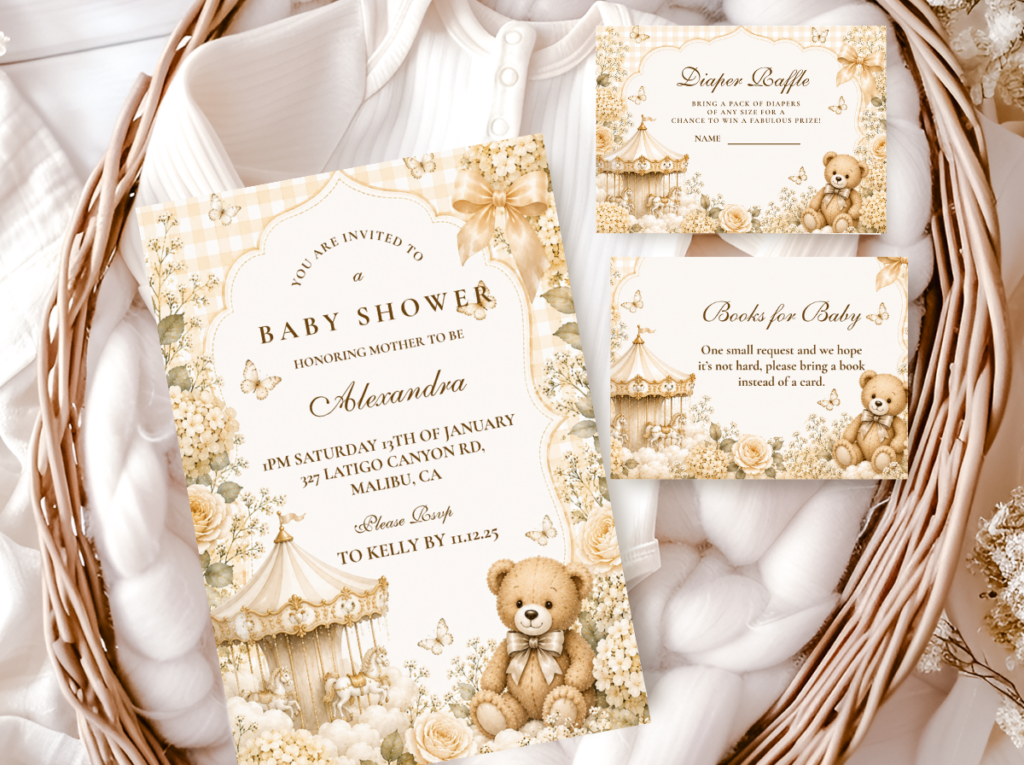
The motif on the cookie and the motif on the invitation belong to the same visual vocabulary — and when they share the same palette and illustration style, the dessert display becomes part of the designed world of the room rather than a separate catering decision. A hand-painted watercolor bear cookie on the dessert table next to an invitation featuring a watercolor-style bear illustration in the same warm honey tones: the two objects are in conversation with each other in a way that every guest registers, even those who do not articulate it. The room reads as complete rather than assembled from separate decisions.
The stationery suite is also the most practical cookie-briefing tool available. The invitation establishes the palette in physical form — the specific tone of the cream, the warmth of the honey amber, the quality of the bear motif — and that physical reference can be handed directly to the baker at the point of consultation. This is the implementation of the briefing advice in Section 01: the invitation is the photo, the palette reference, and the motif direction all in one object. A baker who sees the invitation and produces cookies in that same visual register will produce cookies that belong on the table without any additional coordination effort.
The favor tag — the small printed card attached to each wrapped cookie — is the final stationery element in the room, and the one that a guest carries home. When it belongs to the same suite as the invitation (same typography, same bear motif, same palette), the wrapped cookie becomes a portable extension of the designed world of the shower: an object that carries the aesthetic of the celebration into the guest’s daily life for however long the cookie lasts on their counter. The six collections below each include favor tags alongside the invitation suite for exactly this purpose.
Each collection below corresponds to a specific cookie styling direction in this guide — Brown Bear for the classic brown cookie, Neutral Teddy Bear for the cream and minimal direction, Rustic Teddy Bear for the botanical natural direction, Vintage Teddy Bear for the watercolor illustration direction, and Bear Moon And Stars for the celestial direction. The Bear Theme catalogue brings all collections together for hosts who are still exploring directions before deciding.
Main Collection
Bear Theme
Browse all bear stationery directions together before committing to a palette and cookie direction.
Matches: Classic Brown
Brown Bear
Warm caramel and honey tones — the stationery suite that matches the classic brown bear cookie direction throughout the printed layer.
Matches: Neutral & Cream
Neutral Teddy Bear
Warm ivory and restrained bear motifs — the stationery pair for the minimal cream cookie direction and elegant palette register.
Matches: Rustic Natural
Rustic Teddy Bear
Natural linen-effect stock and organic motifs — the stationery pair for the botanical hand-painted cookie direction.
Matches: Vintage Illustration
Vintage Teddy Bear
Heritage typography and watercolor-adjacent bear motifs — the stationery pair for the vintage illustration cookie direction.
Matches: Moon & Stars
Bear Moon And Stars
Celestial illustrations in lavender and gold — the stationery pair for the moon and stars cookie direction and its deep-tone palette.
Frequently Asked Questions
How far in advance should I order custom bear shower cookies?
For custom decorated cookies in any of the five directions above, a minimum of three to four weeks in advance is the standard recommendation for most specialty cookie bakers — and for watercolor illustration or vintage hand-painted directions, six weeks is more realistic because the technique is more labor-intensive and these bakers typically have longer order queues. The consultation itself — the meeting where you share your invitation and palette reference — should happen at least one week before you place the order, so there is time to confirm the palette interpretation and request any adjustments before production begins. For a shower during a high-demand season (spring and early autumn are typically the busiest), add two weeks to the minimum timeline. Always request a palette-match preview from the baker before the full order is produced: one test cookie in your specified color confirms the interpretation is correct before all cookies are baked. This confirmation step is the highest-return quality check available for any custom cookie order.
Royal icing vs fondant for bear shower cookies — which is better?
Royal icing is almost always the better choice for the bear shower aesthetic, and matte royal icing is better still than glossy. Royal icing allows for fine detail work, hand-painting over a set base, and the matte or semi-matte finishes that suit the warm, organic quality of every bear shower direction. It also sets hard, which means cookies can be stacked for transport and storage without damage — important for a large order. Fondant is the alternative: it produces a smooth, dough-like surface that can be shaped and molded (useful for three-dimensional toppers on cakes) but tends to produce a flat, matte surface on cookies that lacks the crispness of royal icing detail work and tends to look thick and doughy at the edges. For flat decorated cookies in the five directions in this guide, royal icing is the correct medium. The specific instruction to give a baker when using royal icing: “matte or semi-matte finish, not high-gloss.” High-gloss royal icing sets with a mirror-like shine that reads as commercial and sharp — the opposite of the warm, artisan quality the bear shower aesthetic requires.
How many cookie designs should I order for a bear shower?
Two or three designs is the optimal number for a bear shower cookie display, and the three designs should share the same palette rather than the same theme category. The most effective combination is: one primary bear shape (the bear face or bear body in the direction’s main palette tone), one secondary shape (a round cookie with a honey pot detail, a star, or a simple botanical outline in a complementary tone), and an optional third shape (a heart, a small cloud, or a simple oval in the cream base tone). This three-shape palette produces a display that reads as cohesive from across the room and as varied up close — the two criteria that make a cookie display worth photographing. More than three designs tips the display toward visual noise; fewer than two can read as insufficient variety for a significant display area. For a small shower (under fifteen guests), two designs are perfectly adequate and often read as more refined than three.
What are the best DIY cookie decorating options for non-bakers?
For non-bakers who want to produce bear shower cookies at home without advanced royal icing skills, three approaches produce reliable results. First: buy plain shortbread cookies in the natural honey-toned variety and add minimal decoration — a small amount of pre-made icing in a warm ivory tone, applied with a toothpick to create a simple bear face outline, is achievable without training and produces a result that reads as considered rather than amateur. The natural color of the shortbread does the palette work without any icing at all; adding a small dot of warm honey amber icing as a nose is the only detail needed. Second: buy bear-shaped cookie cutters and use a store-bought sugar cookie mix; then purchase pre-made decorating icing in warm cream or honey-brown tones and apply with the included tip. The pre-made icing produces adequate results for the classic and neutral directions without requiring royal icing technique. Third: skip decorated cookies entirely and display plain shortbread in the natural honey-cream color range on a wooden board with a kraft label reading “Little Bear’s Shortbread” — the label does the thematic work, and the warm, natural color of the shortbread sits inside the palette without requiring any decoration. This is the option that most consistently looks deliberate rather than attempted.
Ready to Start Planning?
Find the Stationery That Ties Your Cookies to the Room
The favor tag, the invitation, the baker brief — all from the same suite, in the same palette.