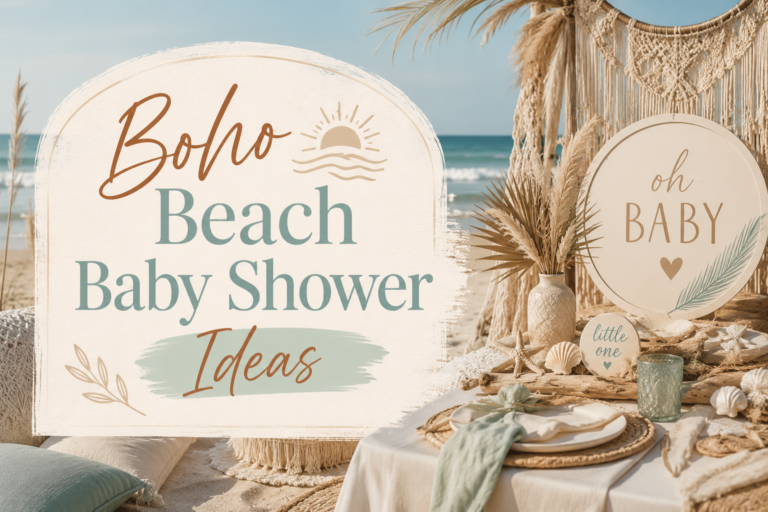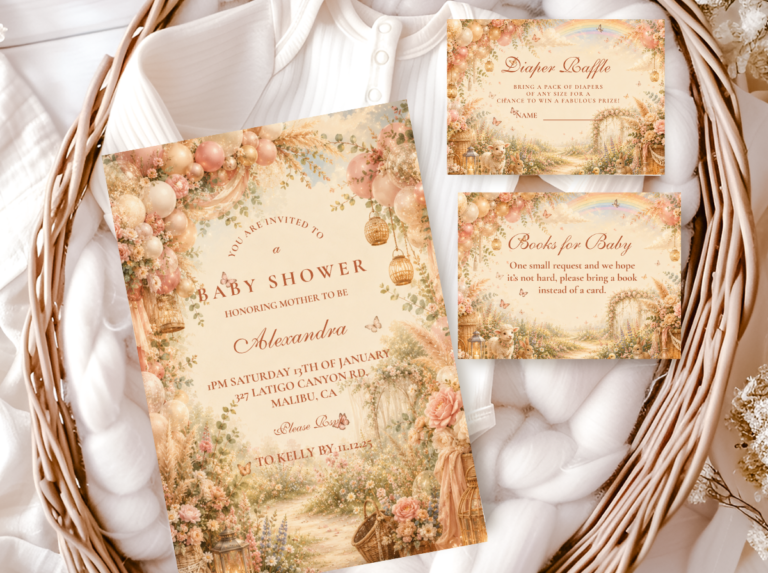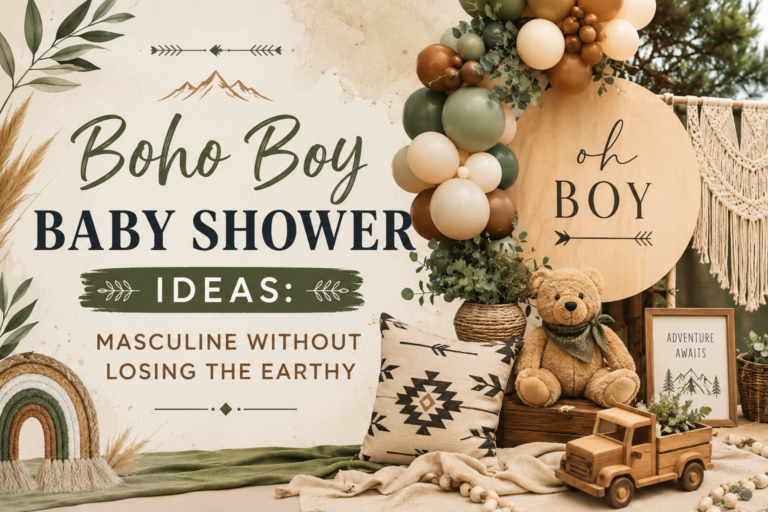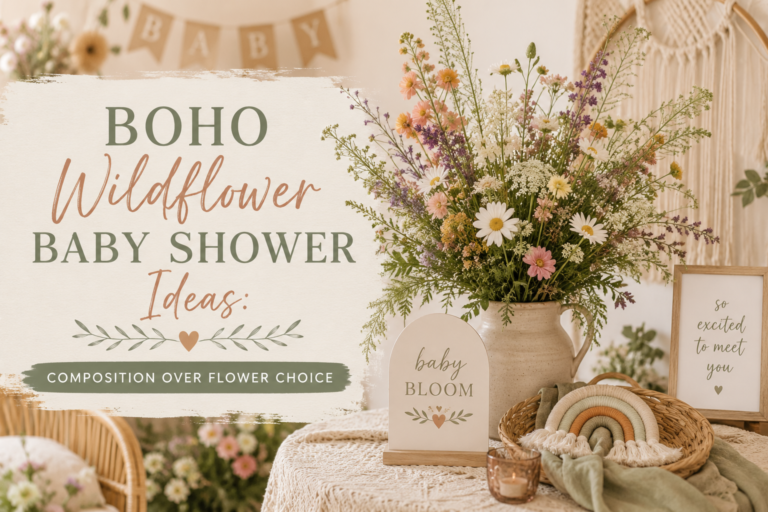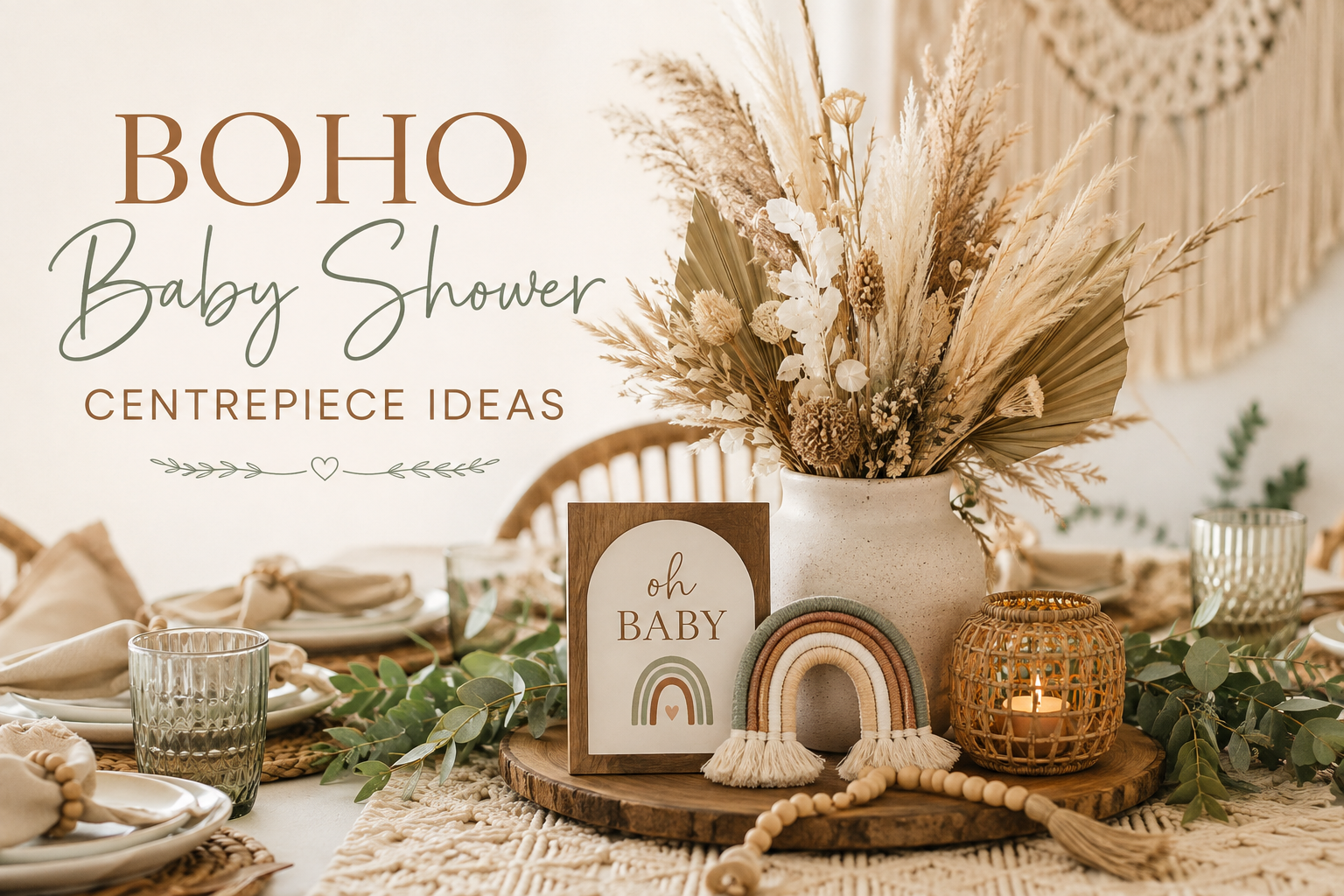
Boho Baby Shower Centrepiece Ideas
Baby Shower · Boho Centrepiece Guide
Boho Baby Shower Centrepiece Ideas
The four design rules that separate a genuine boho centrepiece from a neutral arrangement with pampas placed in it, five complete centrepiece directions, and the table styling guide beyond the centrepiece itself.
A boho centrepiece is not an arrangement — it is a moment from the natural world placed on a table. The difference between these two things is whether the result looks gathered or purchased; whether it looks as though it grew into its form or was assembled into it. That quality comes from four specific design decisions made before a single stem is chosen — and the first of those decisions is the vessel, which defines the boho register before any botanical material is added.
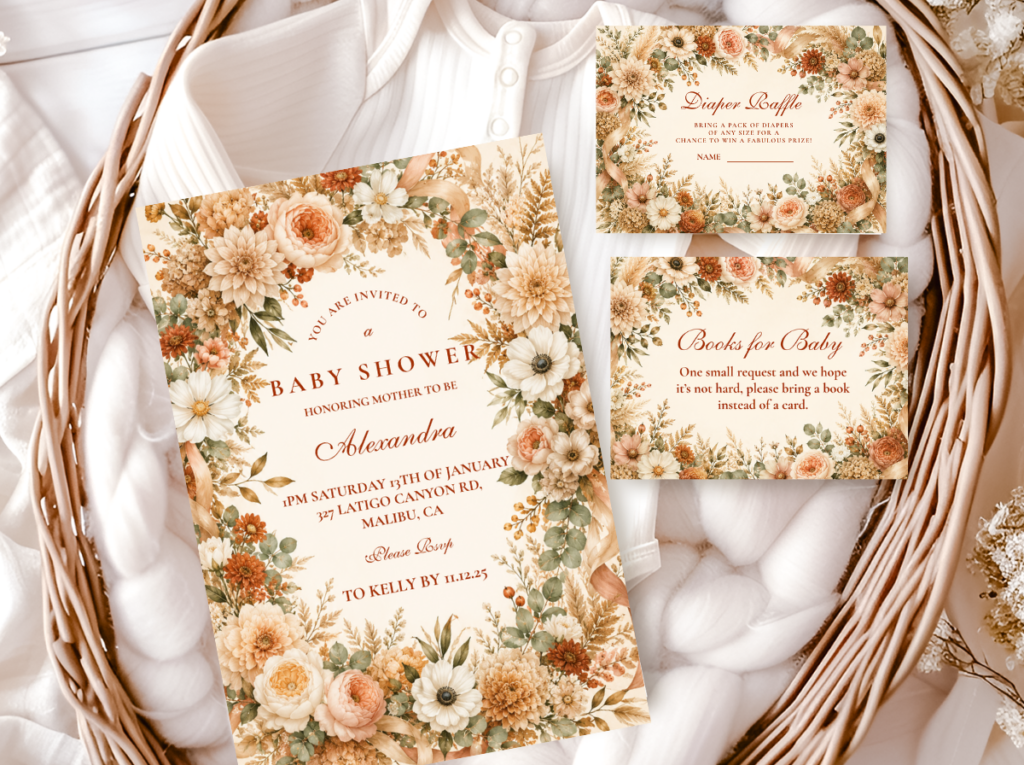
Browse the complete Boho Baby Shower stationery collection.
Invitations, welcome signs, table cards — warm, earthy, and fully customisable.
“A boho centrepiece is not an arrangement — it is a moment from the natural world placed on a table; the difference is whether it looks gathered or purchased.”
Section 01 The Four Boho Centrepiece Rules
The four rules below are not suggestions or stylistic preferences — they are structural requirements for a centrepiece that reads as genuinely boho rather than as a neutral arrangement containing boho elements. Each rule addresses a specific failure mode that appears consistently in centrepieces described as boho but not experienced as boho. Applying all four simultaneously produces the quality of the arrangement that reads as gathered rather than constructed.
Rule 1
Vessel First — The Container Defines the Boho Register Before Any Stem Is Added
Why it matters: The vessel is the first decision in any centrepiece, and in a boho centrepiece it is the most important single decision — because the vessel communicates the boho aesthetic to every guest who sees the table before any botanical material registers. A rattan basket already reads as boho at a distance. A terracotta pot already reads as boho at a distance. A raw wood vase already reads as boho. A glass cylinder, a metallic urn, or a smooth white ceramic vase reads as a vessel from a different aesthetic world, regardless of what is placed inside it. Correct stems in a wrong vessel produce an arrangement that reads as ‘boho flowers placed in a generic vase’ rather than as a boho centrepiece.
✓ Applies: Rattan baskets (the most versatile boho vessel — available in round, oval, and rectangular forms; appropriate for loose arrangements where the basket weave is visible around the stems); terracotta pots (the most specifically earthy vessel — in their natural unglazed form, not painted or lacquered; the specific warm clay tone of raw terracotta belongs directly to the boho earthy palette); raw wood vases or wooden vessels (appropriate for the Woodland Boho and Botanical directions; the visible grain of raw wood communicates the same natural material vocabulary as rattan); and clear glass bottles (appropriate only in the Botanical Boho direction, where the minimal vessel allows the botanical material to carry the entire visual weight).
✗ Breaks when: Smooth white ceramic, metallic urns in chrome or silver, bright coloured ceramic, plastic containers of any kind, and acrylic vases. Each of these belongs to a different aesthetic register from the boho world. The specific problem with smooth white ceramic: it is a beautiful vessel in the right context (contemporary, elegant, garden shower) and a jarring intruder in the boho context, because its smooth manufactured surface is the exact opposite of the rattan’s organic woven texture.
Rule 2
Odd Numbers Always — Even Numbers Read as Formal and Purchased
Why it matters: The number of primary stems in a boho centrepiece must always be odd — three, five, or seven, never two, four, or six. This is not a decorating convention but a perceptual principle: even numbers of elements read as formally balanced and intentionally symmetrical, which communicates the same quality as a symmetrical arrangement — the quality of having been arranged rather than gathered. Odd numbers of elements read as organic and slightly accidental, as though the third stem was added because it belonged there rather than because it completed a pair. The boho aesthetic is built on the quality of things that look found rather than purchased, and an odd number of primary stems is one of the structural decisions that communicates this quality.
✓ Applies: Three primary stems in a small centrepiece; five primary stems in a medium centrepiece; seven primary stems in a large or long-table centrepiece. ‘Primary stems’ means the main botanical elements whose height and form define the arrangement — the pampas plumes, the dried protea heads, the pampas tails. Secondary stems (dried grasses, cotton stems, small botanical scatter material) are not counted and can be in any number.
✗ Breaks when: Two pampas plumes of equal height in a rattan basket (reads as formally balanced — a pair, not a gathering); four dried protea heads evenly spaced (reads as arranged — the equal spacing and even count communicate intentional placement rather than natural abundance); six stems of any kind at equal height (reads as a formal even arrangement regardless of the boho materials used).
Rule 3
Height Variation Mandatory — Same Height Throughout Reads as a Supermarket Bouquet
Why it matters: A boho centrepiece requires at least three distinct height levels: a tall element (the height ceiling that defines the architectural scale of the arrangement — typically pampas grass plumes or tall dried grasses at 35–45cm above the vessel rim); a mid element (dried florals or botanical material at 15–25cm above the vessel rim — dried protea, dried celosia, cotton stems, dried roses depending on the direction); and a low element (botanical material at the vessel rim level or slightly below — dried grass scatter, small botanical tails, dried chamomile clusters). Without this three-level height structure, a centrepiece reads as a bouquet — all elements at the same approximate height, which is the format of a commercial flower arrangement rather than of a gathered natural world moment.
✓ Applies: A clear tall-mid-low structure with at least 30% height difference between each level: if the tall element is at 40cm above the vessel rim, the mid element should be at 20–25cm and the low element at 5–10cm. The visual read of a correctly structured height arrangement: the tall element is clearly architectural (it is read as a height element, not as a botanical detail); the mid element provides the main botanical identity of the arrangement (protea, dried roses, celosia — the element the guest identifies as the centrepiece’s ‘type’); the low element grounds the arrangement at the table surface level.
✗ Breaks when: All stems at approximately the same height (reads as a commercial bouquet regardless of materials); two height levels instead of three (reads as a tall element with a filler layer, not as a gathered natural arrangement with its own internal structure); tall stems without any low ground cover at the vessel base (the arrangement reads as floating above the vessel rim rather than growing from within it).
Rule 4
The Overhang Rule — At Least One Element Must Trail Beyond the Vessel Edge
Why it matters: At least one element in every boho centrepiece must extend beyond the vessel edge and trail toward the table surface. This is the rule that most directly produces the ‘gathered, not purchased’ quality — because botanical material gathered from a field does not stop precisely at the vessel rim; it grows, trails, and extends beyond the container that holds it. An arrangement in which every stem is contained within the vessel outline reads as arranged: the stems were placed with the deliberate intention of keeping them inside the vessel boundary. An arrangement in which one or two elements extend beyond the vessel reads as gathered: the stems are simply too full to be contained, which communicates abundance and organic naturalness.
✓ Applies: One or two stems of trailing material extending 5–15cm beyond the vessel rim and down toward the table surface, on the same side as the taller lean of the arrangement (the overhang and the lean work together to create the direction of the arrangement). Appropriate trailing materials: dried eucalyptus branches (their thin, leafy stems trail naturally and elegantly over the vessel rim); long dried grass stems (a single long grass stem extending well beyond the vessel on one side reads as the most specifically organic boho accent available); dried pampas tails at the low end of their stem (short pampas tails trailing down one side of the vessel).
✗ Breaks when: Every stem trimmed to sit within the vessel outline (reads as arranged and contained — the arrangement looks neat, which is the opposite of the boho aesthetic’s organic quality); stems that trail over the vessel rim on both sides simultaneously (reads as a symmetrical spill — the overhang must be clearly directional, not balanced on both sides).
✨ Styling Tip
The test for a genuine boho centrepiece: cover the vessel with one hand so only the botanical arrangement is visible above your hand. If the arrangement still reads as beautiful and organic — if the height variation, the odd-number structure, and the directional lean communicate a gathered natural moment independently of what is holding them — the stems are doing their design work correctly. If the arrangement reads as a collection of sticks, the vessel was doing most of the work. A correct boho centrepiece is beautiful at the stem level before the vessel is seen. The vessel then adds material coherence (rattan reads as boho; terracotta reads as boho); the stems carry the arrangement’s organic quality.
Section 02 Five Boho Centrepiece Directions
Five complete centrepiece directions, each built on the four rules above. In all five: dried botanicals only, odd-number primary stems, three height levels, at least one overhang element.
Most Authentic
Classic Pampas & Rattan Centrepiece
Honey Cream · Warm Brown · Oatmeal · Muted Sage
Vessel: Wide rattan basket (20–30cm diameter — the weave must be visible; the basket width determines the arrangement’s visual base and should be at least as wide as the tallest element is tall). Fill the base with natural oasis or dried moss to anchor the stems.
Botanicals: Five primary stems: three large dried pampas plumes (honey-cream, the tall element at 35–45cm above the rim — pampas should be the tallest element by at least 30% above the next height level); one dried protea head in warm rust or brown (the mid element at 20–25cm); one cotton stem (the low-mid element at 12–15cm). Secondary scatter: three to five dried grass stems at varying heights between the primary elements; one dried eucalyptus branch trailing over the basket rim toward the table surface (the overhang element).
Structure (odd stems, height, overhang): Tall: 3 pampas plumes (left-leaning — the tallest plume leans 15–20 degrees to the left; the shorter two follow the same direction). Mid: 1 protea at 60% of the pampas height, positioned front-right. Low: 1 cotton stem front-centre at basket rim level. Overhang: 1 eucalyptus branch extending 8–12cm beyond the basket rim on the right side. Scatter: 5 grass stems at varying heights filling the visual gaps between primary elements.
The Classic Pampas and Rattan Centrepiece is the most Pinterest-consistent and the most photographically immediate boho centrepiece available — the honey-cream pampas plumes in a rattan basket communicate the boho aesthetic at the thumbnail scale before any detail is seen. The specific quality that makes this direction the most Instagram and Pinterest saveable: the contrast between the fine, feathery texture of the pampas and the coarse, geometric weave of the rattan basket, which creates the specific visual richness that reads as ‘designed’ even when the arrangement is simple.
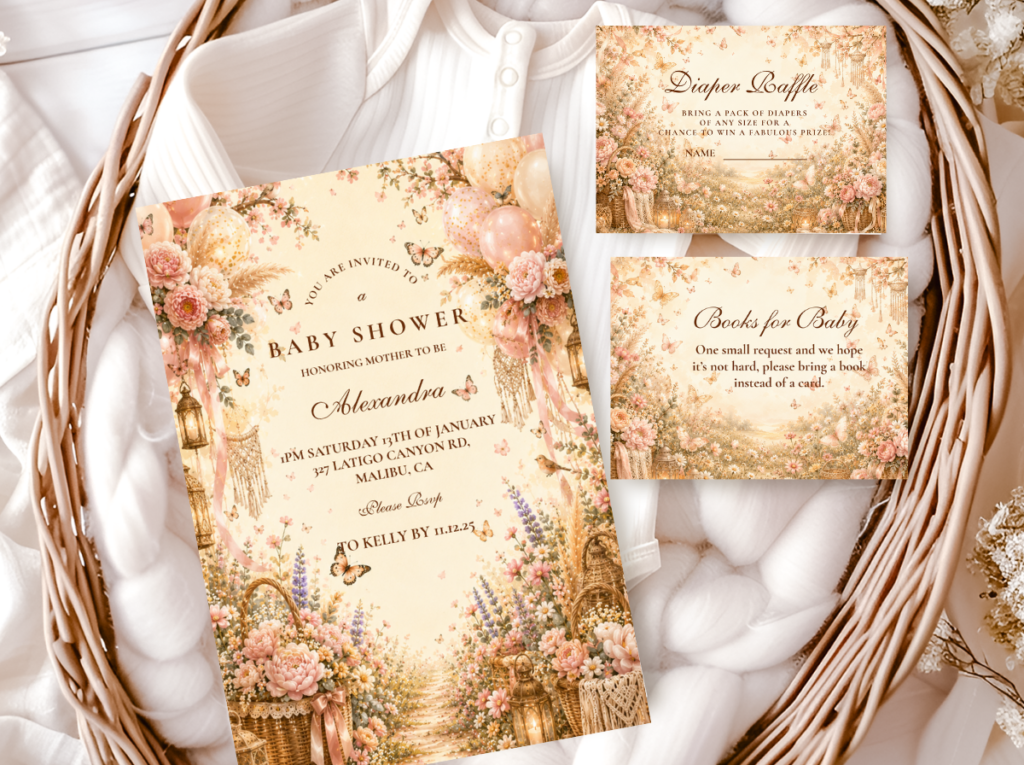
The Boho General collection carries the most authentic terracotta and oatmeal illustration style — coordinated place cards and table signs in the same palette as the centrepiece.
✨ Styling Tip
Pampas grass in a boho centrepiece should be the tallest element by at least 30% — it sets the height ceiling that every other stem relates to. Pampas at the same height as the dried protea or the cotton stems loses its architectural function and reads as just another dried botanical element rather than as the height anchor of the arrangement. The ratio that works: pampas at 40cm above the vessel rim; protea at 22–25cm; cotton at 12–14cm. The visual read: three clearly distinct height levels, with the pampas reading as a height element rather than as a floral element. When pampas is the same height as everything else, the arrangement has no height ceiling and reads as a bouquet.
Most Nature-Immersive
Woodland Boho Centrepiece
Forest Green · Warm Brown · Oatmeal · Moss Green
Vessel: Raw wood slice as the display base (a flat 25–35cm wood slice on which the arrangement vessel sits) + a small birch wood vessel or a bark-wrapped glass jar as the primary stem holder. The wood slice base extends the centrepiece footprint beyond the vessel and provides the table surface texture element simultaneously.
Botanicals: Five primary stems: three tall dried eucalyptus branches (deep green, 30–40cm above the vessel rim — the tall element); one large preserved moss cluster positioned at the vessel base as the low ground cover (the low element — preserved moss sits within and slightly above the vessel rim rather than standing above it); one dried fern frond at mid height. Secondary: two to three pine cones on natural twine hanging from the tallest eucalyptus branch; dried grass stems filling the visual gaps; one trailing eucalyptus branch extending beyond the wood slice base on the left side.
Structure (odd stems, height, overhang): Tall: 3 eucalyptus branches leaning right, the tallest 35cm above the vessel rim. Mid: 1 fern frond at 18cm, positioned left-front. Low: preserved moss cluster at vessel rim, covering the oasis and extending slightly outward. Overhang: 1 trailing eucalyptus branch extending 10cm beyond the wood slice base on the left.
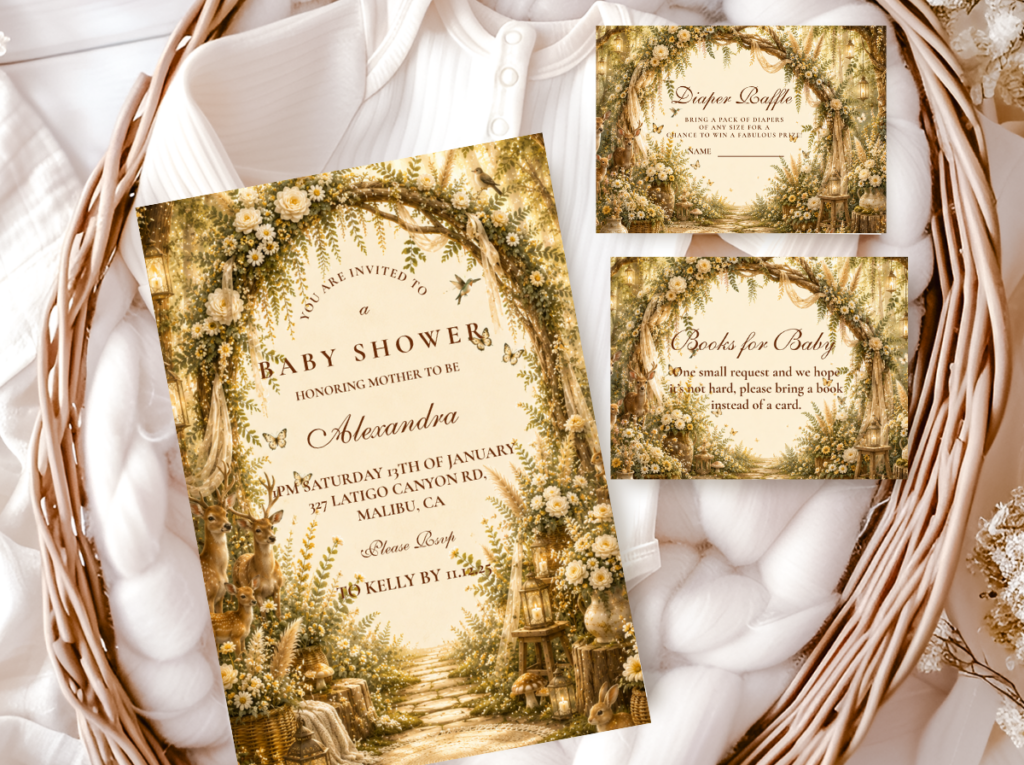
The Woodland Boho Centrepiece is the most specifically nature-immersive of the five directions — the combination of preserved moss (the only direction where moss is the primary low element), raw wood slice base, and deep forest eucalyptus creates an arrangement that reads as a specific place in the natural world: a woodland floor, with its specific combination of deep green canopy and warm earthy ground cover.
Most Floral
Floral Boho Centrepiece
Dusty Rose · Warm Brown · Oatmeal · Warm Ivory
Vessel: Wide-mouth terracotta pot (20–25cm diameter, unglazed — the wide mouth accommodates the abundance of dried floral material without compressing it into a narrow column, which would read as a formal bouquet rather than as a gathered boho arrangement). Not a painted terracotta pot — the raw clay surface belongs to the boho palette; painted terracotta reads as decorated rather than natural.
Botanicals: Five primary stems: one large dried protea head in warm rose-brown (the statement mid element at 22–28cm — the dried protea is the hero botanical in this direction); two dried rose stems in dusty rose (tall element — roses should be 5–8cm taller than the protea to provide the height ceiling); two dried lavender bundles (low element at the pot rim, positioned on opposite sides). Secondary: dried chamomile stems at varying mid heights; one to two dried grass stems for texture; one dried rose stem trailing beyond the pot rim on the right side as the overhang element.
Structure (odd stems, height, overhang): Tall: 2 dried rose stems at 28–32cm, right-leaning. Mid: 1 protea head at 22cm, positioned front-centre. Low: 2 lavender bundles at pot rim level, one on each side — but at slightly different heights (one at 8cm, one at 5cm above rim) to maintain the odd-number logic in the low level. Overhang: 1 dried rose stem trailing 6–8cm over the right side of the pot rim. Dried botanicals only — no fresh florals anywhere in this arrangement.
The Floral Boho Centrepiece is the most romantically beautiful of the five directions and the one that most frequently fails because fresh flowers are introduced in place of dried florals. The dried protea and dried rose combination produces a specific warm, aged beauty that fresh flowers cannot replicate and that belongs specifically to the boho aesthetic register: the dried rose reads as warm and slightly aged; the fresh rose reads as bright and temporarily beautiful. Only dried material belongs in this centrepiece.
Most Seasonal
Fall Boho Centrepiece
Warm Amber · Rust · Oatmeal · Deep Sage
Vessel: Rattan basket (the primary vessel) with one small cream or ivory pumpkin placed beside the basket on the table surface as a base accent — the pumpkin sits outside the vessel, directly on the oatmeal linen runner, and functions as the table-level base element that extends the centrepiece footprint beyond the basket. The cream pumpkin (not bright orange — the ivory and cream pumpkin varieties belong to the boho palette; bright orange belongs to Halloween) acts as a natural prop rather than as a decoration, which reads as gathered rather than styled.
Botanicals: Five primary stems: two tall dried pampas plumes in honey-amber tone (the height ceiling at 35–42cm); one dried celosia in rust or pumpkin (mid element at 20–24cm); one dried wheat bundle tied with natural twine (mid-low element at 14–18cm); one dried autumn leaf cluster (low element at basket rim). Secondary: dried seed pods at varying heights; dried grass stems filling visual gaps; one pampas tail trailing over the basket rim as the overhang; one small cream pumpkin placed beside the basket base on the table.
Structure (odd stems, height, overhang): Tall: 2 pampas plumes (left-lean, at 38cm and 35cm — the two heights prevent the pair from reading as a balanced pair rather than as a gathered cluster). Mid: 1 celosia at 22cm right-front. Low: wheat bundle at 16cm and leaf cluster at basket rim level. Overhang: 1 pampas tail extending 8cm beyond the basket rim, right side. Table-level accent: 1 cream pumpkin placed 5cm to the right of the basket base, directly on the linen runner.
The Fall Boho Centrepiece is the most urgently seasonal and the most specifically harvest-world of the five directions — the pumpkin placed beside the basket (rather than inside it) is the design decision that moves the centrepiece from a boho arrangement in autumn tones to a centrepiece that reads as belonging to the specific world of the autumn harvest table. The combination of tall honey-amber pampas and a small cream pumpkin at table level creates the height contrast that photographs most dramatically of the five directions.
Most Minimal
Botanical Boho Centrepiece
Deep Sage · Warm Ivory · Antique Gold · Warm Grey-Green
Vessel: Slim tall clear glass bottle or narrow-neck ceramic in warm stone glaze (the vessel in this direction must be slim — a wide vessel distributes the botanical material too broadly and prevents the minimal, editorial quality of the Botanical direction). A cluster of two or three identical slim glass bottles at varying heights works better than a single wider vessel in this direction: the vessel cluster creates the odd-number logic at the container level rather than requiring it only at the stem level.
Botanicals: Three primary stems (the minimum odd number — the Botanical direction uses the minimum to create the most edited, most editorial feel): one tall dried eucalyptus branch with silver-dollar leaves (the tall element, at 28–35cm above the vessel rim); one dried sage botanical bundle (the mid element at 15–20cm); one sprig of dried lavender (the low element at vessel rim). One or two pressed botanical prints in small raw wood frames placed flat on the table surface beside the vessel cluster as the table-level accent element.
Structure (odd stems, height, overhang): Tall: 1 eucalyptus branch (single stem — the minimal single tall stem is the Botanical direction’s primary design statement; it should be the only element at this height). Mid: 1 sage bundle at 17cm. Low: 1 lavender sprig at rim level. Overhang: the eucalyptus branch naturally trails over the vessel rim if the stem is long enough — allow 5–8cm of branch to extend beyond the vessel on one side. Table accent: 1–2 pressed botanical prints in raw wood frames, placed flat on the linen runner within 10cm of the vessel cluster.
The Botanical Boho Centrepiece is the most editorial and most minimal of the five directions — it uses the smallest number of stems to create the largest impression of specific intention. The slim vessel cluster, the single tall eucalyptus, and the pressed botanical prints on the table communicate a world of considered natural beauty rather than of abundant gathering. This is the centrepiece direction for hosts who prefer restraint over abundance and whose aesthetic sensibility is more editorial than maximalist.
Section 03 Table Styling Beyond the Centrepiece
The centrepiece is the primary table element — but three additional table decisions determine whether the table as a whole reads as a designed boho world or as a table with a boho centrepiece placed on it. The centrepiece alone, on a plain table with standard place settings, produces the second result. These three elements together with the centrepiece produce the first.
Linen Runner — Mandatory for Every Boho Table
An oatmeal or undyed natural linen runner is the single highest-impact table decision after the centrepiece — and the one that most reliably makes the entire table read as designed rather than as set up. The specific quality of oatmeal linen: the warmth and slight texture of undyed natural fibre communicates the boho material vocabulary at the level of the entire table surface rather than at the level of one centrepiece. Without a linen runner, the centrepiece sits on a smooth, manufactured table surface that belongs to a different material world. With a linen runner, the centrepiece sits in a surface that shares its material vocabulary. Natural linen or undyed jute only — no polyester, no synthetic table runner in any colour, no printed fabric. The linen runner should be slightly wrinkled rather than pressed flat — the specific organic imperfection of slightly rumpled linen belongs to the boho aesthetic; a crisply pressed linen reads as formal.
Place Setting Details — Rattan, Linen, Kraft
Three elements complete the place setting in the boho direction: a rattan charger plate (the material layer between the table surface and the ceramic plate — rattan charger plates are available at modest cost and produce a disproportionate visual impact because they are visible at every seat around the table simultaneously, which means they define the table’s material character more broadly than any centrepiece element); a linen napkin folded loosely and placed on or beside the plate (not a paper napkin — paper napkins, even in warm colours, belong to the generic party supply register; a linen napkin belongs to the boho material vocabulary); and a personalised kraft paper place card positioned at each setting in the boho stationery illustration style (a small card with the guest’s name in a warm font beside a small botanical illustration, leaning against the napkin or plate edge). No plastic elements anywhere on the table — no plastic cutlery, no plastic cups, no plastic name card holders. Clear glass, warm ceramic, and rattan are the only appropriate non-botanical materials at a boho place setting.
The Botanical Runner Alternative — When Continuous Works Better Than Individual
For long tables (longer than 2.4 metres with eight or more place settings), a continuous botanical runner often works better than individual centrepieces at each table section — because a long table with three separate centrepieces reads as three separate table sections rather than as one continuous designed environment. The continuous botanical runner: a length of natural linen or jute as the base layer, with dried botanical material arranged in a loose, organic cluster running the length of the table at the centre. The runner botanical vocabulary: dried pampas tails, dried eucalyptus branches, dried grass stems, dried cotton stems, and small votive candles in raw clay holders, distributed along the linen base in an asymmetric scatter rather than in a symmetrical repeating pattern. The rule that applies equally to the runner: all botanical material must extend beyond the linen base edge at several points along the runner — the overhang rule applied to the full table length rather than to a single vessel. The effect: a long table that reads as a single designed surface rather than as a series of centrepiece positions.
✨ Styling Tip
A linen or jute table runner does more visual work in a boho shower than almost any other single decoration — it grounds the centrepiece, adds the material texture vocabulary at the full table scale, and immediately signals ‘designed world’ rather than ‘set up.’ Use it even if nothing else on this list is possible: a centrepiece on an oatmeal linen runner on a plain table reads as a designed boho table. The same centrepiece on a bare table reads as a decorated table. The runner is not a detail. It is the surface the centrepiece belongs to. The one material rule: natural linen or undyed jute only. A synthetic table runner in any colour, however warm or muted, does not share the material vocabulary of the rattan vessels and dried botanical material and reads as a different material placed alongside them rather than as a continuation of the same material world.
Section 04 Invitations & Stationery
Browse all six collections below — each carries place cards, table signs, and suite elements in the same illustration style and palette as the invitation. The collection whose palette temperature most closely matches the centrepiece direction above is the correct stationery direction for the table.
Most Authentic
Boho General
Classic terracotta and oatmeal — place cards and table signs for the Classic Pampas direction.
Woodland
Woodland Boho
Forest green and warm brown — place cards and table stationery for the Woodland direction.
Most Floral
Floral Boho
Dusty rose and terracotta — the most romantic table stationery for the Floral direction.
Most Seasonal
Fall Boho
Warm amber and rust — place cards and table signs for the Fall Boho centrepiece direction.
Most Editorial
Botanical Boho
Deep sage and warm ivory — the most refined table stationery for the Botanical direction.
Wildflower
Wildflower Boho
Loose meadow wildflower illustration — joyful table stationery for any boho direction.
Frequently Asked Questions
What makes a boho baby shower centrepiece look authentic?
Four design decisions applied simultaneously — all four, not three of four. The vessel must be in a natural material (rattan basket, terracotta pot, raw wood vessel, or slim glass bottle — not smooth ceramic, not metallic, not plastic). The primary stem count must be odd (three, five, or seven — not two, four, or six). The arrangement must have at least three distinct height levels (tall pampas or grass as the height ceiling; mid dried florals or botanical material; low ground cover at vessel rim level). And at least one element must trail beyond the vessel edge toward the table surface. An arrangement that meets three of these four criteria reads as close to boho but not quite; all four applied together produces the specific ‘gathered, not purchased’ quality that makes a centrepiece read as genuinely boho.
Can I make a boho centrepiece at home without professional floristry skills?
Yes — and the four-rule framework in Section 01 is specifically designed to produce a professional result without floristry training, because it describes structural decisions rather than technical skills. The vessel choice requires no skill: buy a rattan basket or a terracotta pot. The odd number rule requires counting. The height variation requires cutting stems to three different heights before inserting them. The overhang rule requires allowing one stem to extend beyond the vessel edge rather than trimming it back. None of these requires training; all of them require the intention to follow the rule. The most achievable home-made boho centrepiece: a medium rattan basket, five dried pampas stems at three height levels (three tall, one mid, one low), one dried eucalyptus branch trailing over the rim, and a dried grass scatter filling the gaps. Total assembly time: 20–30 minutes. Result: reads as specifically designed.
What flowers are used in a boho baby shower centrepiece?
No fresh flowers — dried botanical material only. The primary botanical elements for each direction: Classic Pampas (dried pampas plumes in honey-cream, dried protea in warm rust, cotton stems, dried eucalyptus); Woodland (dried eucalyptus branches in deep green, preserved moss, dried fern fronds, pine cones on twine); Floral Boho (dried protea in warm rose-brown, dried roses in dusty rose, dried lavender bundles, dried chamomile); Fall Boho (dried pampas in honey-amber, dried celosia in rust and pumpkin, dried wheat bundles, dried autumn leaves); Botanical (dried eucalyptus silver-dollar, dried sage bundles, dried lavender). The reason dried botanical only: fresh flowers belong to the romantic and garden aesthetic register and break the boho aesthetic immediately when placed beside dried pampas and rattan — they communicate a different relationship with the natural world (cultivated at peak beauty) from the one the boho aesthetic communicates (aged beautifully over time).
How many centrepieces do I need for a boho baby shower?
One centrepiece per 6–8 guest table positions for round or square tables (a circular table of 6–8 guests requires one centrepiece at its centre); for long rectangular tables, a continuous botanical runner (Section 03.3) or one centrepiece per 1.2–1.5 metre table section. The most common centrepiece quantity error: under-ordering for a long table — a single centrepiece at the midpoint of a 3–4 metre long table reads as a table with one decoration rather than as a designed table. Two centrepieces at the two table quarter-points, or a continuous runner, produce the correctly designed read for a long table. For a shower of 20–30 guests with one round guest table and one dessert table: two centrepieces minimum (one for the guest table, one for the dessert table); three if the sweet table has sufficient width for two smaller arrangements flanking the main display.
Complete the Table
Boho Baby Shower Table Stationery — Six Directions
Place cards, table signs, and the complete stationery suite — warm, earthy, and fully customisable across six boho palette directions.