Safari Baby Shower Favours
Baby Shower · Favour Guide
Safari Baby Shower Favours
The three criteria that determine whether a favour gets kept or discarded, five favour directions from honey jar to boho seed packet, budget ranges per guest, and the tag that makes the favour the final chapter of the celebration.
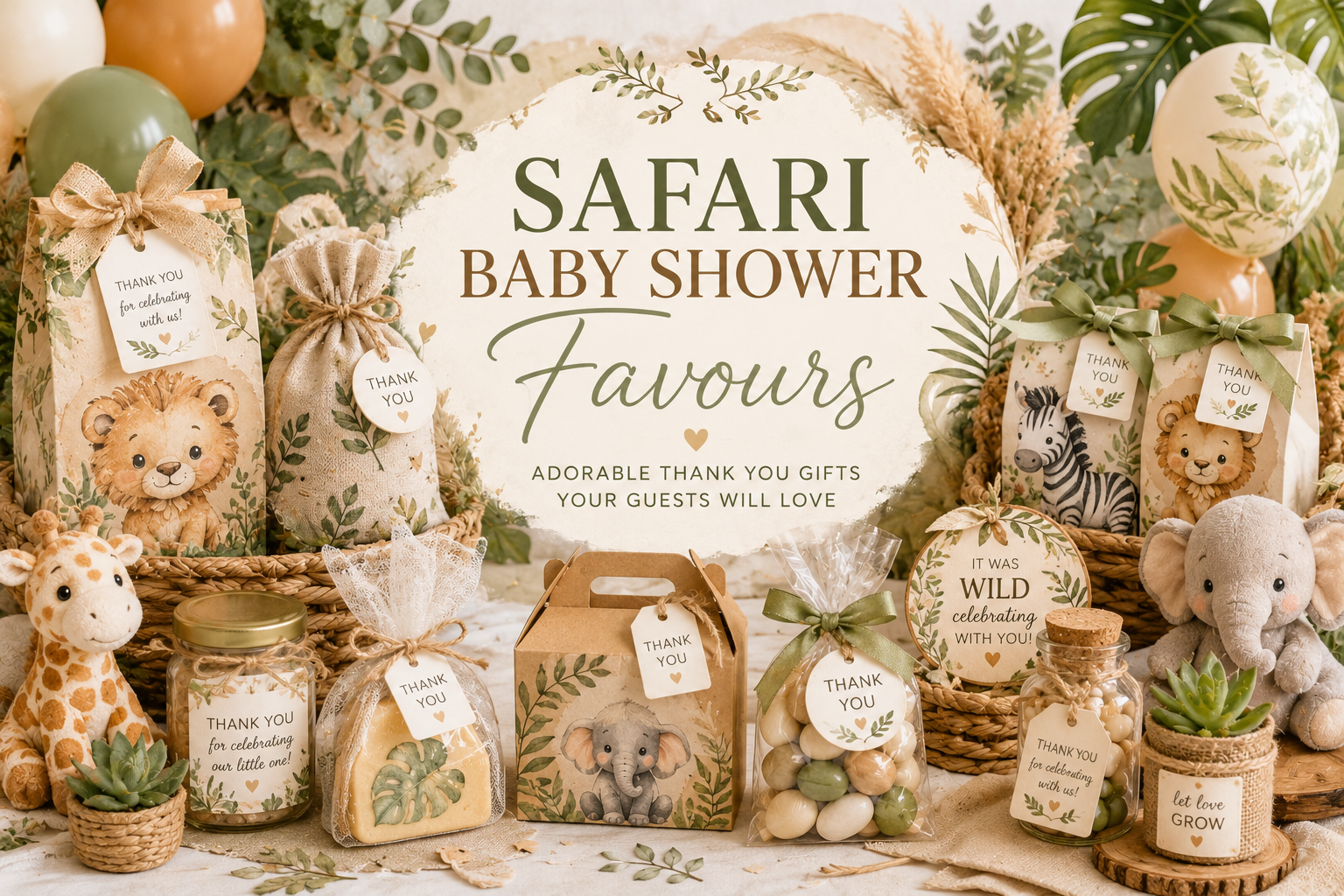
The safari baby shower favour is the last thing a guest takes from the celebration — the object they carry home and look at again later, when the room has been dismantled, the tablecloths washed, and the photographs still being sorted. A genuinely well-chosen and well-packaged favour extends the celebration into the week that follows; a generic one is in the bin before the guest reaches their car. This guide explains specifically what determines which outcome occurs, and how to ensure every safari favour delivered is a favour that stays.
Browse the complete safari stationery collection
Favour tags, labels, and every coordinated printed detail — fully customisable.
“The favour is the last detail guests take home from the safari — when it is beautiful and useful, it extends the celebration long after the savanna has been packed away.”
Section 01 The Safari Favour Test
The question that should be applied to every safari favour option before any other consideration: will this be kept for more than a week? The answer is almost entirely determined by three criteria — and the product inside the packaging is the least important of them. Most favour planning guides focus on the product. This guide focuses on the packaging, the usefulness, and the coherence, which together determine whether the product inside is ever seen again after the shower ends.
Criterion 1
Usefulness
✓ Gets kept: A honey jar (used in tea, on toast, or as a sweetener throughout the week following the shower). A small soy candle (used in the home, providing ongoing pleasure each time it is lit). A seed packet (planted in a pot or garden, providing a living reminder of the celebration through each growing season). Botanical tea sachets (consumed over the days following the shower, with the flavour of the celebration present in each cup). All edible favours, because they are consumed rather than stored — the act of using them is the act of keeping them, and they never reach the decision point of ‘do I keep this or not.’
✗ Gets discarded: A plastic safari animal figurine (appealing at the table, homeless in real life — no adult guest has a designated space for a small plastic giraffe in their home, and it will be placed on a surface, moved several times, and eventually discarded within two weeks). A generic candle in a mass-produced vessel with no personalisation (competes with every other candle already in the guest’s home and loses). A decorative item with no function beyond the decorative (beautiful in the photograph, awkward in the home).
Criterion 2
Palette Coherence
✓ Gets kept: Packaging that belongs to the same aesthetic world as the shower: kraft paper tied with warm brown or natural twine; a warm ivory cellophane bag with a wax seal closure; a small linen pouch in oatmeal; a terracotta pot with a personalised safari tag. When the packaging reads as part of the same designed world as the invitation and the decoration, the favour is experienced as part of the celebration rather than as a separate gift appended to it.
✗ Gets discarded: Generic clear cellophane bags with a bright ribbon (the standard party supply favour format, which immediately communicates that the favour was purchased from a party supply catalogue rather than considered as part of the shower’s aesthetic). Packaging in a colour or material that conflicts with the shower’s palette (a pink sachet at a neutral safari shower; a glossy white box at a boho safari shower; a bright-coloured bag at any safari shower). The packaging communicates the effort invested in the favour before the product inside is seen.
Criterion 3
Packaging Simplicity
✓ Gets kept: Packaging that opens in one movement: a single bow untied; a cellophane twist-tie opened; a paper bag unrolled. The guest should be able to open the favour at the table without tools, without assistance, and without drawing attention to the process. A favour that opens simply and reveals its content immediately creates a moment of pleasant discovery rather than a logistics challenge.
✗ Gets discarded: Multiple layers of packaging that require sustained effort: a box inside a bag inside a ribbon inside a tissue-paper layer. Sealed packaging that requires scissors or tools to open. Packaging so elaborate that opening it feels wasteful or destructive. Any packaging format that requires the guest to ask for help or to find a private space to open it comfortably. Packaging complexity is inversely related to favour-keeping rate: the more effort required to open a favour, the less likely the guest is to engage with it positively.
✨ Styling Tip
The most kept safari favours are edible — honey jars, safari-themed shortbread, botanical tea sachets, and small beeswax candles in that order. Honey in particular is thematically perfect for safari: it references the warm amber palette of the savanna, the sweetness of honey in the natural world, and the warmth and generosity of the celebration simultaneously. It is also the most affordable of all the high-impact favour options — a small honey jar can be purchased at minimal cost per unit, and the personalised safari label that transforms it from a generic honey jar into a safari shower favour costs almost nothing to print on warm ivory or kraft paper at home using the shower’s stationery suite. If the favour budget allows only one upgrade, make it a honey jar with a custom safari label.
Section 02 Five Safari Favour Directions
Five favour directions, each with a specific product, a specific packaging format, and a specific tag. In all five: the tag is the most important design element, not the product inside.
Most Thematically Perfect
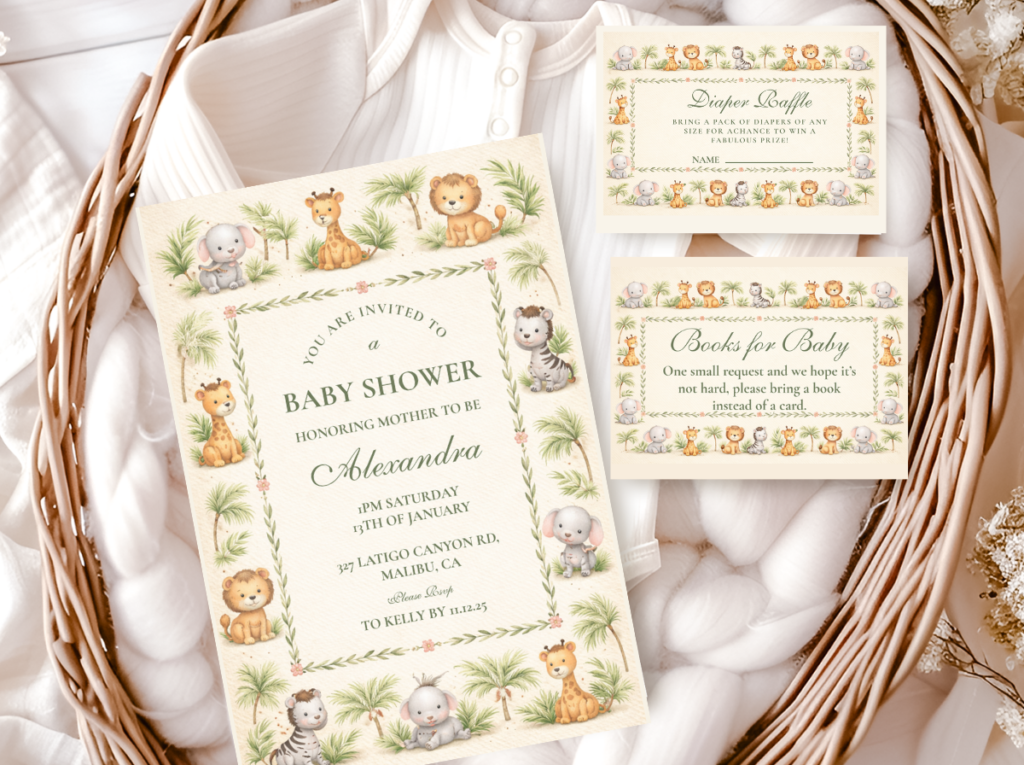
The Neutral Safari Honey Favour
Small Honey Jar · Kraft or Ivory Label · Warm Brown Twine · Watercolour Safari Tag
The Neutral Safari Honey Favour is the most thematically perfect and the most universally appreciated of the five directions — and also, when packaged correctly, one of the most specifically beautiful small objects at any safari table. The favour: a small glass honey jar (40ml–60ml, the size that reads as a generous gift rather than a sample) filled with a warm, golden-toned honey (raw honey, acacia honey, or wildflower honey all have the specific warm amber quality that belongs to the safari palette; processed white honey does not). The label: a personalised watercolour safari animal label in the shower’s specific palette direction (giraffe or elephant in warm brown, with the guest of honour’s name and shower date in warm brown script) on warm ivory or kraft paper stock, applied directly to the jar. The closure: natural twine or warm brown ribbon tied around the jar neck, with a small personalised safari tag attached. The tag: in the invitation’s illustration style, carrying a short warm message on one side (‘Sweet as can bee’; ‘From our hive to yours’; ‘A little sweetness for the wild world ahead’) and the guest of honour’s name and shower date on the reverse.
✨ Styling Tip
A honey jar favour needs exactly three packaging elements to read as designed: a custom label in the shower palette (not a generic printed label), a ribbon or twine tie in a complementary warm colour (not a bright ribbon that fights the palette), and a tag with a safari motif or warm message. The honey jar itself costs less than almost any other favour item of equivalent impact — it is the label and tag that carry the design investment. Both can be printed at home on warm ivory or kraft paper using the stationery collection files, which means the total packaging cost per favour is genuinely minimal. A honey jar without a custom label is a honey jar. The same honey jar with a custom watercolour safari label is a safari shower favour.
Most Keepsake
The Elegant Safari Candle Favour
Small Soy Candle · Elegant Jar · Antique Gold Label · Warm Safari Scent
The Elegant Safari Candle Favour is the most keepsake-forward and the most specifically refined of the five directions — a small soy candle in a warm, slightly textured jar with an antique gold label in the invitation’s illustration register is an object with a functional life of several hours and an aesthetic life that extends well beyond its burning time. The candle’s jar (in warm cream ceramic, warm amber glass, or frosted warm ivory glass) is the vessel the favour occupies in the home after the candle is burned — and a beautiful vessel is kept long after its original content has been consumed. The scent: warm, natural, and specifically safari-appropriate (warm vanilla, warm sandalwood, beeswax, or a warm botanical blend — not synthetic floral, not sharp citrus, not anything that reads as cool or modern). The label: small and elegantly printed in antique gold on warm ivory stock, with the guest of honour’s name and a small watercolour safari animal illustration. The packaging: no additional outer packaging beyond the jar and label — the jar itself is the packaging, and it should be beautiful enough to sit on a surface unashamed.
Boy Direction
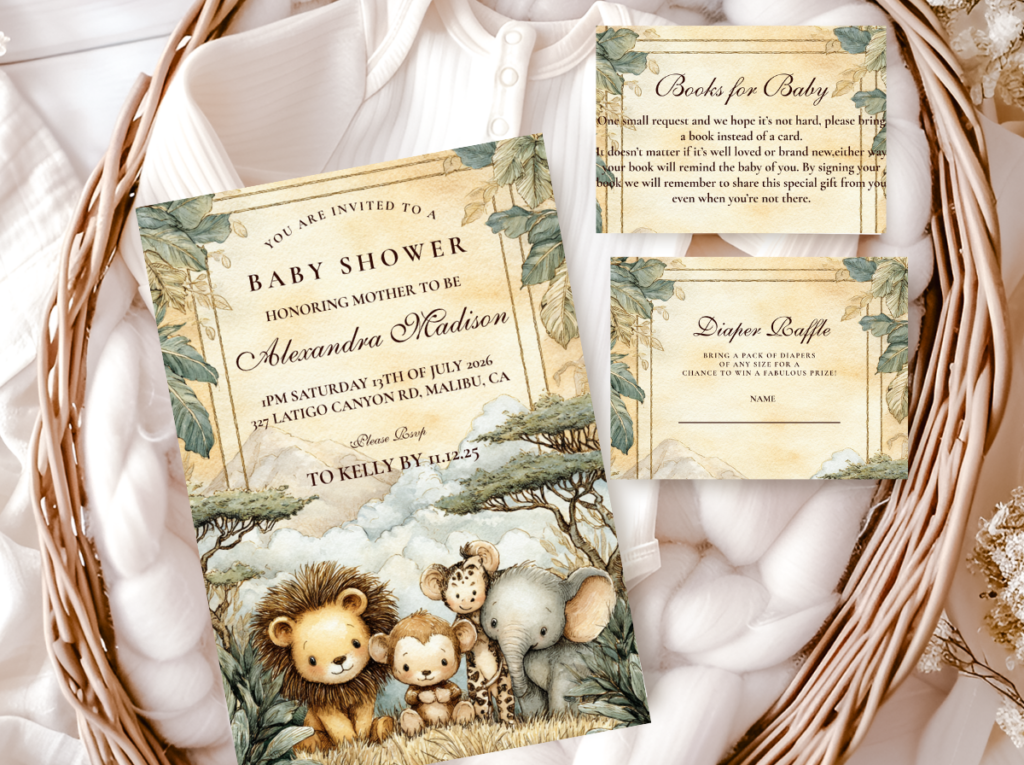
The Jungle Safari Boy Favour
Trail Mix or Safari Snack · Kraft Pouch · Adventure Tag · Warm Brown Twine
The Jungle Safari Boy Favour is the most narrative and the most adventure-forward of the five directions — it takes the specific quality of the jungle safari boy aesthetic (dense, warm, earthy, and specifically adventure-oriented) and applies it to a favour that feels like a provision for an expedition rather than a decoration gift. The favour content: a kraft paper stand-up pouch filled with a trail mix or savoury safari snack selection (a combination of nuts, seeds, dried fruit in warm amber tones, and small chocolate pieces — the specific warm amber, brown, and honey tones of the content should be visible through any transparent window in the pouch). The packaging: a kraft stand-up pouch sealed with a warm brown wax seal or a sticker closure in the invitation’s illustration style; a personalised adventure tag in deep olive and warm brown (‘Fuel for the little explorer’; ‘Adventure rations for the safari ahead’) tied with warm brown twine. The tag wording should match the adventure-forward register of the jungle safari boy aesthetic — warm, direct, and narrative rather than sweet.
Most Sustainable
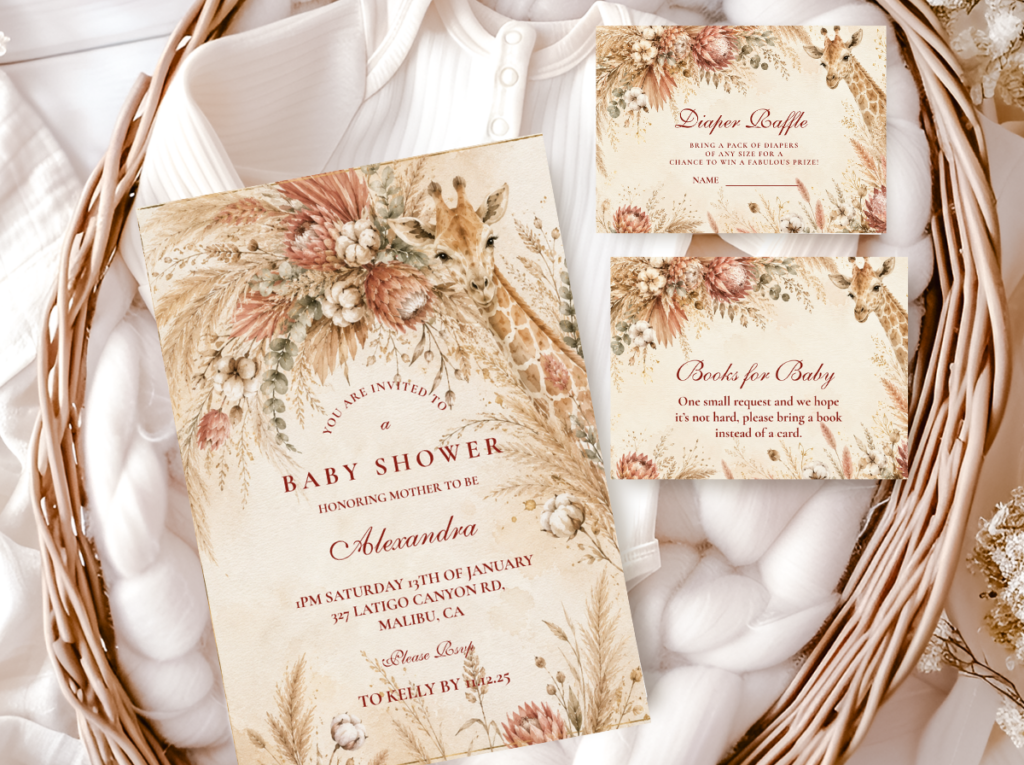
The Boho Safari Favour
Seed Packet or Dried Botanical · Kraft Envelope · Dried Flower Tag · Natural Twine
The Boho Safari Favour is the most sustainable and the most texture-forward of the five directions — it takes the boho material vocabulary (natural, earthy, organic, and specifically beautiful in its imperfection) and applies it to a favour that is both immediately beautiful as an object and potentially permanently useful as a source of living plants in the guest’s home or garden. The favour content: a small packet of wildflower seeds (in a warm tonal mix that favours honey-toned and warm-coloured varieties — wildflowers that will bloom in the same warm amber and dusty rose palette as the shower itself) or a small bundle of dried botanical material (three to five dried pampas grass stems tied with natural twine, or a small dried protea with a dried grass stem — a dried botanical that functions simultaneously as a favour and as a home decoration element). The packaging: a kraft paper envelope (the specific warm brown of kraft paper belongs directly to the boho safari material vocabulary) sealed with a wax seal or a botanical sticker; a small dried botanical tag (a dried pansy or dried chamomile flower glued to the kraft tag surface, with the shower details printed below) tied with natural undyed twine.
Girl Direction
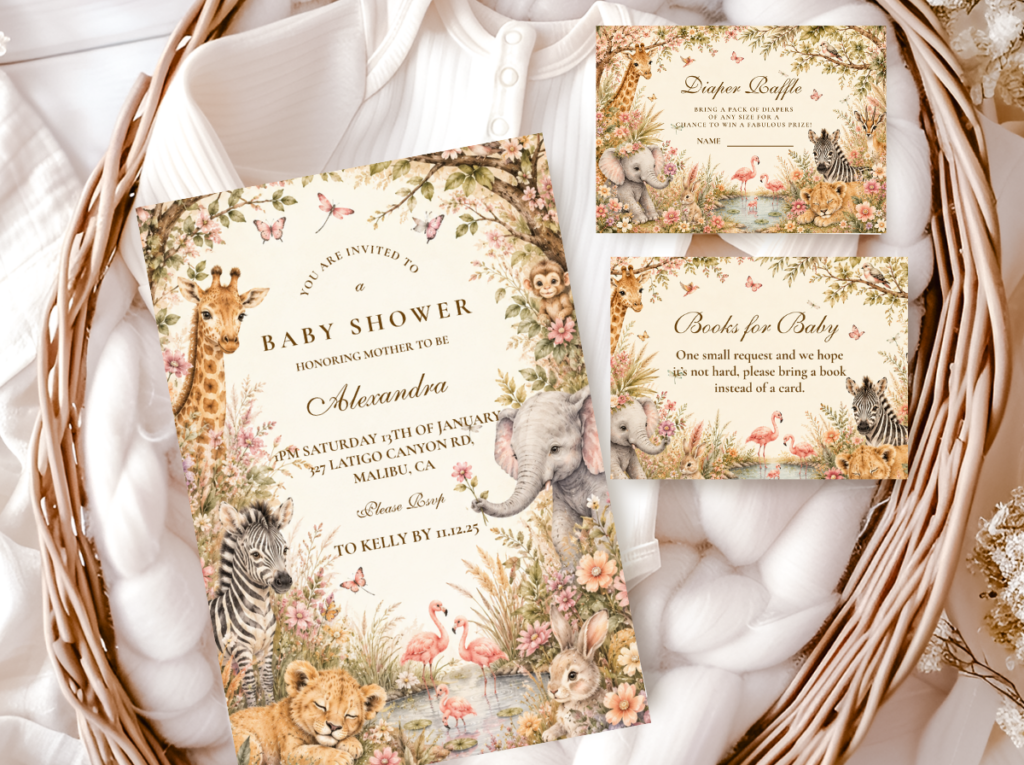
The Pink Safari Girl Favour
Botanical Soap or Bath Salt · Blush Packaging · Dusty Rose Safari Tag · Warm Ivory Ribbon
The Pink Safari Girl Favour is the most romantically beautiful and the most pampering of the five directions — it takes the warm, dusty, botanical quality of the pink safari aesthetic and applies it to a favour that communicates both the feminine warmth of the celebration and the natural world of the safari. The favour content: a small rectangular botanical soap bar (in a warm, honey-tinted soap with a botanical inclusion — dried rose petals, dried lavender, or dried chamomile — visible within the soap; the soap colour should be warm ivory, warm blush, or warm honey, not white or bright) or a small jar of bath salts in warm rose and honey tones with a botanical garnish element visible through the jar. The packaging: a simple warm ivory or blush tissue wrap secured with warm ivory ribbon and a small dusty rose safari tag in the invitation’s watercolour illustration style. Warm pink only: dusty rose ribbon reads as specifically beautiful; bright pink ribbon reads as children’s party regardless of what it wraps. The tag: one small watercolour safari animal illustration and a warm message (‘A little wild beauty, just for you’; ‘Blooming with gratitude’) in warm brown script.
Section 03 Display, Packaging & Logistics
Favour Table Display
The favour table at its best reads as a decoration until guests approach it to collect their favour — which means every favour must be oriented with its label or tag facing outward and slightly toward the guest rather than lying flat with only its top visible. A tiered display (warm wood or rattan tiered stand, with favours placed on each tier at a slight forward angle) achieves the label-facing-outward orientation across all tiers simultaneously and creates the height variation that makes a favour display read as designed rather than as favours placed on a surface. A flat display (favours arranged on a single warm wood or rattan board surface) requires each favour to be leaned against a small support at approximately 15–20 degrees from horizontal so the label is visible from the guest’s standing height. A favour grouped by design direction (all honey jars in one cluster, all seed packets in another) reads as more visually considered than a random arrangement, even within the same palette.
Pre-Packaged vs. Self-Serve Display
Pre-packaged favours (each favour completely assembled and ready to take) are the correct format for any favour where the packaging is part of the aesthetic: a honey jar with a custom label and a tied tag should arrive at the table already tied; a candle in its jar with its label applied should arrive already complete. Self-serve display (in which guests choose from a selection and assemble their own) is appropriate only for bulk edible favours (such as an animal cracker jar display where guests fill their own bag) where the assembly is part of the experience and does not require the guest to make decisions about the packaging quality. For any favour whose design investment is in the packaging — which is the case for all five directions in this guide — pre-packaged is the correct format. A guest who assembles their own favour bag from a bulk display cannot replicate the specific warmth of a correctly tied kraft package, regardless of how beautiful the individual elements are.
Budget Planning per Guest
The following are realistic cost ranges per guest for each direction, based on standard quantities and excluding the stationery collection tag cost (which is separately budgeted as part of the stationery suite):
Honey Jar Favour — Item: £1.50–£3.00 (40–60ml jar) + Packaging & tag: £0.30–£0.60 (label + twine) = Total per guest: £1.80–£3.60 per guest
Most cost-effective direction. Custom label cost negligible if printed at home.
Botanical Tea Sachets — Item: £1.00–£2.00 (3–5 sachets per guest) + Packaging & tag: £0.40–£0.80 (kraft envelope + tag) = Total per guest: £1.40–£2.80 per guest
Lowest item cost. Quality of sachet determines whether the favour reads as considered.
Seed Packet Favour — Item: £0.80–£1.50 (wildflower seed packet) + Packaging & tag: £0.30–£0.50 (kraft envelope + botanical tag) = Total per guest: £1.10–£2.00 per guest
Most affordable direction overall. Dried botanical alternative adds £1.00–£2.00 per guest.
Soy Candle Favour — Item: £3.50–£7.00 (small 30–50g candle) + Packaging & tag: £0.50–£1.00 (label + optional outer packaging) = Total per guest: £4.00–£8.00 per guest
Highest item cost. Justified by keepsake quality — candle jar is kept long after burning.
Botanical Soap / Bath Salt — Item: £2.50–£5.00 (small soap bar or 50g bath salt jar) + Packaging & tag: £0.50–£1.20 (tissue wrap + ribbon + tag) = Total per guest: £3.00–£6.20 per guest
Mid-range cost. Packaging simplicity is important — the tissue wrap must open easily.
Where to spend vs. save: the stationery tag is always worth spending on (it is the element guests read and handle most closely); the packaging material is worth spending on (kraft and linen read as quality; generic cellophane does not); and the item inside can be scaled to the available budget after the tag and packaging are funded. A beautifully packaged affordable item reads as more considered than an expensive item in generic packaging.
✨ Styling Tip
Display favours with the label or tag facing outward and slightly toward the guest — not flat on the table where only the top is visible. A favour display where guests can read the safari tag before picking it up creates anticipation: they know what they are about to take and they want it. A display where the favour is a mystery until lifted creates hesitation: guests wait to see what others take before committing. Anticipation produces a favour table where guests enthusiastically collect their favour. Hesitation produces a favour table with half the favours still on it at the end of the shower. Label outward, slightly angled toward the guest, always.
Section 04 Invitations & Stationery
The favour tag is the smallest stationery item at the safari shower and the one guests read most carefully — because it is in their hands as they leave, at the moment of departure when attention to small details is at its highest. The invitation was read weeks before the shower and kept in a drawer or on a pinboard; the welcome sign was seen at arrival and photographed but not closely read; the place card was glanced at while sitting down; but the favour tag is read at close range at the specific moment of leaving, when the guest is holding the favour and thinking about what they are taking home. It is also the printed element most likely to survive the journey home and be read again in a different context.
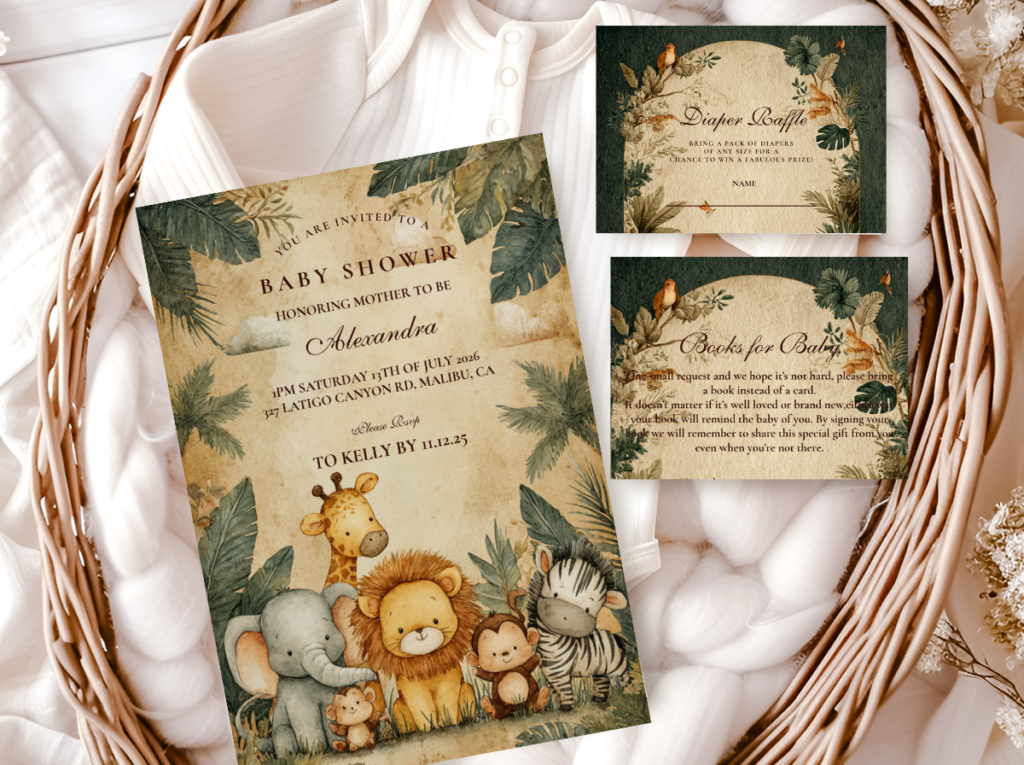
When the favour tag shares the same watercolour illustration style and warm safari palette as the invitation, the favour becomes the final chapter of a cohesive design story that started the moment the guest opened their envelope weeks earlier. The same giraffe illustration — in the same warm brown on the same warm ivory stock — on the invitation and on the favour tag creates a specific quality of completeness: the guest opened the celebration with this illustration in hand and closes it with the same illustration in hand. This quality of narrative closure is what distinguishes a thoughtfully designed stationery suite from a collection of individually sourced printed items.
The tag wording should match the stationery suite’s tone: warm and narrative for a watercolour or neutral safari suite (‘A little sweetness from our safari to yours’; ‘Thank you for sharing in the wild and wonderful’); earthy and direct for a boho safari suite (‘Something wild and good, from our circle to yours’); adventure-forward for a jungle safari boy suite. Browse all six collections below — every collection includes favour tags in the same illustration style and palette as the invitation.
All Safari
Safari Theme Collection
The complete umbrella collection — favour tags and every stationery piece across every safari direction.
Neutral
Neutral Safari Baby Shower
Warm cream and antique gold — the most versatile favour tag direction for any safari palette.
Elegant
Elegant Safari Baby Shower
The most refined stationery direction — favour tags at the highest illustration quality.
Jungle Boy
Jungle Safari Boy Baby Shower
Deep olive and warm gold — adventure-forward favour tags for the jungle safari boy direction.
Boho
Boho Safari Girl Baby Shower
Warm earthy botanical — favour tags in the organic handmade-quality register of the boho direction.
Pink Girl
Pink Safari Girl Baby Shower
Dusty rose and warm cream — the most romantically beautiful favour tag direction.
Frequently Asked Questions
How much should I budget per safari baby shower favour?
The realistic cost range per guest across the five directions in this guide: seed packet or botanical tea sachets at £1.10–£2.80 per guest (the most affordable directions); honey jar at £1.80–£3.60 per guest (the most cost-effective high-impact direction); botanical soap or bath salt at £3.00–£6.20 per guest; and soy candle at £4.00–£8.00 per guest (the most keepsake-forward direction). These costs exclude the stationery favour tag, which should be budgeted separately as part of the stationery suite. The most important allocation principle: distribute the budget with 60–70% on the item and 30–40% on the packaging and tag combined. A favour with a well-designed tag and quality packaging that costs £2.00 total reads as more considered than a favour with a £5.00 item inside generic cellophane packaging — because the packaging and tag are the elements the guest sees and handles first, and their quality sets the expectation for everything inside.
Edible vs. keepsake safari favours — which do guests prefer?
Edible favours have a consistently higher retention rate than keepsake favours, for the specific reason that they are consumed rather than stored — which means the guest never faces the ‘do I keep this or discard it’ decision. A honey jar that is opened within a week of the shower has been ‘kept’ by being used; a decorative item that is placed on a surface and moved several times over the following months is eventually discarded even by guests who initially liked it. The practical implication: edible favours produce a higher rate of positive guest outcomes at lower cost per unit than most keepsake alternatives. Keepsake favours (candle, soap) produce the highest quality individual outcomes when the item is both beautiful and functional — the candle jar that is kept after burning, the soap that is actually used — but are more vulnerable to the ‘I already have one’ problem for guests who have similar items at home. The recommendation: edible favours for mixed guest lists where preferences are unknown; keepsake favours for smaller, more intimate gatherings where the host has specific knowledge of guest preferences.
How many extra favours should I order beyond the headcount?
Order 10–15% more favours than the confirmed guest count, for three specific reasons. First, some guests will take two — this is not greed but generosity: a guest who genuinely loves the favour and wants to share it with a partner or family member at home is a guest who has responded to the favour exactly as hoped, and the extra units allow this without depleting the display. Second, the favour display looks most beautiful when it is full — a display designed for 30 that has 35 favours on it looks abundant and generous from arrival to departure; the same display with exactly 30 favours will look depleted within the first 30 minutes of the shower. Third, packaging errors and minor damage to units will account for 2–3% of the total favour quantity. For a 25-guest shower: order 28–29 units. For a 40-guest shower: order 44–46 units.
How do I display safari favours so guests actually take them?
Three specific display decisions determine whether guests take favours confidently or hesitate: label orientation, display height variation, and signage. Label orientation: every favour must have its label or tag facing the guest at a readable angle, not lying flat. A favour whose front face is visible from a standing viewing distance creates anticipation; a favour that reads only from above creates mystery that most guests resolve by waiting for someone else to take one first. Display height variation: a tiered display (three levels) with favours at different heights reads as an abundant and designed display; a flat single-surface display reads as a pile. Even two heights — some favours on a raised platform, some at table level — is significantly more inviting than a single level. Signage: a small personalised sign (‘Please take a little safari sweetness home’ or simply ‘For you — with love’) positioned at the front of the display gives explicit permission to take, which removes the hesitation that comes from uncertainty about whether the favours are intended to be taken or displayed.
Complete the Celebration
Safari Baby Shower Favour Tags & Stationery
Favour tags and the complete stationery suite — all coordinated, fully customisable, and available across every safari palette direction.