Teddy Bear Baby Shower Games & Activities: A Planning Guide That Actually Works
Bear Baby Shower Games Guide
Teddy Bear Baby Shower Games & Activities: A Planning Guide That Actually Works
How many games to plan, how to time them, and which bear-themed options make guests forget they’re playing a game at all.
Games are the moment a baby shower stops being a pretty room and becomes an actual celebration. When they are well chosen, well timed, and introduced with warmth, they create the memories guests talk about afterward — the moment that broke the polite conversation into genuine laughter. When they are poorly chosen or forced on a group that is not ready for them, they create the awkward silence that guests politely forget and hosts quietly regret.
This guide covers the specific formula for how many games to plan and when to run them, four categories of bear-themed game and activity options, prize ideas that suit the bear aesthetic, and the printed game card connection that makes every activity feel like part of the designed celebration.
⚠ This post contains affiliate links. If you click and purchase through these links, I may earn a small commission at no extra cost to you. I only recommend products I genuinely believe will add value for my readers. Thank you for supporting Baby Wonderland Studio.
“The best baby shower game is one that makes guests forget they’re playing a game — it just feels like the conversation got more interesting.”
Section 01 The Games-to-Guest Ratio Formula
Most shower game problems are planning problems rather than game problems. The specific failures are predictable: too many games produce a schedule that feels like a processed agenda; too few games produce a shower that stalls after food and gift-opening into polite, directionless conversation. Both are avoidable with a specific formula applied before a single game is chosen.
2-Hour Shower
2 games maximum
Total game time: 25 minutes maximum. Run one game before food service while guests are arriving and settling; run one during or after food when the group is relaxed. Do not run games during gift opening — the two activities compete for attention and neither gets the focus it deserves. Best choices for this format: Teddy Bear Bingo (runs simultaneously, works while other things are happening) and a short prediction card activity.
3-Hour Shower
3 games maximum
Total game time: 35 minutes maximum. Space games across three distinct moments in the event: arrival/settling, mid-event after food, and a short closing activity before guests leave. The onesie decorating station (Section 04) works well as a passive activity running throughout, which means it does not count against the game time budget. Best choices: bingo during arrival, a conversational guessing game mid-event, advice cards at the close.
20+ Guests
Simultaneous only
Games that run simultaneously — bingo, prediction cards, Don’t Say Baby — work at large group scale because every guest participates at the same time and there is no dead time for those waiting their turn. Sequential games (relay-style, charades, any game where guests take turns one at a time) create dead time at scale: the guests who have finished or are waiting become an audience rather than participants, and their disengagement is visible to the group. Avoid all sequential formats with groups over fifteen guests.
Under 12 Guests
Conversational formats
Small groups of under twelve guests can sustain interactive and conversational game formats that would stall with a larger group — because every person can hear every other person’s answer without microphone logistics, and the group is small enough that no individual feels lost in the crowd. The Mommy or Daddy quiz, the mystery bag guessing game, and interactive prediction rounds all work well at this scale. Printed card games like bingo also work, but are slightly over-engineered for a small gathering where a spoken-round format creates more warmth.
Styling Tip — Announcing Games
Announce games — do not surprise guests with them. A brief, warm introduction from the host before each game — “we’re going to play two games today, this is the first one” — gives guests who are less comfortable with group participation a moment to mentally prepare. Guests who are surprised mid-conversation by the sudden start of a game tend to resist: they are not in the right mental register and their disengagement signals to others that resistance is socially acceptable. Guests who were told a game was coming are already oriented toward participation and respond to genuine host enthusiasm by matching it. The single biggest improvement any host can make to game participation rates is a warm, confident ten-second introduction before each game starts — not an apology for the game, not a lengthy explanation of the rules, just an enthusiastic frame that makes the game feel like something guests want to do rather than something being done to them.
Section 02 Classic Crowd-Pleaser Games
2.1 Teddy Bear Bingo
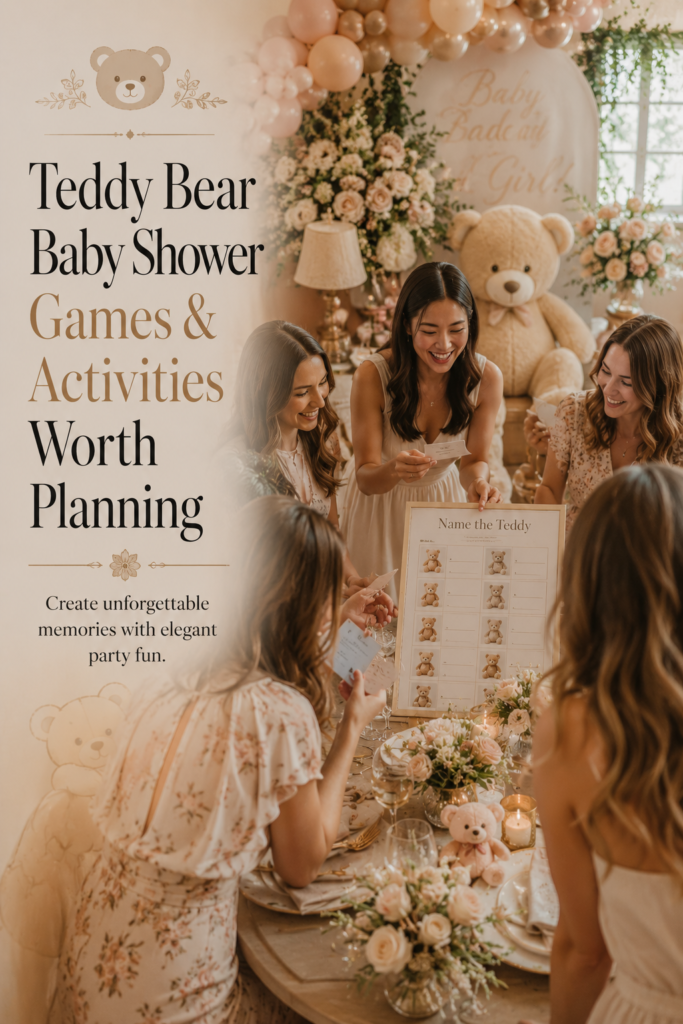
Teddy Bear Bingo is the most universally reliable bear shower game because it scales to any group size, runs simultaneously with other activities, and produces a natural game arc without requiring a host to actively facilitate beyond the initial distribution and call announcements. The bear-themed version uses baby gift categories as the bingo spaces (nappy cream, bear onesie, muslin square, soft toy, bath set) so guests fill their cards during gift opening — which means the game and the gift-opening moment are the same event rather than competing events. Guests who might otherwise disengage during a long gift-opening sequence remain actively involved because each gift is also a potential bingo square.
The design of the bingo card is the detail that determines whether it reads as part of the shower or as a photocopied afterthought. A card printed on warm ivory card stock with a bear motif in the header, the grid squares in warm cream rather than stark white, and the text in the same warm brown tone as the rest of the shower’s printed materials reads as a designed element. The same content on a bright white sheet of standard printer paper reads as a utility handout. The investment required is minimal — the card is printed at home — but the design decisions (paper stock, color, motif) produce a dramatically different guest experience. A free bingo card with a professionally printed look takes approximately fifteen minutes to design in a standard word processor using the shower’s palette colors.
🐻 Teddy bear baby shower bingo cards: Ready-made bingo cards on warm kraft paper with bear-themed illustrations — the detail that makes the game feel like part of the shower rather than a separate activity. These print on quality card stock and are ready to use straight out of the pack, saving the time and cost of home printing.
2.2 Don’t Say Baby
Don’t Say Baby is the game with the highest sustained engagement-to-effort ratio of any shower game: it requires no facilitation once it starts, runs passively throughout the entire event, and generates organic moments of laughter that do not require any host intervention. The logistics: each guest receives a bear-shaped token (a small paper bear cut-out, a honey jar label charm, or a simple kraft tag with a bear illustration) at the start of the event. The rule is that no guest may say the word “baby” during the shower. Any guest who catches another using the forbidden word takes their token; the guest with the most tokens at the end of the event wins.
The token is the bear-specific design detail that makes this game feel integrated into the shower’s aesthetic rather than generic. A standard clothespin is the conventional token; it is functional and has no visual connection to the bear theme. A small bear-shaped kraft tag punched with a hole and strung on a short length of twine — worn as a tag or pinned to an outfit — reads as part of the celebration’s designed world and stays in character with the overall aesthetic. Announcing the winning token count at the end of the event, before prize presentation, creates a moment of communal closure that the standard clothespin version rarely achieves because the token is too generic to create any aesthetic narrative around it.
🐻 Wooden bear token for Don’t Say Baby: A small wooden bear chip as the forfeit token immediately makes the game feel specific to the teddy bear shower rather than generic — guests notice the detail and it reads as considered rather than improvised. Far more cohesive than a plastic clothespin in a warm, styled bear shower.
2.3 Baby Price Is Right
Baby Price Is Right asks guests to guess the retail price of common baby items — the winner is the guest whose guesses come closest to the actual prices without going over, in the format of the classic television game show. For a bear shower, the product list should be curated to include items that a bear-themed nursery would actually contain rather than a generic selection of baby products. A honey-toned plush bear, a woodland-print muslin swaddle, a natural beeswax teething toy, a bear-print sleep sack, an organic cotton onesie in a warm cream tone: these products feel specific to the shower’s aesthetic and make the game feel integrated into the theme rather than generic.
The optimal number of items for this game is five to seven: enough to create genuine price variation and decision complexity without overwhelming guests with too many rounds. Display the items on a small table or tray where they are visible to all guests before the game begins; guests write their guesses on a printed sheet in the shower’s palette before any prices are revealed. The reveal sequence — going through each item one by one with the actual price — is where the game’s entertainment value concentrates, so move through it at a measured pace that allows for reactions rather than rushing to determine a winner. Best run time: ten to twelve minutes including distribution of guess sheets, completion time, and reveal sequence.
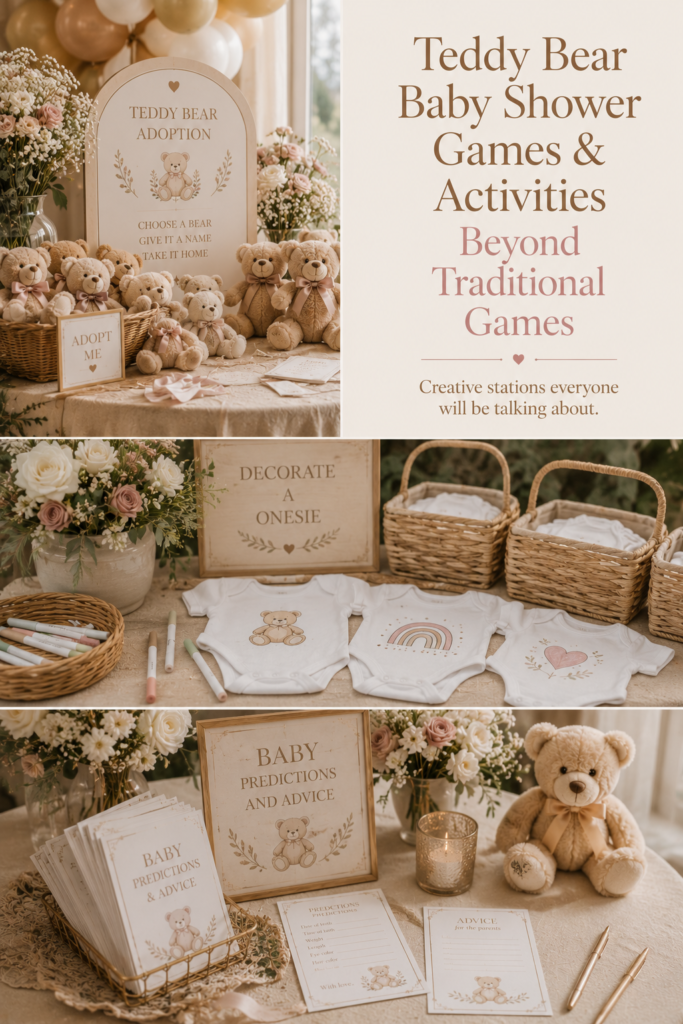
Styling Tip — Game Card Design
Print all game cards — bingo sheets, prediction cards, guess sheets, advice cards — on warm ivory or kraft paper rather than bright white. The card is in guests’ hands for the duration of the game; it should look like it belongs to the same visual world as the invitation and the table setting. A bright white card in a cream and honey bear shower is a small detail that registers subconsciously as “off” even when guests cannot name why — the same temperature conflict as bright white linen on a warm palette table. The fix costs nothing beyond the paper stock choice: a packet of warm ivory card stock from any stationery or craft shop, used instead of standard white printer paper, produces a printed game card that reads as part of the designed celebration rather than a utility handout from a different event.
Section 03 Prediction & Guessing Games
3.1 Due Date & Baby Stats Predictions
The prediction card is the game format most likely to be kept as a memento by both the host and the guests who played — provided it is designed to be kept rather than designed to be functional and disposable. Guests record their predictions for the baby’s birth date, time, weight, length, and first word; the parent-to-be reviews the cards after the birth and contacts the closest predictor. The card becomes a record of the collective anticipation of the shower, which gives it sentimental value that a bingo card or a guessing sheet does not carry.
The specific design qualities that make a prediction card a keepsake rather than a discarded sheet: quality warm ivory card stock rather than standard printer paper; a space for the guest’s name at the top in a slightly enlarged field so it reads as a personal record; a small bear motif in the shower’s palette at the header or corner; and a warm closing message from the host at the bottom — “Thank you for being here to welcome this little one.” These four details cost nothing beyond the design time and produce a card that guests put in a pocket or bag rather than leaving on the table. Providing a small envelope with the prediction card — so guests can seal their predictions and only the parent opens them after the birth — adds a playful narrative quality that increases the keepsake value further.
📋 Baby prediction cards on kraft paper: The prediction card guests keep rather than discard — warm kraft paper with quality printing reads as a keepsake rather than a game printout. Due date, weight, first word, and personality predictions all on one card; parents open and read them together in the weeks after the shower.
3.2 Guess the Baby Item
The mystery bag version of this game places ten to twelve common baby items into a fabric bag; guests feel each item through the bag without looking and write their guess on a card. The game works because the challenge is genuine and universally achievable — every guest can feel a dummy, a muslin cloth, and a small toy, and the guessing process produces a mix of confident recognition and comic uncertainty that creates the organic laughter the best shower games generate without forcing it.
Item selection is the difference between a game that is genuinely challenging and one that is frustrating or too easy. The optimal list mixes immediately recognizable items (a dummy, a bib) with items that are tactilely ambiguous (a folded muslin square that could be confused with a washcloth, a small silicone teething ring that could be confused with a bracelet, a baby nail file that could be confused with an emery board). Avoid items with very sharp edges or items that are fragile; avoid items so obscure that no guest is likely to identify them, which produces frustration rather than fun. The bag itself should be opaque fabric rather than a pillowcase — a linen or cotton drawstring bag in the shower’s palette reads as part of the designed event; a tea towel or random pillowcase does not.
3.3 Mommy or Daddy Quiz
The Mommy or Daddy quiz presents statements about the parents-to-be and guests decide which parent they apply to: “Who was more excited to find out the due date?” “Who is most likely to sing lullabies?” “Who chose the bear theme?” The game works best when the questions are warm, celebratory, and gently humorous rather than probing or potentially embarrassing. Questions should reveal the couple’s warmth and character, not their private arguments or vulnerabilities — the distinction matters because the wrong question register can make the parent-to-be visibly uncomfortable, which shifts the room’s energy in a direction that is difficult to recover from mid-event.
Prepare eight to ten questions and present them one at a time, either verbally for a small group or on a printed card for a larger one. The parent-to-be answers each question simultaneously with the guests — holding up a card reading “Mum” or “Dad,” or simply calling out the answer — and the guest whose answer matches earns a point. Questions specific to the bear shower: “Who suggested the teddy bear theme?” “Who is most likely to buy the baby too many stuffed animals?” “Who will be reading bedtime stories in funny voices?” These bear-specific questions make the quiz feel integrated into the shower’s narrative rather than generic.
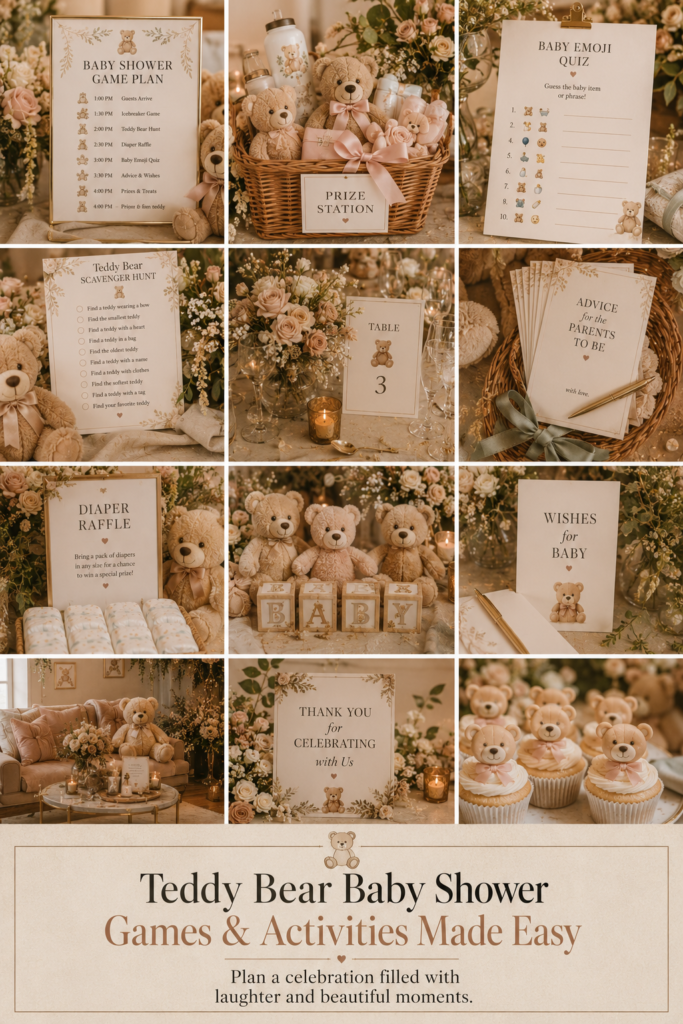
Section 04 Wishes & Memory Activities
4.1 Advice Cards for the Parents
The advice card station is the activity with the highest post-shower value — the parents-to-be keep the cards and read them again in the weeks and months after the birth, which gives this activity a sentimental longevity that no game can match. The station needs three things to function well: a clear display location that guests pass naturally on the way to or from food or drinks rather than a dedicated corner they must make a special trip to; pens that actually work (test every pen before the event starts; a pen that scratches or runs dry produces a guest who abandons the station without completing a card); and a prompt that generates genuine rather than generic responses.
The prompt wording is the most important design decision for this station. Generic prompts (“Write your advice for the new parents”) produce generic responses (“Sleep when the baby sleeps,” “Enjoy every moment”). Specific prompts produce specific, memorable responses. Bear-themed prompt options that generate genuine answers: “The best thing anyone ever told you about becoming a parent” — “A small thing you wish someone had told you before your first baby” — “One thing you hope the baby inherits from this family.” Each of these requires the respondent to think rather than to reproduce a platitude, which produces cards the parents actually want to re-read. Provide one card per guest and stack completed cards in a small kraft box or glass jar near the station so guests can see the growing collection as they add to it.
4.2 Bear-Themed Wishes Jar
The wishes jar is the bear shower’s most thematically specific memory activity: guests write a wish for the baby on a bear-shaped tag or a warm ivory card, fold or roll it, and add it to a glass jar that the parents take home after the shower. The bear-shaped tag is the detail that makes this activity specific to the shower rather than generic — a standard rectangle tag works functionally, but a small bear silhouette shape die-cut from kraft card or warm ivory card stock creates a visual moment both when the tag is written and when the jar is displayed. A jar of rolled bear-shaped wishes looks beautiful as a table display during the event and as a nursery detail afterward.
The jar itself should be a wide-mouth glass jar — clear glass, no label, large enough that rolled tags can be extracted easily — placed near the advice card station or at a separate small display with a few extra pens and a warm invitation card explaining the activity. The prompt for the jar should be distinct from the advice card prompt to prevent guests from writing the same thing twice: “Write a wish for this little bear’s life ahead” generates responses that are forward-looking and imaginative rather than practical and retrospective, which makes the wishes jar complement the advice cards rather than duplicate them.
🫙 Glass wishes jar with kraft tags and twine: Everything needed for the wishes station in one set — glass jar, kraft paper tags, and natural twine already included. Place on a wooden tray beside a pen cup and guests will use it without being directed. Parents consistently say the wishes jar is the activity they return to most often in the years after the shower.
4.3 Decorate a Onesie Station
The onesie decorating station is the only activity in this guide that runs passively for the duration of the event — guests visit it when they want to rather than when directed, which makes it the least intrusive activity available and the one most likely to be completed by every guest including those who would decline a structured game. The setup requires plain white or warm cream onesies in a range of sizes (newborn, 0-3 months, 3-6 months), fabric markers in the shower’s palette colors (warm brown, dusty rose or sage depending on direction, warm gold or yellow, black for outlines), a cardboard insert inside each onesie to prevent bleed-through, and a display surface where completed onesies can be seen by other guests during the event.
The marker choice is the most important logistical decision for this station: fabric markers that require heat-setting after the event (a standard iron on the reverse side for thirty seconds) produce permanent designs; washable markers produce designs that will fade in the first wash, which defeats the purpose. Confirm that any fabric marker purchased is labeled as permanent and heat-settable before the event. Provide a small reference card near the station with simple bear-themed drawing prompts for guests who want to participate but are uncertain what to draw: bear face, honey pot, star, heart, the baby’s initial, “Little Bear,” or simply their name and the shower date. Completed onesies strung on a short clothesline with natural twine between two fixed points make an appealing mid-event display and a natural conversation piece among guests who have not yet visited the station.
👕 Permanent washable fabric markers: The most important supply at the onesie station — these markers work on cotton onesies, stay permanent through washing, and come in warm neutral tones that suit the bear shower palette. Test every color on a spare piece of fabric before guests arrive; some colors bleed on lightweight onesie cotton without a cardboard insert inside.
Section 05 Prize Ideas for Game Winners
5.1 Prizes That Suit the Bear Aesthetic
A shower game prize that belongs to the aesthetic of the celebration reads as a deliberate extension of the designed world; a prize that was sourced from a generic prize drawer or a supermarket gift aisle reads as an afterthought. The prizes most consistent with the bear shower aesthetic are those that share its warmth, its natural material quality, and its connection to the bear and honey narrative of the theme. Honey-based products — a jar of artisan honey, a honey and beeswax hand cream, a small honey comb in a jar — are the most thematically specific and universally appreciated option. A botanical soy candle in a warm amber or honey tone, in simple cream or kraft packaging, is the non-edible equivalent.
A bear-themed tea set — a small selection of premium loose-leaf or pyramid-bag teas in kraft packaging with a bear illustration, presented in a small box — is the most gift-quality prize option in this direction. A dried botanical arrangement in a small bud vase, a small rattan or wooden tray with a candle and a honey dipper, or a book with personal relevance to the shower’s tone (a well-illustrated nature book, a cookbook for new parents) are all prizes that feel chosen rather than selected by default. The connecting principle: every prize should be something the host would be comfortable receiving themselves — which is a useful self-test when uncertain whether a prize rises to the level of “considered” or merely “functional.”
🍯 Honey gift set as game prize: The most thematically perfect teddy bear shower prize available — honey references the palette, the warmth of the theme, and the sweetness of the occasion simultaneously. A small honey jar set wrapped in kraft paper with a bear tag reads as genuinely considered regardless of its actual cost per winner.
5.2 Budget Guidance for Prizes
One prize per game is the correct number — not one prize per round, not prizes for second and third place unless the group is very competitive and a specific game produces multiple natural winners. The per-prize budget range that reads as generous without being extravagant is £5–£15 (or the local currency equivalent). Below £5, prizes can read as token rather than considered; above £15, they create a slight awkwardness for guests who feel they have received a gift that exceeds the social expectations of a shower game prize. The £7–£10 range is the most productive: it is enough to source a quality honey or candle product with considered packaging, and it does not create any social imbalance.
Presentation matters more than price within this range. A £5 soy candle wrapped in tissue paper, tied with a satin ribbon in the shower’s palette color, and labeled with a small bear motif tag reads as a £10–£12 prize to the winner. The same candle handed over in its standard retail packaging reads as a £5 afterthought. The additional packaging investment — approximately £1–£2 per prize in ribbon, tissue, and tag — produces a disproportionate return in perceived value and guest satisfaction. Prepare and wrap all prizes before the shower begins; a pre-wrapped prize that is visibly present at the prize display creates anticipation before the game starts.
Styling Tip — Prize Display
Wrap prizes before the shower and display them on a small tray, wooden board, or tiered stand near the game station or favor table — visible from the moment guests arrive. A beautifully wrapped prize displayed in advance of the game creates anticipation before the game starts; it gives guests a reason to want to win that exists independently of the game’s own entertainment value. An unwrapped prize handed over at the moment of winning registers as a nice gesture but not a deliberate one. The visual difference between a wrapped prize on a display and an unwrapped item produced from a bag is the difference between “this host thought about prize presentation” and “this host remembered to buy a prize.” Both are appreciated; only one is remembered. Total setup time for three wrapped prizes on a small tray: approximately ten minutes, including the wrapping. The return on those ten minutes — in guest anticipation, in photograph moments, in the overall impression of thoughtfulness — is among the highest available anywhere in shower planning.
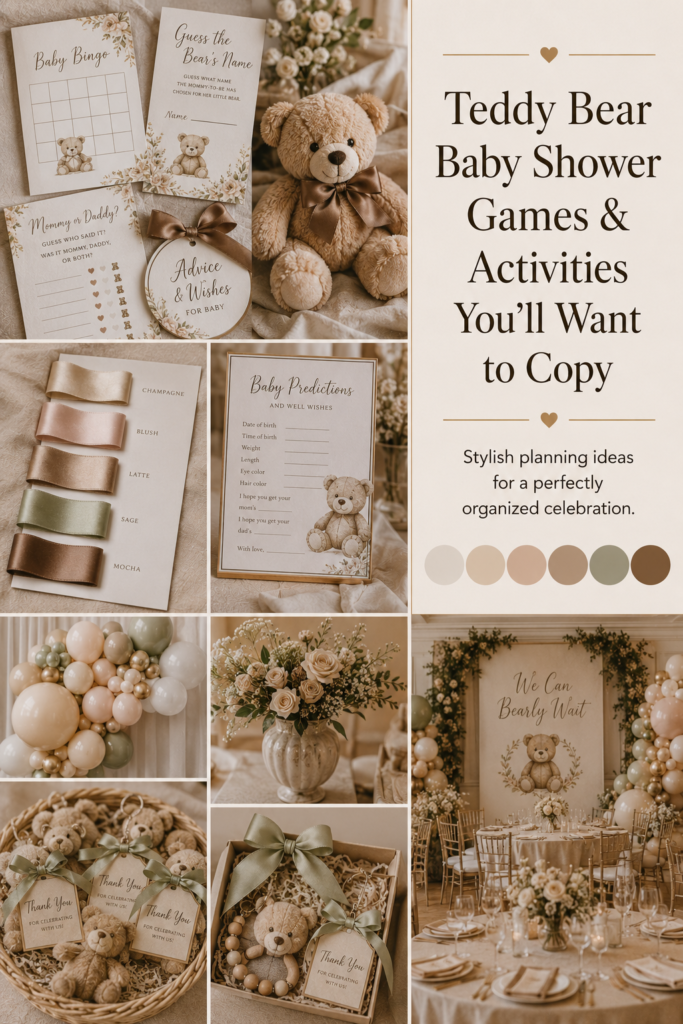
Section 06 Game Cards, Bingo Sheets & Printables
Every printed game card, prediction sheet, bingo card, and advice card at the shower is a stationery decision — and when they share the same illustration style, palette, and typography as the invitation suite, the games feel like part of the designed celebration rather than a separate activity bolted on at the last minute. A bingo card in warm ivory with a bear motif in the header, in the same warm brown tone as the invitation’s bear illustration, reads as designed; a bright white photocopy reads as functional. The design decisions are identical; only the paper stock and the palette color choices differ, and those choices require less than five minutes to implement in any standard design tool.
The practical argument for matching game cards to the stationery suite is the same as the practical argument for matching the favor tag to the invitation: palette consistency across every printed element in the room eliminates the visual noise that comes from multiple uncoordinated color references. A room where the invitation, the place card, the bingo card, the advice card, and the favor tag all share the same warm cream, honey amber, and bear motif reads as a single designed world. A room where each of these is in a different color and a different font reads as assembled from separate decisions — which is exactly what it is, and guests register the difference even when they cannot articulate it.
The six collections below each offer the full stationery suite — invitation, favor tag, place card, food label, and the printed elements that translate into advice cards, prediction cards, and game prompt cards when adapted for the activities in this guide. Each palette direction has its own aesthetic register: from the warm honey and cream of the Neutral collection to the graphic navy and white of the Preppy, the dusty blue and warm brown of the Blue and Brown Boy collection, the airy celestial quality of the Moon and Stars, and the adventure warmth of the Hot Air Balloon. Choose the collection that matches the shower’s palette first, then use its typography, bear motif, and color palette as the reference for every printed game element.
Each collection links to the full product range — browse all six to find the palette and bear illustration style that matches your shower direction, then use the suite as the visual reference for every game card and printed activity element from bingo to advice to prediction.
Main Collection
Bear Theme
Browse all bear stationery and palette directions before choosing a game card collection.
Warm Classic Direction
Neutral Teddy Bear
Warm ivory and restrained bear motifs — the game card palette for honey and cream shower directions.
Graphic Direction
Preppy Teddy Bear
Navy, white, and clean bear typography — the game card palette for preppy and structured shower directions.
Boy Bear Direction
Brown And Blue Teddy Bear
Dusty blue and warm brown — the game card palette for the most-saved boy bear shower direction.
Adventure Direction
Bear Hot Air Balloon
Warm adventure tones and a hot air balloon bear motif — game card palette for the whimsical and journey-themed direction.
Celestial Direction
Bear Moon And Stars
Lavender and gold celestial motifs — game card palette for the moon and stars whimsical and gender-neutral direction.
Frequently Asked Questions
How many games should I plan for a 2-hour bear baby shower?
Two games maximum for a 2-hour shower, with a total combined game time of no more than 25 minutes. The most effective combination for this format: Teddy Bear Bingo run during gift opening (which adds engagement to the gift-opening sequence without adding separate game time) and Don’t Say Baby running passively throughout the entire event from the moment guests arrive. Don’t Say Baby requires no facilitation time and no dedicated game slot because it is integrated into the normal flow of conversation — it simply adds a layer of playfulness to every exchange rather than interrupting the event with a structured activity. If a third, more structured game is desired, add it only if the shower runs closer to 2.5 hours and the guest list is engaged and game-oriented; for a guest list that skews toward people who prefer conversation over organized activities, two games are sufficient and three may feel like too many.
How do I make games feel inclusive for guests who don’t enjoy party games?
Three specific approaches make games accessible to guests who are not natural game participants. First, choose games that require participation by presence rather than active performance — bingo and prediction cards mean guests fill in a sheet rather than standing up, performing, or speaking in front of the group, which reduces the performance anxiety that makes games uncomfortable for some people. Second, use passive activities (Don’t Say Baby, the onesie decorating station, the advice card and wishes jar stations) as the backbone of the shower’s activities, reserving structured games for brief, time-limited moments. Third, never call on a specific guest to answer or participate — always offer the opportunity to the whole group and accept when individuals pass. The guests who are least comfortable with games will participate in passive and low-stakes activities readily; they will visibly disengage from high-stakes or performance-based games, and their disengagement changes the room’s energy. Matching the game format to the guest list’s comfort level is the single most important game-selection decision available to any host.
What prizes are appropriate for a baby shower?
The most appropriate shower game prizes are those that any adult guest would be genuinely pleased to receive regardless of their age, lifestyle, or preferences. This rules out anything age-specific, gender-specific, or highly personal (no clothing, no books that assume specific tastes, nothing that requires knowledge of the winner’s home to be useful). It rules in: consumable products (candles, honey, tea, botanical soap), experience-neutral items (a beautiful notebook, a seed packet), and decorative items with broad appeal (a small dried botanical arrangement, a scented sachet). The bear shower aesthetic naturally produces prize options that fit these criteria — honey products, botanical candles, and natural material objects — which makes prize selection easier for a bear shower than for many other shower themes. One prize per game, presented wrapped and displayed in advance of each game, is the standard that produces the best guest experience at any budget level.
How do I run games smoothly without killing the atmosphere?
Four specific practices prevent games from interrupting the atmosphere rather than contributing to it. First, prepare all materials before guests arrive — game cards distributed at each place setting, bingo markers ready, the mystery bag assembled and placed at the game station. Games that require setup while guests wait produce the awkward pause that kills momentum; games that begin the moment the host announces them maintain it. Second, keep rules explanations to two minutes maximum — any game that requires more than two minutes of rules explanation before it starts is either too complex for a shower setting or being over-explained. State the core rule, give one example, start playing; answer questions as they arise rather than front-loading every edge case. Third, assign a co-host or a willing guest to help distribute materials and manage logistics while the host runs the game verbally — the host who is simultaneously explaining rules, distributing cards, and managing a crowd loses the room’s attention. Fourth, close each game decisively: announce the winner, present the prize, start the applause, and move on within thirty seconds of the winner being identified. A game that lingers past its natural ending becomes awkward; a game that closes crisply becomes a positive memory.
Ready to Start Planning?
Find the Game Card Suite That Matches Your Bear Shower
Game cards, advice cards, bingo sheets — all in the same palette as the invitation.